
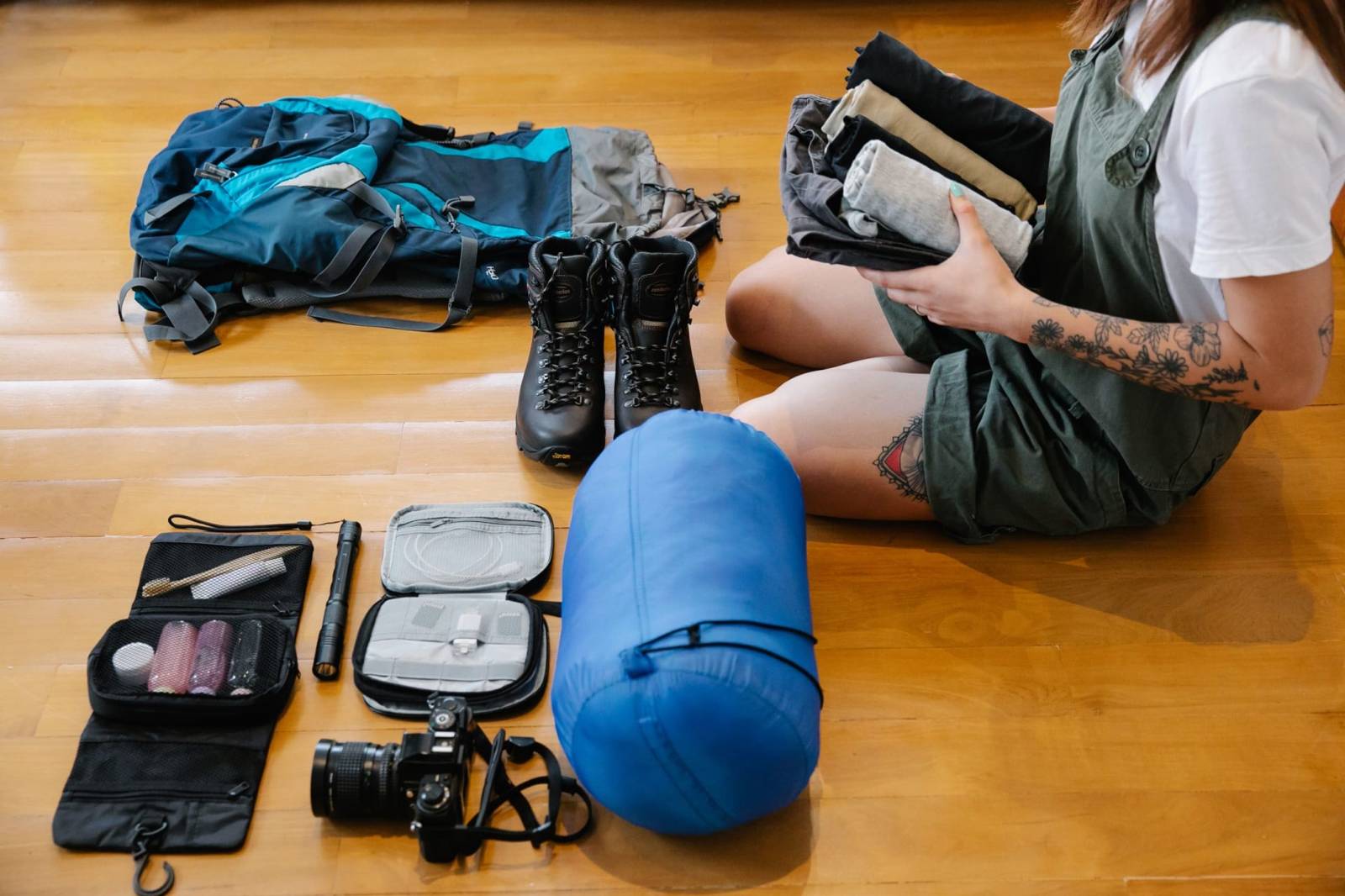
At some point in week two you will be sitting on the edge of a hostel bunk with your whole backpack tipped out on the floor. And it hits you: the rain trousers, the second pair of jeans, the outfit “in case somewhere is fancy”. Never out of the bag. But dragged along on every bus, up every staircase and down every hostel corridor.
Everyone packs too much the first time. Not because you are bad at packing, but because you are sitting in your bedroom at home trying to guess what you will need in three months, in a country you have never been to. So you throw in a bit more, just in case. If this really is your first big trip, read first time backpacking Southeast Asia as well: it tells you what to sort out in which order.
The good news: Southeast Asia is about the easiest region in the world to travel light. It is warm, your laundry gets done for a few euros a kilo, and whatever you forget you can buy round the corner that same afternoon. A T-shirt there costs less than a coffee back home. The only things that really have to come from home are the things you cannot just pick up there: your documents, your own medication and a handful of items where your size or your brand matters.
This list is built around the routes we cover on this site. And those are not only beaches: cold mornings in the mountains and thirty degrees, temples and snorkelling, sleeper buses and scooters. For every item we say why it comes along, and what you simply buy when you get there.
The backpack itself
Forty to fifty litres. You do not need more out here, and less to carry means less grumpiness. A bag that size also fits in the luggage rack of a minivan and usually still counts as cabin baggage, which helps on those short hops between the islands.
Add a small daypack of around twenty litres. That one goes on the boat, into the cave and through the temple, and it stays with you on the bus while your big bag sits somewhere down in the hold. Everything you cannot afford to lose belongs in it: passport, phone, money, medication.
Three small things that earn their weight twice over:
- A padlock for the locker in your dorm. Almost every hostel has a locker, almost no hostel gives you a lock.
- A rain cover, or just a big bin bag to wrap your backpack in. On the roof of a bus or at the back of a boat, that is the difference between dry clothes and wet ones.
- A few waterproof pouches for your phone and your documents. On the boats between the Philippine islands you get wet even when it is not raining. Especially if you sit at the front.
Clothes: far less than you think
Three to four days of clothes. That is it. You wash as you go.
Almost every hostel and every street has a laundry that charges by the kilo and hands your pile back the same day, neatly folded and with a smell you will link to this trip for the rest of your life. That is cheaper than carrying an extra shirt around, and it saves kilos.
This really has to come
Long trousers or a long skirt, and something to cover your shoulders. That is not fashion advice but an entry requirement: at Angkor Wat you simply do not get in without covered shoulders and knees, and the temples in Thailand, Laos and Vietnam work the same way. A thin scarf in your daypack solves it everywhere, without sweating in long sleeves all day.
Beyond that: a light long-sleeved top for the evenings and the buses, swimwear, and a quick-dry towel. Leave the cotton bath towel at home. In this climate it stays damp for days and ends up smelling like something you do not want in your bag.
For the cold mornings, because they exist
Almost everyone underestimates this, and it is the classic mistake.
In northern Thailand it drops to around ten degrees at sunrise in December and January, down in the valley at Pai. In Chiang Rai the nights head towards the same number. And that happens to be exactly where you get up in the dark to reach a viewpoint.
Then there is the transport, where the air con has one setting. It is in our comparison of the sleeper bus, night train and flying in Vietnam for a reason: take a jumper onto the sleeper bus.
One thin jumper or fleece and one pair of long trousers are enough. You will not need a winter coat on any of these routes.
What you just buy there
Keep that space in your bag free for the trip home. T-shirts, elephant trousers, flip flops, a beach towel, a cheap bag: all on the spot, for a fraction of the price. Soap, shampoo, toothpaste and shaving gear are in every supermarket.
Besides, an afternoon wandering a market looking for a decent shirt is one of the better ways to arrive somewhere.
Shoes: two pairs and done
Together they weigh less than one pair of proper hiking boots.
Flip flops are your everyday shoe. Hostel, beach, shower, night market. Within a week you will have worn them more than anything else.
On top of that you want something with grip. Not for the city, but for the moments when wet steps get interesting. You do not climb the 500 steps up to Mua Cave in Ninh Binh in flip flops, and in the jungle of Khao Sok shoes with grip are literally on our list. Light trail trainers or sturdy sports sandals do that job fine.
Electronics
- Power bank. On Don Det in Laos power cuts are just part of life, and on a long bus ride a working socket is luck rather than a given.
- Torch or head torch. Dark Cave at Phong Nha is genuinely pitch black, and on plenty of islands the street lights stop at the last houses of the village.
- Plug adapter. A universal one gets you in everywhere in this region.
- Internet from minute one. Sort it before you leave, so you are online the moment you land instead of hunting for wifi at an airport. How that works is on our page about the SIM card or eSIM for Asia.
- Earplugs and an eye mask. The two cheapest things on this whole list, and in a dorm, a night bus or on a boat by far the most valuable.
For most travellers a laptop is just extra weight, unless you work on the road. A camera is a real choice: brilliant if you use it, and otherwise a brick you carry for three months while your phone does the work.
Health and personal care
Repellent with DEET goes in your daypack, not at the bottom of your backpack. Dengue is present across large parts of the region, and that mosquito bites during the day: in the Philippines and in Khao Sok we call it out specifically. So repellent here is not an evening ritual but something you put on in the morning.
Bring sunscreen, but watch one thing. If you are snorkelling or diving over living coral, pick one without oxybenzone. We flag it on our Philippines pages, at Honda Bay near Puerto Princesa among others, and it is quite literally the difference between a reef that stays alive and a reef that bleaches. A shirt in the water works just as well, by the way.
Beyond that, a small first aid kit of your own: plasters, antiseptic, painkillers, something for diarrhoea, and your own prescription medication in its original packaging. What else belongs in it and which jabs you need is on our vaccinations page, including what travel health services advise per country.
Money and documents
- Two bank cards, from two different banks, and not together in the same bag. If one gets lost or a machine swallows it, you are not stuck empty-handed on an island. Which card costs what is on cards and cash in Asia.
- Cash as a backup. Not everywhere has a machine. On the lake in Khao Sok, on Siquijor outside the bigger towns and on Don Det you cannot take any money out, so you do that beforehand.
- A passport valid for at least six months, plus digital copies in your email. What visa you need per country depends on your passport: check it with the passport picker on our visa page.
- Your insurance documents and the emergency number, offline on your phone. You do not want to be looking that up at the moment you need it. What is and is not covered is on travel insurance for backpacking Asia.
- An onward ticket. Several countries ask for one at check-in, and then you are standing at the desk with your backpack. How to sort that without buying a flight you will never take is on our onward ticket page.
If you are getting on a scooter
Almost every route here has a scooter day somewhere, and those are often the best days of the trip. The catch: that “scooter” is usually 110 or 125cc, which legally makes it a motorbike, and for that you need a motorcycle licence plus an international driving permit. Which permit your route needs and what your insurance thinks of it is all worked out in renting a scooter in Southeast Asia.
So sort that paperwork before you leave, because you cannot do it once you are out there. And bring long trousers for the days you are really putting in hours on the bike. That is not only about the sun.
For women
Everything above applies, with a few additions that come up again and again:
- Your own period products, especially if you are attached to a particular brand or type. A cup is the lightest option for a long trip, and you are not relying on whatever the village shop happens to stock.
- A long skirt or loose long trousers. The easiest thing for temples, and at the same time the coolest thing you own.
- A sarong. The most versatile item of the whole trip: beach towel, skirt at a temple, blanket on the air con bus and a curtain against the light in your dorm. Buy it there, for a few euros, in a colour that makes you happy.
- A cross-body bag that zips shut, for your phone and your money on busy markets.
For men
- Two pairs of swim shorts that pass as normal shorts. One less pair of shorts to carry.
- A short-sleeved shirt or polo. Some temples, restaurants and clubs will not let you in wearing a vest, and it weighs next to nothing.
- A battery shaver, or just razors. Buy the shaving foam there.
- Think about your shoe size. Above a European 45, replacement flip flops or trainers are a lot harder to find locally, so bring a spare pair instead.
What to pack differently per country
The basics above work across the whole region. Still, every country asks for a few extras, and they are exactly the things people leave at home.
Thailand packing list
Thailand is where most people start, and it gets underestimated on one point: the cold. In December and January it is around ten degrees at sunrise in the valley at Pai, and in Chiang Rai the nights head the same way. A thin jumper and long trousers are no luxury up there.
For the rest of the country: something to cover your shoulders for the temples, sunscreen without oxybenzone for the coral around Koh Tao and Koh Lanta, and a waterproof pouch for your phone on the longtail boats. Riding a scooter on the mountain roads around Pai or across Koh Lanta? Then you want your international driving permit on you. What you need where is covered stop by stop in our Thailand route.
Vietnam packing list
Vietnam is 1,650 kilometres long, and you feel that in your backpack. The north is properly cold in winter: Sapa is cold from November to February and often inside the cloud, the paths through the rice terraces are mud, and a rain jacket plus shoes with grip are no luxury there. In the south you are in a T-shirt that same week.
Riding the Ha Giang Loop? Bring gloves and long sleeves, even when it feels warm. And almost every traveller does at least one night bus or night train here: that jumper comes out again. Which of the three to take for what is in sleeper bus, night train or flying, and the route itself is in Vietnam from north to south.
Laos packing list
Laos is where you notice you are off the grid. On Don Det the power simply drops out and there is no cash machine, so a power bank, a torch and cash taken out beforehand are the difference between relaxed and making do.
Beyond that: the mountains in the north are cool in the evening, the bus rides are long and the roads winding. Earplugs, a charged power bank and something for motion sickness make those days a lot more pleasant. In the temples of Luang Prabang and at the morning alms ceremony, shoulders and knees are covered. The whole route is in two weeks in Laos.
Cambodia packing list
Cambodia revolves around one morning, and it starts in the dark. For sunrise at Angkor Wat you get up at four and walk onto the temple site without street lights: a torch or head torch really helps there. Shoulders and knees have to be covered or you do not get in, and take two litres of water per person into the temples, because there is hardly any shade.
You pay in dollars and riel mixed together here, so always keep some cash on you. How many days to give the temples is on our Cambodia page, and the rest of the country is in ten days in Cambodia.
Philippines packing list
In the Philippines almost everything goes by boat, and on a boat you get wet. Waterproof pouches for your phone and documents are not an extra here but something you use every day. There is no shade on those boats either, so water and sunscreen come on board with you; if you snorkel over coral, make it one without oxybenzone.
You cannot take cash out everywhere. On Siquijor the only machines are in Larena and San Juan, and for El Nido you get your money out in Puerto Princesa. Expect to live on cash for a few days. Repellent with DEET belongs in your daypack here, because the dengue mosquito bites during the day. The island hopping itself is written out in our island hopping route.
The checklist to tick off
Sorted before you leave: visa, vaccinations, travel insurance, eSIM, bank card, onward ticket and your international driving permit if you are going to ride. The order and how long each one takes are on our travel prep page.
In your backpack: three to four days of clothes, long trousers, something for your shoulders, a thin jumper, swimwear, two pairs of shoes, a quick-dry towel, padlock, power bank, torch, adapter, earplugs, repellent with DEET, sunscreen without oxybenzone, your own first aid kit and medication.
In your daypack: passport, two bank cards, cash, phone, repellent, sunscreen, water bottle.
Bought on the road: T-shirts, elephant trousers, flip flops, sarong, toiletries, and that one bag for everything you end up taking home anyway.
Want to see what your trip will cost per day before you go? Work it out in My Trip, where you keep track of your route and your spending.
What is the biggest packing mistake people make?
Packing for the weather instead of for the route.
Everyone packs for thirty degrees and a beach. And then you are shivering at six in the morning on a viewpoint near Pai in December, or you spend three hours turning blue on a sleeper bus with the air con set to freezer. One thin jumper and one pair of long trousers fix both, and together they weigh less than the two extra T-shirts you never wear.
The second mistake is thinking you need to own everything before you go. Southeast Asia sells literally everything a traveller needs, usually round the corner and for a fraction of the price. Run short of something and it is not a problem, just an errand.
So leave with a half-full backpack. It fills up on its own.


