
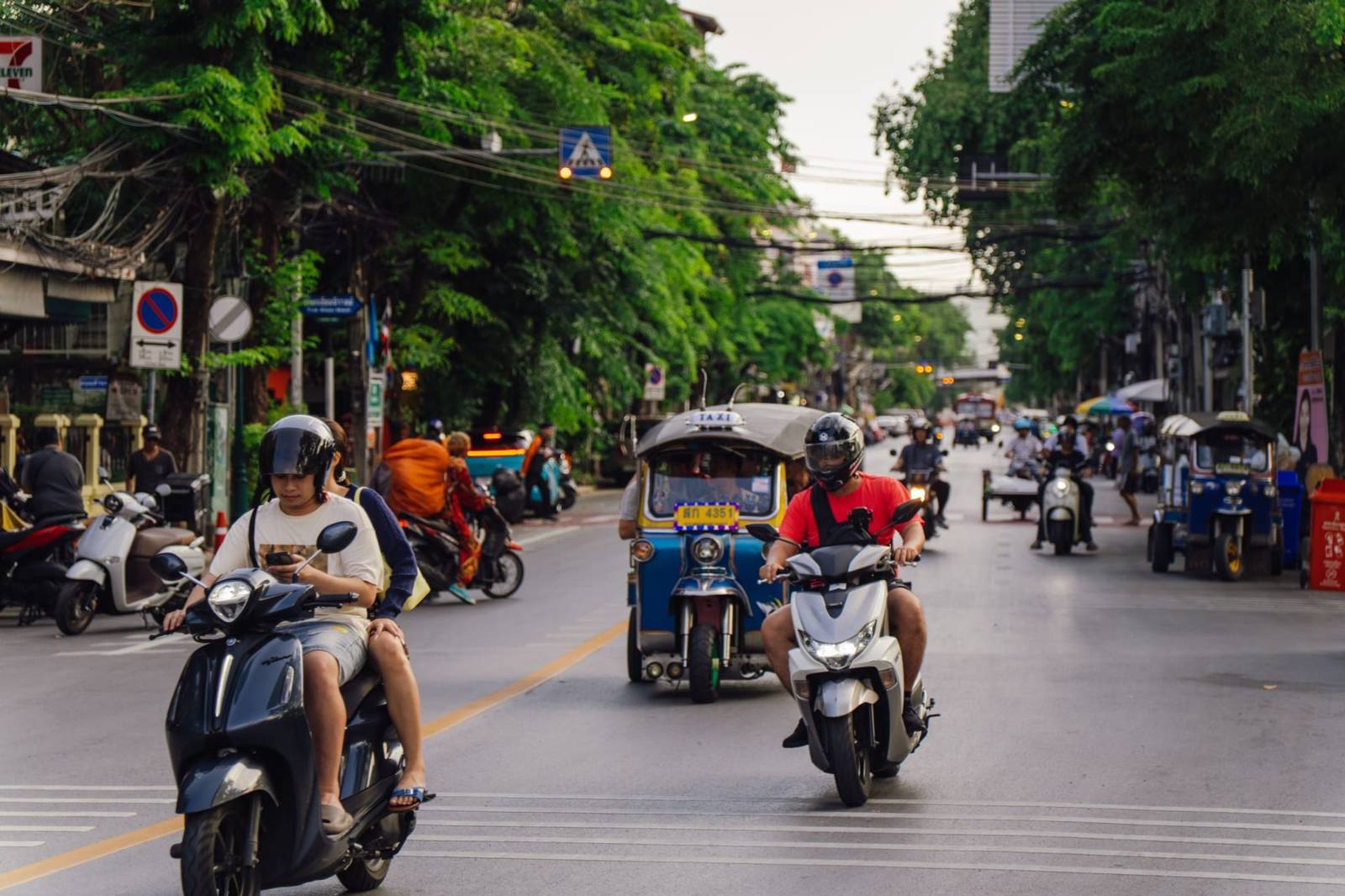
It always goes the same way. You walk out of the hostel, there is a row of scooters against the wall, and the guy next to them looks up from his bowl of noodles. You point. He nods. You put down a few notes, he hands you a key and a helmet that used to belong to someone else, and ten seconds later you are bumping off down the street. Nobody asked anything. Nobody looked at a licence. For €4 to €7 a day the whole island is suddenly yours.
And to be fair, that is exactly why it is so good. Half of what we write about on this site you cannot reach by bus. The mountain passes, the waterfalls with nobody at them, that one place to eat twenty kilometres out of the village: you find those on two wheels or not at all.
There is just one thing underneath it that almost nobody knows, and you only find out on the day it goes wrong. The thing between your knees is usually not a scooter but a motorbike. Not in everyday speech, but in law. And that one detail decides whether your insurance pays out when you come off.
No need to panic, because this is easy to fix. It takes a bit of paperwork at home, before you fly. Below is exactly what you need per country, and what to check when you take that key.
Why your scooter is a motorbike
Have a look at the side panel of your rental. It almost always says 110 or 125. That is the engine size in cc, and it is bigger than 50.
That number is the whole story. Across this region, the bikes you rent are over 50cc, and legally that makes them motorbikes. In Thailand you need a motorcycle licence for one, plus an international driving permit. Vietnam works the same way, with one extra box to tick. There a two-wheeler only counts as a moped if it is 50cc or under and designed for no more than 50 km/h. That is how road traffic law 36/2024/QH15 has put it since 1 January 2025. Miss either one and the law calls it a motorbike. For your rental it changes nothing, because at 110 or 125cc you are over the line anyway, but it does mean “it is only 50cc” is no free pass in Vietnam.
Now your own licence. A standard car licence does not cover a motorbike. For a machine up to 125cc you need a motorcycle category on your licence, and that usually means a separate test that most of us never took.
So there you are, on exactly the wrong vehicle. Not because you are doing anything sneaky, but because everyone calls these things scooters and nobody ever told you they are not.
What you need per country
First the part that is the same everywhere: your own licence on its own is not enough anywhere. Not in Thailand, not in Vietnam, not in Laos, not in Cambodia and not in the Philippines. There always has to be an international driving permit with it.
Which permit you need does differ, and this is where it gets a bit fiddly. There are two, named after the international conventions of 1949 and 1968:
| Country | International driving permit | Watch out |
|---|---|---|
| Thailand | 1949 or 1968, 1968 recommended | above 50cc a motorcycle licence is required |
| Vietnam | 1968 only | a moped is 50cc and 50 km/h at most, anything heavier needs a motorcycle licence |
| Laos | 1949 | your own licence plus the permit |
| Cambodia | 1949, to apply for a local licence | even with a permit you cannot ride here: you get a Cambodian licence on the spot, valid for a year |
| Philippines | 1949 or 1968, 1968 recommended | 90 days, after that a local licence |
Cambodia, as ever, does its own thing. Your own licence is not valid there, and neither is your international permit. You have to get a Cambodian licence on the spot, and to apply for it you need exactly that 1949 international permit. The local licence is valid for a year.
And one misunderstanding out of the way right now: an international driving permit is not an upgrade. It is nothing more than an official translation of the licence you already hold, in a booklet with stamps. You carry both documents, because one does not replace the other. And if your licence at home has no motorcycle category, the translation does not have one either. It really is that simple.
Which permit do you get?
The two permits are not interchangeable. This is the bit where your route decides what you apply for:
- The 1968 permit can be valid for up to three years. You need it for Vietnam, and it is the recommended one for Thailand and the Philippines.
- The 1949 permit is valid for one year. You need it for Laos, and to sort out that local licence in Cambodia.
See where this is going? If you are doing the classic loop through the region, you need both. Vietnam only takes the 1968, Laos only the 1949. And it is the cheapest insurance you will buy on this whole trip.
Getting one is less hassle than it sounds, with one catch: you apply in the country that issued your licence, not out here. Who issues it, what it costs and whether you have to collect it in person all depend on that country, so look it up at home well before you leave. This is not a job for the night before your flight.
Is your own licence due to expire within those three years of a 1968 permit? Then the permit is not valid for longer than your licence. Logical, but good to know before you pay for three years.
And what does your insurance make of it?
This is where the money is, and there are two separate things here that people mix up all the time.
Thing one: the scooter itself is almost never insured. Rental motorbikes and mopeds in this region are, with rare exceptions, not insured. Ride into a parked car and that is your bill. A scratch on the scooter itself? Also yours.
Thing two, and this is the important one: your travel insurance covers you, but only if you are allowed to ride what you are riding. If you are on something that is legally a motorbike without the right licence, your insurance is not riding with you. And that is not just about the scratch, but in the worst case also about your own hospital bill. A hospital bill in Asia adds up faster than you think.
What our travel insurance does and does not cover on two wheels, including whether you need extra cover for it, is on our page about travel insurance for backpacking Asia.
In short, you want this: the right permit in your pocket, an insurance policy that knows you will be riding, and at the back of your mind the fact that the scooter itself is your problem.
“But nobody ever asks for it, right?”
Quite right. Nobody asks for it.
Our Thailand page says it plainly: the rental shop will not ask, so ask yourself. A shop handing you the key without questions does not mean you are riding legally or insured. Why would he make it difficult? His money is in the moment you ride off.
There are checks, just not there. They happen at a police checkpoint by the side of the road, and they end in a fine. Annoying, and usually manageable.
What really matters is the one day you had not planned for. The dog that walks into the road, the layer of sand on the bend, the van that does not indicate. That is when everything lands on you at once: the damage to the scooter and the question of whether your insurance picks you up. You make that day a lot less likely by leaving the scooter where it is after dark, when unlit roads, loose animals and potholes all come at you at once, and by never riding after a drink, because then your insurance is not riding with you either.
So we never say you should not ride. Quite the opposite. But this is the subject where more travellers in this region get caught out than any other, so if you sort one thing in advance, make it this.
What it costs and what to check at the rental shop
Count on €4 to €7 a day for a normal automatic. That is what we note down per place on our destination pages, from about €4 in Da Nang to around €7 for the temples around Battambang, with the ring road on Siquijor in between at €6. Petrol you buy on the way, in litre bottles by the side of the road, from a rack next to someone’s front door.
Four things to do before you ride off, and you will see them come back on our destination pages again and again:
- Film your scooter all the way round. Thirty seconds on your phone, every existing scratch in shot. That video is your only defence if a dent that was already there suddenly turns up when you bring it back.
- Never hand over your passport as a deposit. Never. A shop that asks for it is a shop you do not rent from: offer a cash deposit or leave a copy, and otherwise just walk on to the next one.
- Take the helmet and keep it on. Also on that five-minute ride to the 7-Eleven, because that is exactly the ride where it goes wrong.
- Squeeze the brakes and look at the tyres. And please do not make your very first scooter ride a mountain road full of hairpins.
Riding yourself or hopping on the back
Not every ride has to be behind your own handlebars, and that is not a cop-out.
On a quiet island or out in the countryside, riding yourself is the whole point of the day: stop wherever you like, turn round when you see something good, go for hours without meeting anyone. But in the traffic of Hanoi or Ho Chi Minh City, and on the long mountain routes, sitting on the back with someone who lives there is often both safer and more fun. They know where to go, and you finally get to look around instead of at the road.
For the Ha Giang Loop we weigh that up in full on our Ha Giang Loop page, and for the rest of the country the riding routes are on our Vietnam page. The Thakhek Loop in Laos, the Bolaven Loop and the Mae Hong Son route from Pai each have their own place page.
Where we got this
This piece is about the law and not about our own experience, so we go to the source and show it. Check along with us:
- The permit rules per country are on our country pages, each with its own line on which permit that country recognises: Thailand, Vietnam, Laos, Cambodia and the Philippines.
- The two permits themselves come from the international road traffic conventions of 1949 and 1968. The one that suits your route is issued in the country that issued your licence, and that is also where you find its price and validity.
- The motorcycle categories on your licence are set by the country that issued it, so check there which category covers a bike up to 125cc.
Checked in September 2026. Licence rules change, so take another look at the country page for your destination just before you leave.
Can I rent a scooter with just my car licence?
Rent, yes. Ride, no.
You get the key almost everywhere without anyone asking a thing, but in Thailand, Vietnam, Laos, Cambodia and the Philippines your own licence without an international driving permit is not valid. And for a scooter over 50cc you also need a motorcycle licence. That is pretty much every rental scooter, because they are usually 110 or 125cc.
What you can do, and it is a bit of admin at home: before you leave, get the international permit that fits your route (the 1968 for Vietnam, the 1949 for Laos and Cambodia, either one in Thailand and the Philippines), make sure your insurance knows you will be riding, and hop on the back with a local rider on the stretches where you do not feel comfortable.
You see exactly the same mountain passes and the same rice fields. Just without one bend being able to turn your whole trip upside down.


