
Backpacking Don Det
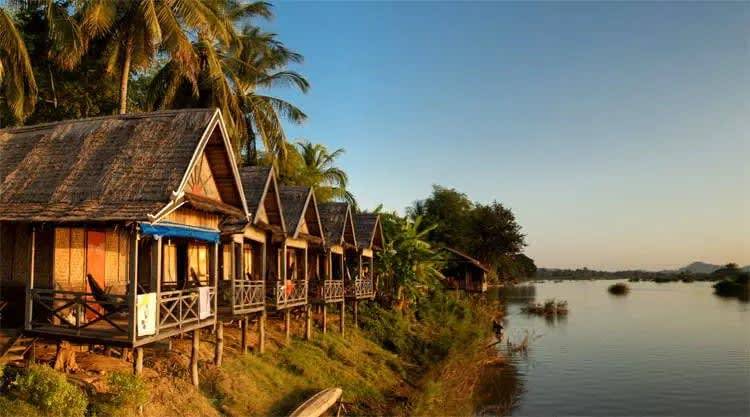
Right before the Cambodian border the Mekong spreads out fourteen kilometres wide and breaks into thousands of islands, and on one of them is Don Det: a bamboo bungalow on stilts over the water, a hammock, and no cars at all.
This is the end of the road in Laos and the point of it. There is nothing to do here beyond cycling, swimming, looking at waterfalls and lying down, and after three weeks of buses that is precisely what everybody wants. A bed costs four euros. A day costs fifteen.
Two things stop it being purely horizontal: the old French railway across to Don Khon, with waterfalls at the far end, and Khone Phapheng, which by volume is the largest waterfall in Southeast Asia.
Why Don Det is popular with backpackers
- No cars, no roads to speak of, and no reason to hurry
- A bungalow over the water for about €4
- The cheapest stop on this entire route at €15 a day
- Waterfalls you can cycle to across a hundred-year-old railway bridge
- Sunsets over the Mekong from a hammock, every single evening
- The natural last stop before Cambodia
Best time to visit Don Det
Don Det is in the 4000 Islands, where the Mekong spreads out for kilometres just before the Cambodian border. The water level decides what everything looks like here.
Khone Phapheng is the largest waterfall in Southeast Asia by volume of water. In the rainy season the noise alone is worth the trip; in the dry season you see the rock formations underneath it instead, and they are the reason no boat has ever got past this point.
Backpacker budget: around €15 a day
- €4hostel bed
- €2local meal
- €1beer
- €4bicycle per day
Guide prices from our own days in Don Det. Add a tour or a night out and it climbs fast.
Best hostels on Don Det
There are no hostel chains here and no booking desks: it is family-run bungalows along the two banks, most of them wooden, most of them with a hammock on the porch. You can turn up and walk the path until something looks right, which is what a lot of people do.
Mr Mo Guesthouse is the simple, social one right on the water, a short walk from the boat landing, the bike hire and the restaurants. Mama Leurth Sunset Guesthouse sits on the sunset side and is the quiet option: hammocks, river views and very little happening, which is the entire product. Don Det Backpackers Hostel is where you go if you want company, shared dinners and other people to cycle to the falls with.
Pick a side rather than a price. The west bank gets the sunset and the bars; the east bank gets the sunrise and the silence, and they are eight minutes apart on foot.
Best things to do on Don Det
Cycling to Don Khon
The best day here, and it costs two euros. Ride south across the old French railway bridge onto Don Khon, past the rusting remains of the only railway the French ever built in Laos, out to the Li Phi waterfalls, and back along the far bank. Three hours with stops, entirely flat.
Khone Phapheng falls
Not the tallest waterfall in the region, the biggest: more than ten thousand cubic metres of water a second across a front of ten kilometres. It is on the mainland rather than the islands, so you go by boat and tuk-tuk, and it is loud enough to feel in your chest.
Looking for the dolphins
A handful of Irrawaddy dolphins still live in the deep pool off the southern tip of Don Khon, and going out at dawn or dusk in a small boat to look for them is the other thing people do here.
Be realistic about it: this population is critically endangered and down to single figures, so sightings are a fin in the distance rather than anything close, and some days there is nothing. Go with a boatman who cuts the engine and keeps his distance, and treat it as a quiet hour on the water that might have a dolphin in it.
Kayaking through the islands
A full day paddling between the islands, through channels barely wider than the boat, with stops at waterfalls and villages and usually a walk in the middle. It is the only way to see how big this stretch of river actually is.
Doing nothing, deliberately
This is a real item and it is why the island exists. A hammock on a wooden porch, the Mekong going past at walking pace, a book, a Beerlao, and the sun going down behind the palms on the far bank. Four euros a night. Whole days disappear.
Best area for backpackers
The riverbank on Don Det
The island has two banks and one path between them, and the choice is which way you want to be facing. The west side, the sunset side, has most of the guesthouses, the restaurants and the bars.
The east side is quieter, cheaper and gets the sunrise. Everything on the island is within a fifteen-minute walk or a five-minute cycle, so this is a preference rather than a decision.
Good to know about this area
- No cars anywhere on the island. You walk or you cycle
- Bungalows over the water from about €4, most with a hammock
- The west bank gets the sunset and the bars, the east bank the quiet
- The bridge to Don Khon is at the southern end
- No ATM on the island, and the power cuts out regularly
- Bring cash from Pakse, enough for your stay and the bus out
How to plan your days on Don Det
Don Det is the place where you do nothing, and that is the plan. Pick how long you have.
Cycle the islands. Across the old French railway bridge onto Don Khon, past the Li Phi falls and the remains of the colonial railway. The whole loop is about three hours.
Tonight: sunset from a hammock, which is the standard evening here.
Dolphins and Khone Phapheng. A few Irrawaddy dolphins still live off the southern tip of Don Khon. Combine it with Khone Phapheng, the largest waterfall in Southeast Asia by volume.
Tonight: eat on the sunset side of Don Det.
Kayak, or nothing at all. A day paddling between the islands with stops at waterfalls and villages. Or a whole day in the hammock, which counts as a full programme here.
Tonight: boat and bus to Cambodia, or back up to Pakse.
Food and drink on Don Det
Small island, simple food. You eat at your guesthouse or at one of the places along the path, usually looking at the river, and the menu is fried rice, noodle soup, laap and whatever fish came out that morning.
There is no ATM on the island and the power drops out regularly. Bring cash from Pakse, and do not count on paying for anything by card.




Take out enough cash in Pakse for your whole stay plus the bus out. There is no machine on the island and the nearest one is a boat ride and a tuk-tuk away.
Getting there and onward
For a lot of people Don Det is the last stop in Laos before crossing into Cambodia towards Siem Reap or Kratie.
Getting there. The minibus from Pakse takes about three hours to Nakasang, and from there it is a ten-minute longtail across to the island.
On the island. There are no cars. You walk or you cycle, and a bicycle is about €2 a day. Don Det and Don Khon are joined by the old railway bridge.
The border. Into Cambodia you go on a combined ticket: boat, minibus and the crossing at Nong Nok Khiene. Expect a long day to Kratie and a longer one to Siem Reap.
- LongtailNakasang to Don Det, 10 minutes
- MinibusPakse to Nakasang, 3 hrs
- BicycleFrom about €2 a day, and the best way here
- BorderNong Nok Khiene into Cambodia, combined ticket
- KayakBetween the islands, a full day
Crossing into Cambodia
This is where most people leave Laos. From Don Det you book a combined ticket that takes you by boat to the mainland, by minibus to the border at Nong Nok Khiene, and on into Cambodia.
Bring clean US dollars and a passport photo. This crossing has a long-standing reputation for small unofficial fees at the window, and what works is asking politely for a receipt. What applies on your own passport is on our visa page.
Staying safe on Don Det
Very safe, and very slow. The things that catch people out here are the river and the road surface, in that order.
- Bring cash from Pakse. There is no ATM on the island
- Swim only where people are already swimming, and never near the falls
- Take a torch. The power goes off and there is no street lighting at all
- Ask for a receipt at the Cambodian border if you are charged anything extra
- Kayak or swim above the waterfalls. The current gives no warning
- Cycle the island path after dark without a light. It is sand and rock
- Expect wifi or a working card machine. Neither is reliable
- Buy drugs, which are openly offered here and carry severe sentences in Laos
Rebels on the Road tip
Get a bicycle and ride to the southern tip of Don Khon at six in the morning, before anybody else is up. The path is sand, it takes forty minutes, and at the end of it there is a beach, a rock, and the Mekong going past very wide and very quiet. That is where the dolphins are, if they are anywhere, and whether or not they show up you will have the bottom of Laos to yourself for an hour. Then cycle back for a baguette and spend the rest of the day horizontal.
Frequently asked questions
How many days do you need on Don Det?
Two or three. One for the cycle to Don Khon, one for the falls and the dolphins, and a third because you did not feel like leaving, which is what usually happens.
Is Don Det worth it?
If you want things to do, no. If you want to stop moving after three weeks of buses, it is the best four euros a night in Southeast Asia and the single most relaxed place on this whole route.
Is there an ATM on Don Det?
No. Take out enough cash in Pakse to cover your stay, your food and your ticket out. The nearest machine is a boat ride and a tuk-tuk away on the mainland.
Will I see the dolphins?
Maybe. The Irrawaddy dolphins in this stretch of the Mekong are critically endangered and there are very few of them left, so a sighting is a fin in the distance and plenty of trips see nothing. Go for the boat ride at dawn, and treat a dolphin as a bonus.
Don Det or Don Khon?
Don Det has the guesthouses, the bars and the crowd. Don Khon, across the bridge, is quieter and greener and has the waterfalls on it. Sleep on Don Det, spend your days on Don Khon, and the bridge between them is a five-minute cycle.
How do I get to Cambodia from Don Det?
On a combined ticket: boat to the mainland, minibus to the border at Nong Nok Khiene, and on into Cambodia. Take dollars in cash for the visa and expect a full day to Kratie.
When is the best time to visit Don Det?
November to February, when it is dry and the sandbanks appear. September and October if you want Khone Phapheng at full volume, and March to May if you want the best chance of a dolphin, though it is very hot.
