
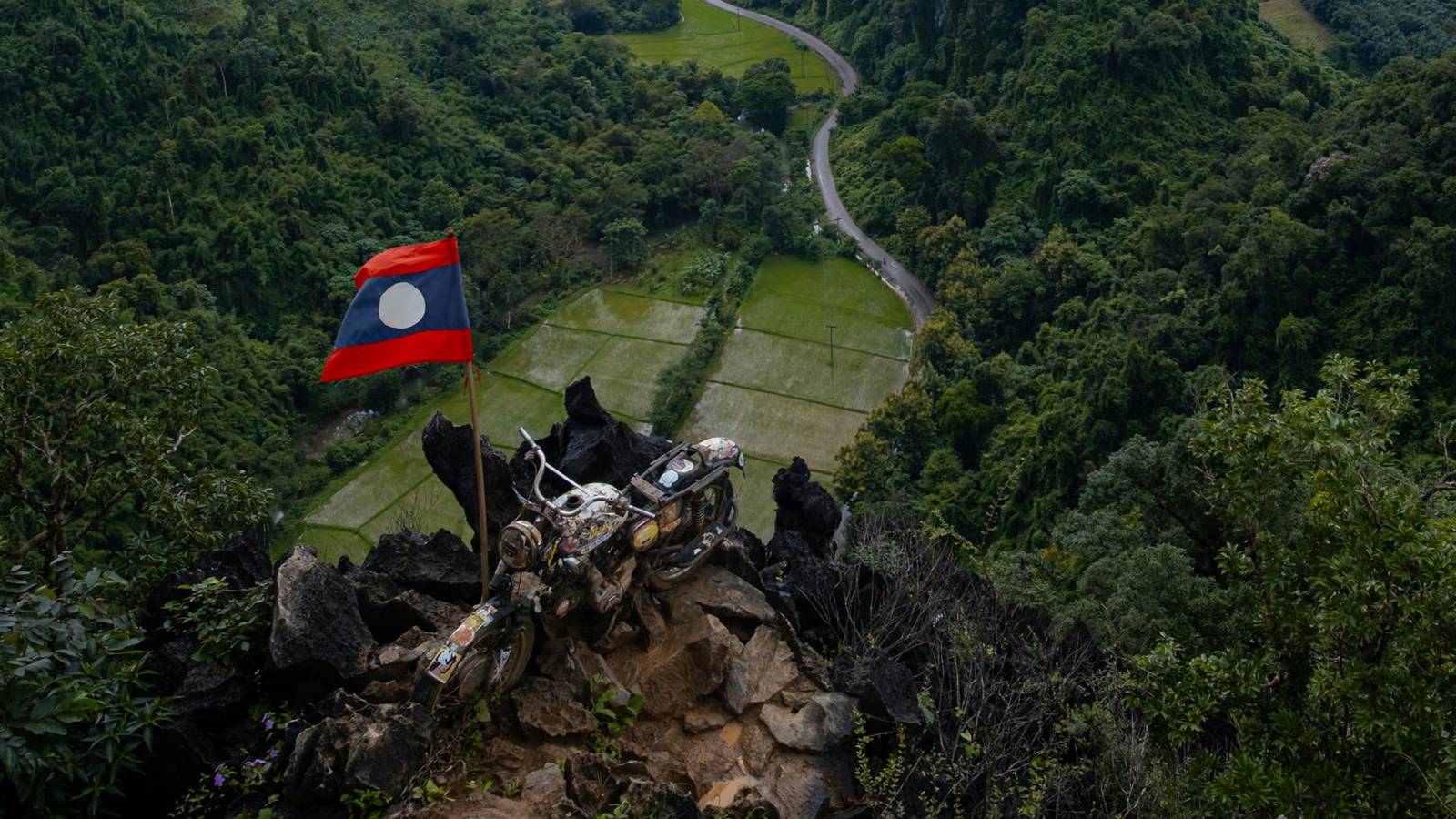
Laos is the country where the trip changes pace. There is no coastline, there are no big cities worth the name, and there is nothing here that anybody is queueing for. What there is: seven and a half million people, a landscape that is seventy percent mountain and jungle, and the Mekong running the length of it.
The route is one line. You come in from Thailand at Huay Xai, get on a wooden boat for two days down the river, and work your way south through Luang Prabang, Nong Khiaw, Vang Vieng, Vientiane, Thakhek, Pakse and finally Don Det, where the river splits into four thousand islands and stops entirely. Eight stops, about three weeks, and roughly €25 a day.
It is also the country people are most surprised by. Everyone arrives expecting a quiet week between Thailand and Vietnam, and a large number of them end up saying afterwards that it was the best part of the trip.


Why Laos?
Because it is the least commercial country on this route and it has not worked out how to sell itself yet, which is exactly the point. Mountains, caves, rivers and roads with nothing on them.
- Limestone mountains and jungle you can walk straight into
- A UNESCO town full of temples and orange robes at dawn
- Waterfalls that are genuinely turquoise, and free to swim in
- Two motorbike loops and the best zipline in Asia
- Two days on a wooden boat down the Mekong
- An island at the bottom of the country with no cars on it
And because it is cheap even by this region's standards: €6 for a bed, €2 for dinner, and a bus to the next stop for €8.
Best time to visit Laos
Tropical, landlocked and mountainous, which means the difference between the seasons is bigger inland than you would expect. November to February is the window.
Two things that catch people out. In March and April the north has a burning season, when farmers clear the fields and the haze sits in the valleys for weeks: Nong Khiaw and Luang Prabang lose their views entirely. And the rainy season is not the disaster it sounds like: the waterfalls are at full force, everything is green, and the famous places are quiet.
Practical information
Laos is the one country on this route where nearly everybody needs a visa: thirteen of the fourteen passports on our visa page. Only a Swiss passport gets you in without one, for up to 15 days. Apply for the e-visa beforehand at laoevisa.gov.la, or get a visa on arrival at the main border crossings and airports. Either way it is 30 days and it costs money, and for the visa on arrival you want clean US dollars in cash plus a passport photo. What it costs on your own passport is on our visa page.
The Lao kip, and it has a lot of zeros. ATMs are thin on the ground once you leave the main towns and often have a low limit, so take cash out where you can and keep dollars for the border.
Lao, which is close enough to Thai that the two are partly mutually intelligible. English is common where backpackers are and rare elsewhere. "Sabaidee" gets you a long way.
Very safe in terms of crime. The real risks here are different: rented motorbikes on mountain roads, river currents in the wet season, and unexploded bombs from the war in rural areas, which is why you never walk off marked paths in the east and the south.
Nothing is required to enter, but Laos is the one country on this route where two things do come up. Malaria tablets are worth discussing with a travel clinic for rural areas, and if you stay four weeks or longer you can be asked for proof of polio vaccination when you leave, on an international certificate, given between four weeks and twelve months before you go. Four weeks adds up faster here than people expect. It is all on our vaccinations page.
Our daily budget is an average across the country. Luang Prabang and Vang Vieng sit above it, the north and the far south below it, and the Gibbon Experience is its own line in the accounts entirely.
Backpacker budget: around €25 a day
- €6hostel bed
- €2local meal
- €1beer
- €8bus ride
Guide prices from our own trips. Add a night out or a dive and it climbs fast.
Lao culture
There is a phrase you hear constantly here: bo pen nyang. It means no problem, never mind, it does not matter, and it is applied to everything from a missed bus to a broken chair. It is not laziness. It is a whole way of deciding what is worth being bothered about, and after a week it starts happening to you too.
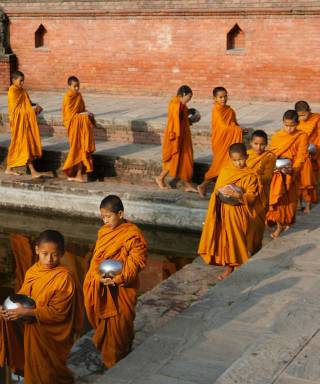
Buddhism runs through the day rather than sitting on top of it. In Luang Prabang a few hundred monks walk the streets barefoot at dawn collecting alms, and it is a religious ritual and not a photo opportunity, which is worth remembering when you see forty people with flashes on.
Getting annoyed here does not speed anything up. It just makes you the only person in the room who is annoyed.
Shoes off before you go into a temple or a home, shoulders and knees covered, and never touch a monk if you are a woman. Beyond that: keep your voice down, keep your feet pointed away from people, and let things take the time they take.
- Take your shoes off before entering a temple or someone's home
- Cover shoulders and knees at any temple
- Watch the morning alms round from a distance, in silence, if at all
- Slow down. The pace here is lower, and that is the entire appeal
- Touch a monk, which applies to women in particular
- Use a flash during the alms round, or stand in the line of it
- Touch anyone's head, or point at anything with your feet
- Get loud or impatient. It works against you here more than anywhere
Lao food
Lao cooking looks like Thai and is not, and almost nobody outside the country knows it exists. Sticky rice with everything, eaten with your hands out of a little woven basket, and a lot of raw herbs.
The dish to start with is laap: minced meat or fish with lime, chilli, mint and toasted rice powder, and the unofficial national dish. Then tam mak hoong, the Lao papaya salad, which is the same idea as the Thai one and considerably more aggressive.





And then there is the baguette, which the French left behind and which Laos kept and improved. A filled one off a street cart costs about a euro and is the best breakfast in the country. Buy two, because the bus is four hours and there is nothing at the other end.
The Gibbon Experience
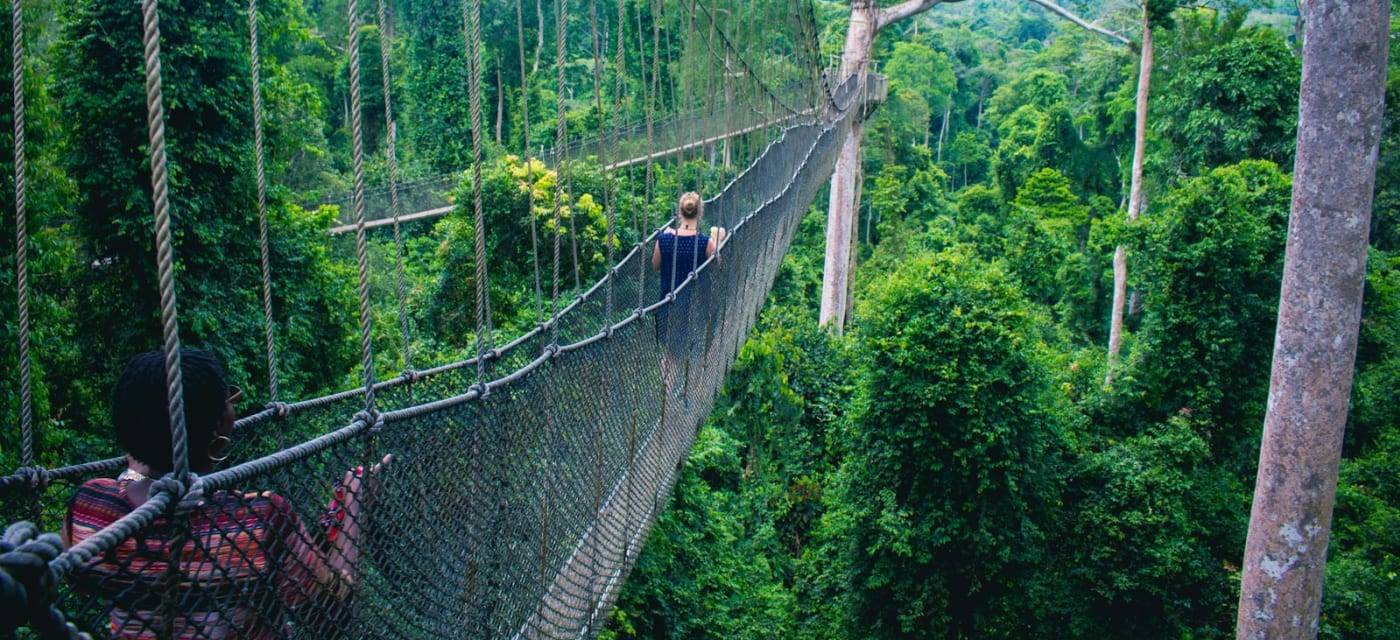
The single most talked about thing in Laos, and it starts at Huay Xai, the first stop on the route. You spend two or three days in the Bokeo Nature Reserve moving between ridges on ziplines, some of them half a kilometre long, and you sleep in a treehouse forty metres up with no walls on it.
You get to your bed by zipline. There is no other way in or out. Dinner arrives by zipline too, and if you are lucky you wake up to black-crested gibbons calling across the valley, which is what the whole project exists to protect.
It is not cheap by Lao standards and it is the thing people most often say was worth every kip. Book ahead, because the treehouses sell out weeks in advance in high season.
Getting around Laos
Travelling here is its own adventure, and slower than anywhere else on this route. Roads wind, buses stop constantly, and the distance on the map has very little to do with the hours it takes.
The one thing that changed everything is the Laos-China Railway, open since 2021: Vientiane to Luang Prabang in under two hours, on a modern train, for about €13. It turns a punishing eleven-hour minivan into a morning, and it is the single best transport decision you can make in this country.
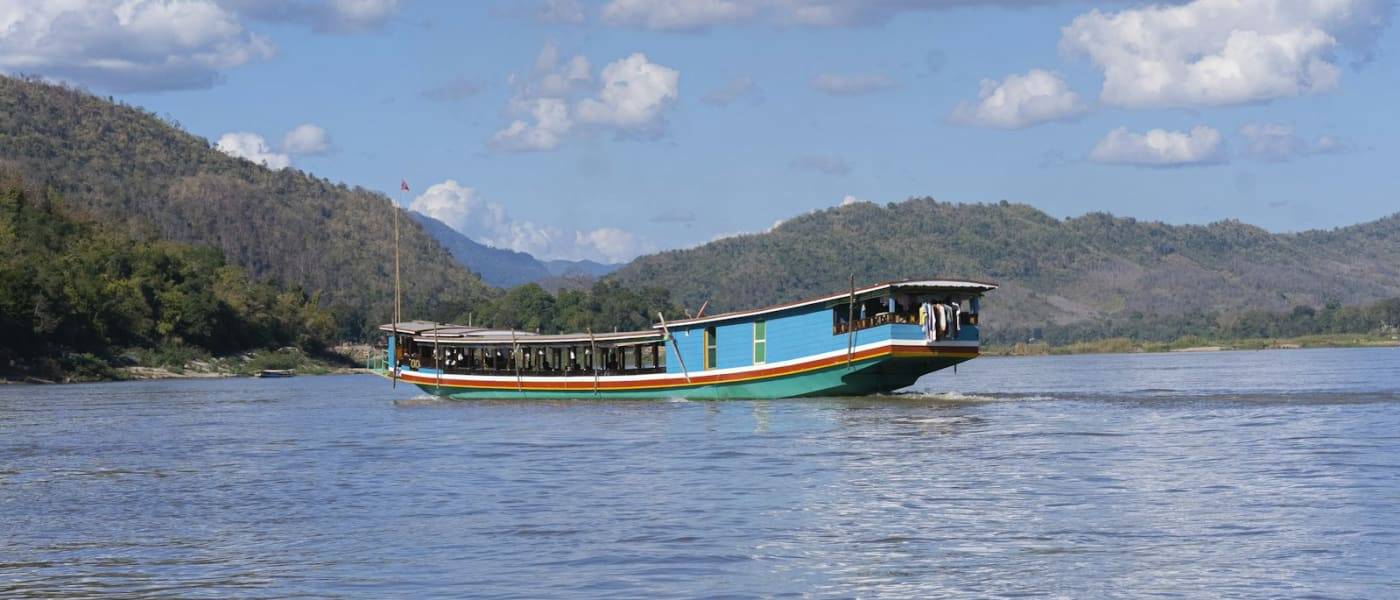
For everything the train does not cover there are local buses, minivans, night buses and cheap domestic flights. And then there is the slow boat: two days from Huay Xai to Luang Prabang on a wooden riverboat, which is not a way of getting somewhere so much as one of the great journeys in Asia.
Riding the Thakhek or the Bolaven loop yourself? Laos recognises the 1949-convention international driving permit alongside your own licence, and almost every bike you can rent is over 50cc, which makes it legally a motorbike. Without the right category your travel insurance does not cover you.
- The railwayVientiane to Luang Prabang in under 2 hrs
- Slow boatTwo days down the Mekong from Huay Xai
- Bus & minivanEverywhere the train does not go, from €8
- MotorbikeThakhek Loop three or four days, Bolaven Loop two or three
- PlaneFor the long hops north to south
Laos for every traveller
Laos suits people who are happy with a day that does not go to plan. If your trip is a list to get through, this is the country that will annoy you; if it is not, this is the one you will miss afterwards.
The cheapest country on the route and the least commercial. One road, eight stops, and the same faces the whole way down.
Seventy percent mountain and jungle, waterfalls that are actually turquoise, and caves you go into by kayak.
Ziplines into treehouses, two motorbike loops, multi-day treks and a seven-kilometre cave you ride a boat through.
Hammocks on the Mekong, an island with no cars on it, and nobody anywhere trying to sell you a boat trip.
Travelling alone is easy here, mostly because the country is small and there is only one route through it. Get on the slow boat at Huay Xai and you will still be running into the same eight people in Vang Vieng a week later.


