
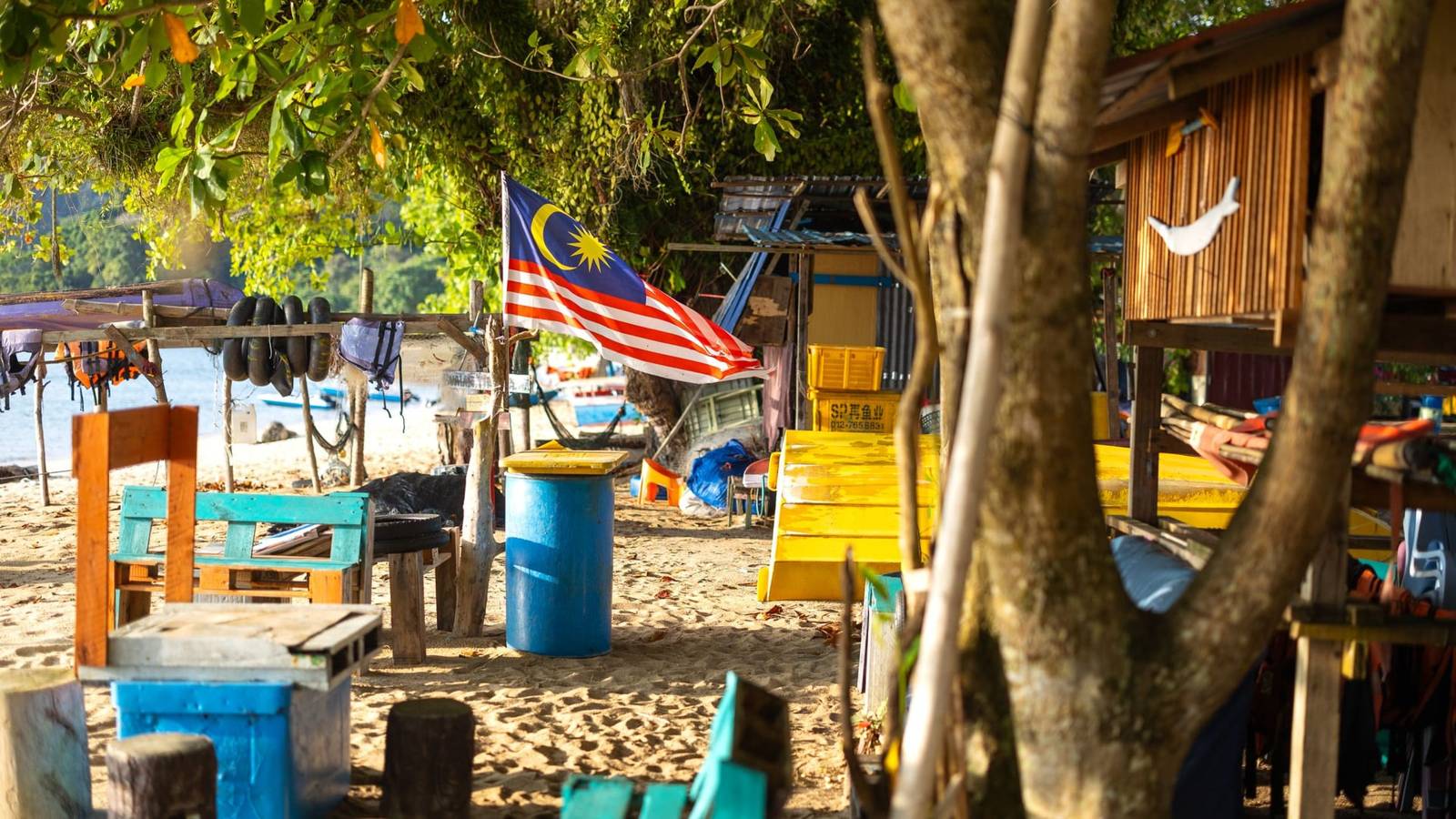
On most routes Malaysia is the country where you do a few days of Kuala Lumpur, stop in Penang and move on. Ask the same travellers a year later what they talk about most, and a surprising number of them start on Malaysia. On a bowl of laksa for breakfast, on proboscis monkeys above a brown river, on an island without roads.
That is because Malaysia does not fit into a few days. It is really two countries, with three cultures, two coasts that each run on their own season, and a slice of Borneo you can disappear into for a week. If all you saw was the big city, the other Malaysia is still waiting for you.
Malaysia is also a country that stays true to itself.
Malaysia in brief
Malaysia comes in two parts with the South China Sea in between. One is the peninsula, with Kuala Lumpur, the colonial streets of Penang and Melaka, tea plantations in the hills and islands on both coasts. The other lies hundreds of kilometres away: Sabah and Sarawak, the Malaysian part of Borneo, the third largest island in the world.
The country has 4,675 kilometres of coastline, its highest peak is Mount Kinabalu at 4,095 metres, and the average daytime temperature is 31 degrees. The official language is Bahasa Malaysia, but on the street you also hear Hokkien, Cantonese and Tamil, and on Borneo dozens of indigenous languages. You pay in ringgit, which everyone writes as RM.
Two countries under one flag
You feel the difference between the two halves the moment you land. On the peninsula everything is sorted: a train from the airport that has you in central Kuala Lumpur in 28 minutes, hostels with rooftop bars, a route that practically travels itself. On Borneo the adventure starts. You fly there in under three hours, and the next day you are standing in one of the oldest rainforests in the world.
The airport tells you how separate those two worlds are, too. Sabah and Sarawak run their own immigration, so after a domestic flight from KL you queue at a desk again and get a fresh stamp in your passport. It is one country, but Borneo makes sure you know you have arrived somewhere else.
Three cultures on one pavement
In one block of George Town you walk past a mosque, a Chinese clan house and a Hindu temple, and smell curry, incense and charcoal in that order. Chinatown in Kuala Lumpur is the same: Chinese temples, a Hindu temple and a mosque within a few streets of each other. That is not a stage set for tourists, it is simply how the country works.
Malay, Chinese and Indian Malaysians have lived side by side here for centuries. Almost a quarter of the population has Chinese roots, a smaller share Indian, and on Borneo add the indigenous peoples, like the Iban and the Kadazan-Dusun. In Taman Negara on the peninsula live the Batek, one of the original peoples, who live in and from the forest.
For you it means walking through three worlds in a single day. An Indian breakfast in the morning, a Chinese temple full of red lanterns in the afternoon, and late in the day the call to prayer rolling over the rooftops.
A Muslim country that feels relaxed
Islam is the official religion, and you see it in the headscarves, the halal stalls and Friday lunchtime, when the men head to the mosque en masse. What you do not notice is strictness. Malaysians are relaxed, helpful and curious about where you are from.
It does vary by region. In the conservative east coast states, Kelantan and Terengganu, beer is hard to find and off the beach you are better off covering your shoulders and knees. And during Ramadan Muslims do not eat in the daytime, while late every afternoon Ramadan markets open everywhere with the best stalls of the year. How to behave in a mosque, in someone’s home and at the table is in Malaysia etiquette.
The street is the kitchen
If one thing about Malaysia catches you off guard, it is the food. Three cuisines have been mixing here for centuries, and the result is not in restaurants but out on the street: in hawker centres full of stalls where every cook makes one dish and has spent years perfecting it. You grab a table, remember the number and order from three stalls at once, for about two euros a plate.
Every city has made something of its own out of it. Penang is the food capital, Ipoh the city of white coffee, Melaka the home of Peranakan cooking, and in Kuching you eat laksa for breakfast. What to try where is all in food in Malaysia.
Five hundred years of trade in the streets
In Melaka you walk through five hundred years of trade. The Portuguese, the Dutch and the British all ruled here. The Dutch took the city in 1641 and stayed for more than a century and a half, and their red Stadthuys and Christ Church from 1753 still stand on Dutch Square. A little piece of the Netherlands in the tropics, strange and familiar at the same time.
That trade also produced the Peranakan, descendants of Chinese traders who married Malay women, with their own kitchen and their own houses full of woodcarving. Melaka and George Town have been a Unesco World Heritage Site together since 2008. Ipoh tells another chapter: the city got rich on tin, and the colonial shophouses and the brilliant white railway station are still there to show it.
The newest chapter played out on Merdeka Square in Kuala Lumpur. That is where, at midnight on 31 August 1957, the flag of Malaya went up for the first time.
A forest older than you can get your head around
The rainforest of Taman Negara has been standing for around 130 million years. You walk a canopy walkway between the treetops, and in the evening you hear the crickets and cicadas swell over the river. It is the kind of forest where only after dark, with a guide and a torch, do you see how much was hiding in the daytime.
On Borneo it gets wilder still. Sepilok has been taking in orangutans that lost their mothers since 1964, and twice a day they come down out of the trees to the feeding platform. Along the Kinabatangan, at 560 kilometres the longest river in Sabah, proboscis monkeys, crocodiles, hornbills and pygmy elephants are packed into a narrow strip of forest between the palm oil plantations. You do not see them from a trail but from a little boat, at sunrise and sunset.
That picture of forest next to plantation is the story of Borneo itself. Which is exactly why a visit to the rehabilitation centre or a lodge on the river is more than a day out. Which jungle suits your trip is in Malaysia’s jungle: Taman Negara or Borneo.
Two coasts, two seasons
Malaysia has no cold season: it sits around thirty degrees all year. What moves is the rain, and it never falls everywhere at once. When the east coast is in monsoon, the west coast is dry, and the other way round.
That is the whole trick of this country: there is an island for every season. In the northern winter you lie on Langkawi, in the northern summer on the Perhentian Islands or Tioman. Which island fits which month and which kind of traveller is in Perhentian, Tioman or Langkawi, and the full calendar in the best time to visit Malaysia.
Under water
Malaysia is a diving country without making a big deal of it. Off the Perhentian Islands you snorkel with reef sharks and green turtles, on Tioman you get your certificate from about €200, and off Semporna lies Sipadan, where schools of barracuda spin into a whirlpool and you see turtles on every dive. Only around 250 people a day are allowed out there.
Several governments, the UK’s FCDO among them, advise against all but essential travel to the islands off the coast of eastern Sabah, including Mabul and Sipadan. Read your own government’s current advice and the small print of your travel insurance before you book. How the permit system works, and what to do without Sipadan, is in diving Sipadan and Semporna.
A country that runs smoothly
The biggest difference from the neighbours is the language. Plenty of people speak good English, stall holders included, so you get by easily everywhere. A bus station, a menu, asking the way: no miming, no translation app.
On top of that, almost everything just works. The ETS train up the west coast is fast and comfortable, the buses run on time and in the cities you order a Grab at a fixed price. You do not need to figure much out to get around well here.
That makes it a great country to start your trip with, or to catch your breath in after a few weeks on the road. How to get from stop to stop, and why you fly to Borneo, is in getting around Malaysia.
What a day here costs
On average, reckon on about €30 a day in Malaysia. On the peninsula you get by on less: a bed for seven or eight euros and a hawker plate for two. Borneo costs more, because the nature there usually means booking a tour or a river trip.
Beer is the exception to the cheap rule. Thanks to the heavy duty you soon pay three euros, except on Langkawi and Tioman, which are duty free. What a day costs place by place is broken down in what backpacking Malaysia costs.
Visa: 90 days without applying
You get 90 days visa free in Malaysia. You do fill in the free digital arrival card, the MDAC, before you arrive, and you have to be able to show a return or onward ticket. Not got one yet? Then sort out an onward ticket.
On Borneo you get a stamp of its own, even after a domestic flight, so keep your passport in your hand luggage. What applies to your passport, with the time limits and the official sources, is on our visa page.
The half most travellers miss
Plenty of travellers do Malaysia in a week: Kuala Lumpur, Penang and gone. That shows you the easy Malaysia, and that is already very good. But the part you end up talking about most is across the sea.
Eat your way from stall to stall in Penang, sit in a boat under the proboscis monkeys a week later, and you have seen both countries. How to combine that in three weeks is in our Malaysia itinerary, and the five experiences that stay with you longest are in best things to do in Malaysia. Torn between the two states on Borneo? Read Borneo: Sabah or Sarawak.
Ready to plan the rest? Head to our Malaysia page: fourteen stops in order, with the hostels and the daily budget for each.
Is Malaysia good for backpackers?
Yes, and it is one of the easiest countries in the region. It is safe, straightforward, everyone speaks English and the food is cheap and excellent. For a first trip that is a great start, and after a few busier countries it feels like a place where everything runs that little bit smoother.
What it asks of you is a choice. With two weeks you see the peninsula properly: the cities, the hills and whichever coast suits your month. With three weeks or more Borneo comes in, and you give it at least a week: Sepilok, the Kinabatangan and, if you dive, Semporna.
Check which month you are travelling in and which coast is dry then, and build your route around that. That way one trip gets you the big city, the rainforest and the tropical island, without much planning to make it happen.


