
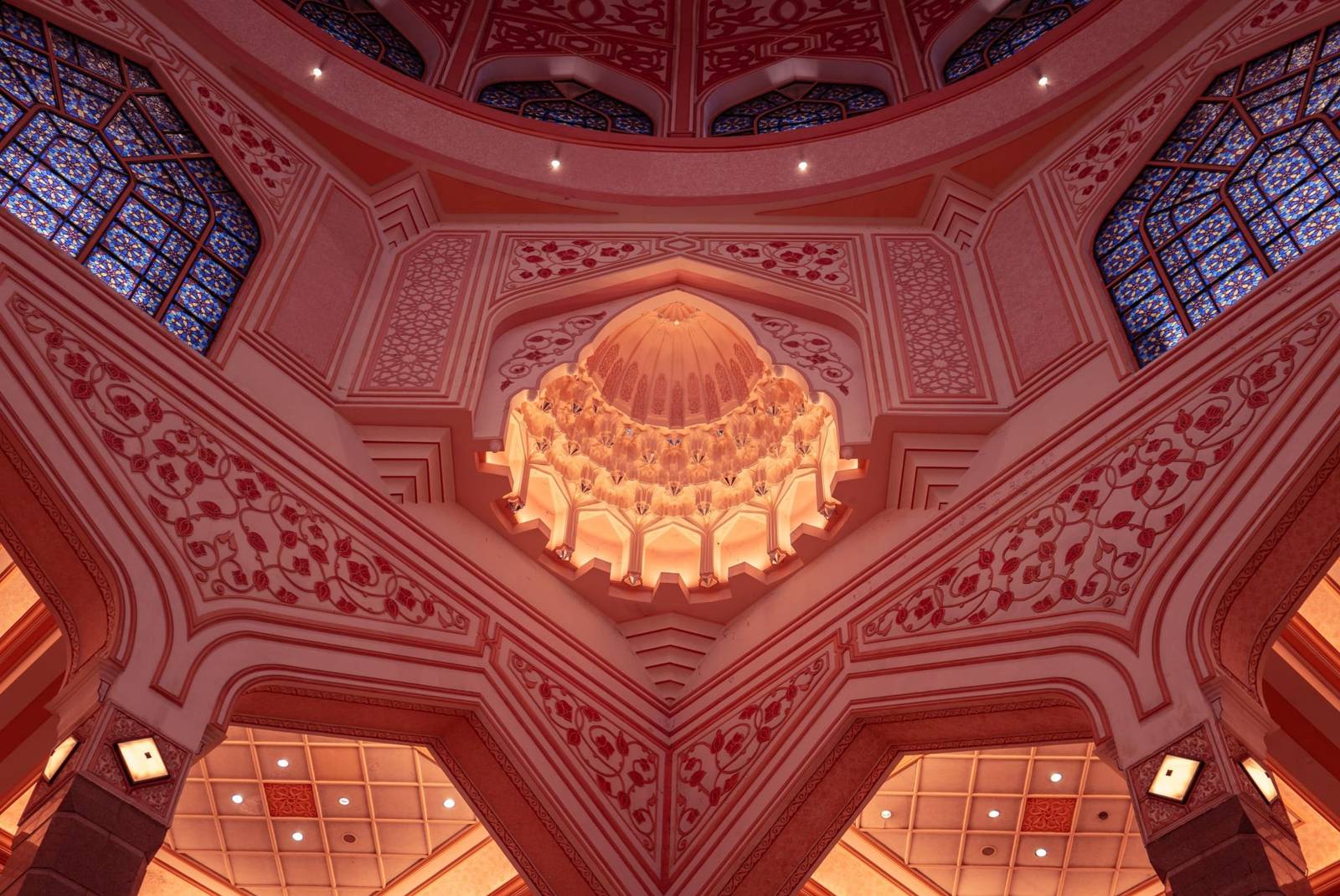
You are walking through Chinatown in Kuala Lumpur. The call to prayer drifts out of a mosque, a few streets on red lanterns hang over a Chinese temple, and in between stands a Hindu temple crowded with painted statues. Nobody looks up. That is a normal day here.
Malaysia is a Muslim country, but not a strict one. You see headscarves and halal stalls, you hear the call to prayer five times a day, and at the same time every town has a Chinese clan house and you can order a beer in a Chinese restaurant without a second thought. That mix makes the country easy, as long as you know where the lines are.
And those lines are not hard. A few rules for mosques and temples, something to cover your shoulders, your right hand and a bit of feel for the east coast: that is about it. What to eat here and where to find your beer is in our guide to food in Malaysia.
Three communities on one street
Malaysians are not one people. Alongside the Malay majority, almost a quarter of the population has Chinese roots, and a smaller share Indian. They have lived side by side for centuries, and you can read it off the street: in George Town a mosque, a Hindu temple and a Chinese temple stand within a few hundred metres of each other, with clan houses full of carved wood in between.
Where those communities really blended, something new appeared. In Melaka and Penang live the Peranakan, descendants of Chinese traders who married Malay women. They built their own houses and their own kitchen: Chinese techniques with Malay spices, coconut and tamarind. At the Baba & Nyonya Heritage Museum in Melaka you walk through one of those houses, the way a wealthy family once furnished it.
On Borneo there is one more layer. Indigenous peoples live there, like the Iban in Sarawak and the Kadazan-Dusun in Sabah, and you hear dozens of languages of their own. The official language of the country is Bahasa Malaysia, but you also hear Hokkien, Cantonese and Tamil. And almost everyone speaks English, right down to the food stalls. That is one of the biggest differences from the neighbouring countries: plenty of people here speak great English, so you get by easily wherever you go. Directions, a question about a dish or a chat with the owner of your guesthouse: no pointing and miming required.
A Muslim country with a relaxed feel
Islam is the official religion, and you notice it in small things. In the headscarves, the halal stalls and on Friday lunchtime, when the men head to the mosque en masse. Some sights work around it too: in Sepilok the orangutan centre closes at eleven in the morning on Fridays, and the canopy walkway in Taman Negara is closed on Fridays. If you are there on a Friday, plan your day around it.
What you do not notice is any strictness in how people treat you. Malaysians are relaxed, helpful and curious about where you are from.
Mosques: how to go in
Mosques in Malaysia are not off limits to travellers, and a few are genuinely beautiful. In Kuala Lumpur, Masjid Jamek, one of the city’s oldest mosques, sits exactly where two rivers meet. On the edge of Melaka the Straits Mosque stands on stilts in the sea, white with a golden dome, and at high tide it looks like it is floating.
The rules are the same everywhere. Shoes off, shoulders and knees covered, and you do not go in during prayers. At the big mosques you can borrow a robe if you have nothing with you. Still, keep a thin scarf or long trousers in your daypack, and you never have to turn back.
You come across mosques on the islands too. On Perhentian Kecil there is one in the middle of the fishing village, and if you sleep there, the call to prayer wakes you early in the morning. That is part of it, and it is a nicer sound than an alarm.
Temples: Chinese, Buddhist and Hindu
The temples are as varied as the people. The Batu Caves near Kuala Lumpur are the holiest Hindu shrine in the country: a 43 metre golden Murugan, 272 rainbow steps and a temple inside a limestone cave at the top. You can hire a sarong for about €1. And leave your food at the bottom, because the macaques on the steps know exactly which bag to go for.
Kek Lok Si on Penang is the biggest Buddhist temple complex in Malaysia, with a seven storey pagoda and a bronze Guanyin at the top of the hill. In Ipoh the temples sit deep inside the limestone cliffs, with Buddhas in the half dark and ponds full of koi. There too you cover your shoulders and knees, and you go in good time: the cave temples close early, so be there before four. For the steep stairs at Perak Tong, wear something sturdier than flip flops.
In a lot of temples your shoes come off. Not sure? Look at the door: if there is a row of shoes, put yours next to them.
Clothes: the city, the beach and the east coast
In Kuala Lumpur and George Town you mainly think about your clothes when you go into a mosque or temple. On the islands the difference is the step from the sand into the village. On Langkawi, cover your shoulders and knees when you head into the villages away from the beaches.
On the east coast it matters even more. Kelantan and Terengganu are Malaysia’s conservative states, and the Perhentian Islands belong to Terengganu. You barely notice it on Long Beach, but walk into the fishing village and you put on a shirt and something over your knees. A sarong in your bag sorts it in seconds.
Alcohol: pricey, duty free and not everywhere
Alcohol is on sale in Malaysia, in Chinese restaurants, bars and supermarkets. You will not find it at Malay food stalls, and barely at all in the conservative east coast states. Heavy duty also makes beer pricey: in a bar in Kuala Lumpur you easily pay three euros or more, while a fresh fruit shake costs a fraction of that.
There are two exceptions, and backpackers find them fast. Langkawi and Tioman are duty free islands, and there a can from the shop costs less than a euro. Just do not take more drink off the island than you are allowed.
The Perhentian Islands are different again. There is beer, at the beach bars on Long Beach, but not everywhere and not cheap: count on about three euros. Away from the beaches, leave your can where it is, and in the conservative states you do not walk down the street with a beer.
Ramadan and the holidays
If your trip falls in Ramadan, Muslims do not eat or drink during the day. You can, just preferably not conspicuously in the middle of the street or right next to someone who is fasting. There is something lovely on the other side of it: towards the end of the afternoon Ramadan markets open everywhere, with dishes you barely see the rest of the year. Those weeks are when Kuala Lumpur tastes best.
Chinese New Year, in January or February, sets the country moving too. Kuala Lumpur and Melaka get busy, and in the evening Kek Lok Si on Penang is lit up with thousands of lanterns. Expect crowds in those weeks.
Your right hand, your thumb and the handshake
A few small habits make a big difference. Give, take and eat with your right hand. You do not use your left hand to pass food or money. Point with your thumb rather than your index finger: it feels odd on day one, and after that you do it without thinking.
When you greet someone of the opposite sex, do not go straight in for a handshake or a hug. Wait for them to offer their hand, and follow their lead. Going into someone’s home? Shoes off. That sometimes goes for where you sleep too: at Tioman Dive Resort they come off at reception.
Drugs: the line with no room to negotiate
There is one rule with no give in it at all. Malaysia has some of the strictest drug laws in the world, and the penalties are extremely harsh. Do not bring anything, do not buy anything and do not let anyone talk you into it, not even on an island where everything feels super relaxed.
A guest of the indigenous peoples
Outside the cities you meet people who do not live in a museum, but simply at home. Around Taman Negara live the Batek, one of the indigenous peoples of the peninsula, and many boat trips stop at one of their villages. Go with a guide who knows the community, ask before every photo and buy something of what is made there. You are a guest, so act like one.
Around Semporna on Borneo live the Bajau Laut, sea nomads who live on boats and in stilt houses, many of them without any nationality. Children sometimes paddle up to your boat. Do not give them money, sweets or things, do not ask them to swim or pose for your photo, and do not photograph anyone without asking.
Want to learn more about the peoples of Borneo? There are ways to do it that everyone gets something out of. At the Sarawak Cultural Village near Kuching you walk through traditional houses, a longhouse among them, and see the dances and crafts of the Dayak peoples. At Mari Mari near Kota Kinabalu stand the houses of five of Sabah’s peoples, you fire a blowpipe and eat a local lunch. And on Penang’s clan jetties, Chinese families have lived above the water for generations: walk out along the boardwalks, just not into their homes.
The attitude that works everywhere
Cover your shoulders and knees when you walk into a place of worship or a village, use your right hand, go easy on the beer on the east coast and ask before you take a photo. That is all you need to remember. Malaysia is a country where three cultures have been making room for each other for centuries, and they make room for you too.
What to do in each place, where to sleep and what a day costs is on our Malaysia page.
Do women need to cover up in Malaysia?
Not everywhere. Covering up is mainly for mosques and temples, where shoulders and knees are covered for everyone and the big mosques lend you a robe.
On top of that, it is polite to cover your shoulders and knees in the villages away from the beaches, on Langkawi just as much. The east coast, Kelantan and Terengganu, is more conservative. There you put something over your shoulders and knees away from the beach, on the Perhentian Islands too. So a sarong or a thin scarf in your daypack is the handiest thing you can bring: with it you are ready in seconds for any mosque, temple or village street.


