
In Malaysia you plan your day around food, and after a week you catch yourself doing it too. Breakfast is roti canai from an Indian Muslim stall, lunch is a bowl of noodles from a Chinese cook who has been making the same dish for decades, and at night you sit at a plastic table between the smoking grills. For about two euros a plate.
That is because Malay, Chinese and Indian Malaysians have lived side by side here for centuries, and their kitchens have run into each other along the way. On one square full of stalls you eat three countries at once. And every city on the route has made something of its own out of it: Penang the laksa, Ipoh the coffee, Melaka the Peranakan kitchen, Kuching a soup you eat for breakfast.
Below are the dishes you have to try, where they taste best, and what to drink in a country where beer is pricey and tea is a performance.
How a hawker centre works
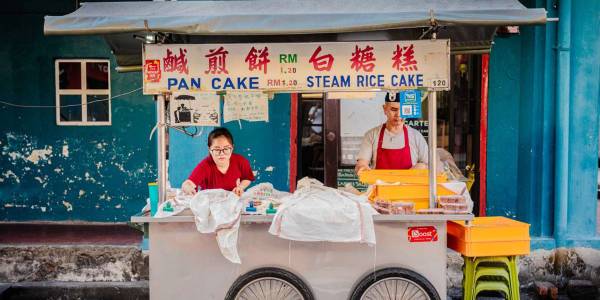
Nearly all the best food in Malaysia comes out of a hawker centre: a covered square or a hall packed with stalls, where every cook makes one dish and has spent years getting it right. You wander round, look in the pans and order from whoever you like.
The trick is the table number. Find a seat first, remember the number on your table, and give that number at every stall you order from. They bring it to you. That way you get your noodles from one stall, your satay from another and your drink from a third, all in one round.
Can’t decide between two stalls? Look for the queue and join the back of it. A cook who has stood in the same spot for thirty years is not there by accident.
The dishes you have to try
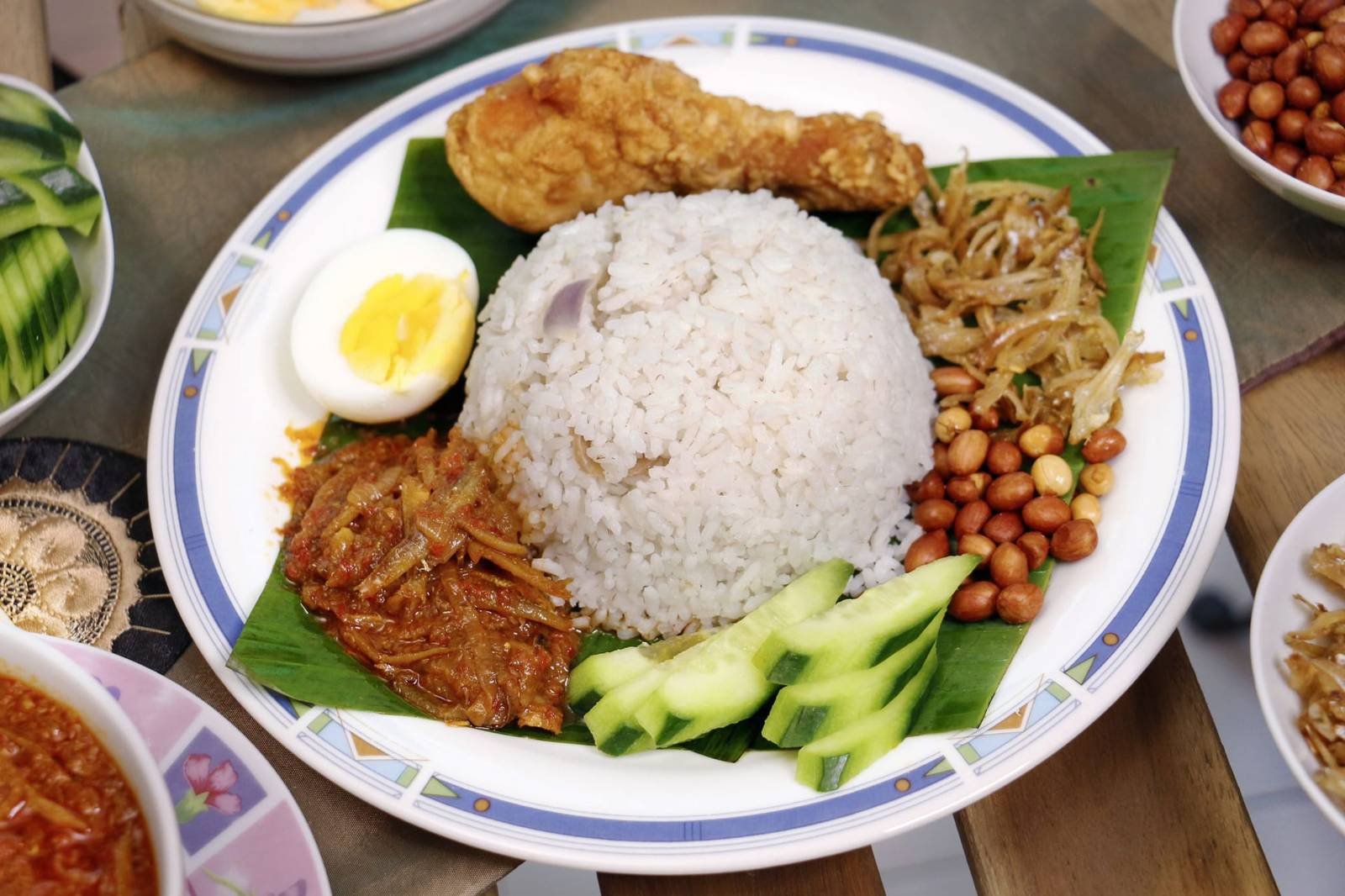
Nasi lemak: our favourite
If we had to pick one dish, this is it. Coconut rice with sambal, anchovies and peanuts, and the dish Malaysians think of as theirs. For us it beats everything else on this list. You eat it for breakfast: in Kuala Lumpur on your first morning, and on Tioman or the Perhentian Islands on the beach. A plate costs about two euros in KL, and it is exactly what you need for a day in the heat.
Satay: our second love
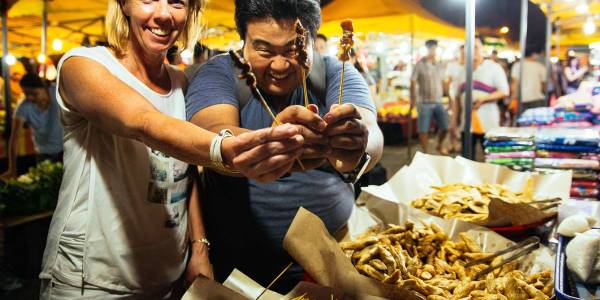
Right behind it for us comes satay. Skewers off the charcoal grill with peanut sauce, wherever there is grilling at night: on Jalan Alor in KL, at the Jonker Street night market in Melaka and at the hawker centres of Penang. Go ahead and order a second round. In Melaka you can also order satay celup, where you dip the skewers yourself, a whole evening’s eating for a table full of travel mates.
Roti canai
Paper thin, flaky flatbread with a little bowl of curry for dipping. It comes from the Indian kitchen and you find it everywhere, from the kopitiams of Ipoh to the Indian restaurants in the Cameron Highlands, where a warm roti in the cool evening air tastes even better.
Char kway teow
Flat rice noodles from a roaring wok, the dish every cook builds a reputation on. Everyone in Penang has an opinion on who makes the best one, and nobody ever wins that argument. You also eat it on Jalan Alor in KL and in Ipoh.
Asam laksa
Penang’s dish: a sour fish soup with noodles, sharp with tamarind and thick with mackerel. Nothing like the creamy laksa you eat later on Borneo, and that is exactly why it is addictive. A bowl costs about €1.50. Order a second one straight away, everybody does.
Nasi kandar and curry mee
Two dishes from Penang and Ipoh. With nasi kandar you get a plate of rice and point at the curries you want on top. Curry mee is a bowl of noodles in a spicy coconut curry, and a solid lunch.
Banana leaf rice
Rice with a row of curries and sides, served on a banana leaf instead of a plate. It is South Indian, and it tastes best in Brickfields, the Indian quarter next to KL Sentral, or in the evening in Tanah Rata. Eat with your right hand, like everyone around you.
Cendol
The dessert that beats the heat: shaved ice with coconut milk and gula melaka, the dark palm sugar named after Melaka. You find it at every night market, but in Melaka you eat it where it got its name.
Our verdict: nasi lemak for breakfast and satay for dinner, our two favourites, with Penang’s asam laksa and a cendol in between
Where to eat what
Penang: the food capital
The whole of Malaysia calls Penang the place to eat, and that comes from Malaysians themselves. You come here to eat, and the rest of George Town is the frame around it. In the evening, head to Gurney Drive on the seafront for the big hawker centre, or to the stalls on Chulia Street, walking distance from your hostel. Plates start at around €1.50.
One of the island’s most famous asam laksa stalls is at the Air Itam market, at the foot of the Kek Lok Si temple, and you eat it on a stool by the road. Combine it with the temple and Penang Hill and you have the tastiest afternoon of your trip. More in things to do in Penang.
Ipoh: coffee and bean sprout chicken
Ipoh is the city Malaysians drive to at the weekend just for the food. The city’s dish is bean sprout chicken: poached chicken with rice and a plate of fat, crunchy bean sprouts, which according to the locals is down to the water from the limestone hills. The best known places are small and do one speciality, and at the weekend there is a queue. Come on a weekday or come early. See things to do in Ipoh.
Melaka: the Peranakan kitchen
The Peranakan, descendants of Chinese traders who married Malay women, created a kitchen of their own in Melaka (Malacca): Chinese techniques with Malay spices, coconut and tamarind. Try the nyonya laksa, noodles in coconut curry, and chicken rice balls, Melaka’s take on chicken rice where the rice is rolled into little balls. Go at the weekend: from Friday to Sunday Jonker Street turns into a night market in the evening, with snacks from about a euro.
Kuala Lumpur: Jalan Alor and Brickfields
From around six in the evening the tables on Jalan Alor in Bukit Bintang spill into the middle of the road, with satay, grilled fish, char kway teow, durian and fresh fruit juice. A dish costs two to four euros. During the day you have breakfast in a kopitiam around Petaling Street and lunch off a banana leaf in Brickfields. If your trip falls in Ramadan, Ramadan markets open all over the city towards sunset, selling dishes you barely see the rest of the year.
Cameron Highlands: steamboat in the cold
At 1,440 metres, with a jumper on, you eat steamboat: a pot of boiling broth in the middle of the table, where you cook vegetables from the Highlands’ greenhouses, fish and meat yourself. Then there are the strawberries, which you pick yourself or drink in a milkshake, and on Friday and Saturday the Brinchang night market with corn and grilled snacks.
Kuching: laksa for breakfast
On Borneo the food changes again. In Kuching, Sarawak laksa is breakfast: a creamy, spicy soup with prawns, chicken and vermicelli that tastes nothing like Penang’s laksa. Go early, because the best stalls sell out around midday. For lunch, order kolo mee, dry noodles with roast pork, which locals eat pretty much every day. You find both in the kopitiams, for a euro or two. More in things to do in Kuching.
Kota Kinabalu: the taste of Sabah
In KK the grills light up behind the Filipino Market on the waterfront every evening after sunset. Fish, squid, prawns and chicken wings lie in long rows on ice, you point at what you want and mix your own sauce. A chicken wing costs from about €0.40. On Sunday morning you drink pineapple juice from a cart at the Gaya Street market, and in Kundasang, on the flank of Mount Kinabalu, you taste fresh milk and ice cream at Desa Dairy Farm.
Our verdict: you eat well pretty much everywhere, but plan at least one extra day in Penang and one early morning in Kuching
Fish on the coast and the islands
As soon as you are by the sea, the menu changes. On Langkawi you eat ikan bakar at the warungs behind Cenang, and every evening there is a night market somewhere on the island. On Long Beach on the Perhentian Islands the grills fire up at night with the day’s catch, and in Salang on Tioman the barbecue is on. In Semporna the restaurants stand on stilts over the water and you pick your own fish and seafood from the tanks.
Places without a sea are just as special. In Kuala Tahan by Taman Negara you eat at floating restaurants on the river, with the rainforest on the other bank. And on the Kinabatangan your food is part of your lodge package: a buffet with rice, curries, fish or chicken and fresh fruit, shared with the other guests after the cruise.
Two things worth knowing. With fish and seafood, always ask the price per kilo before anything goes on the grill, on Jalan Alor just as much as at the KK night market. And in Semporna, pick fish you know was caught well: the reef you snorkel over during the day is one you want to see looking the same a year from now.
Our verdict: every evening you spend by the water, with the price per kilo agreed up front
Teh tarik, white coffee and pricey beer
Teh tarik
Sweet milky tea poured from a great height from one jug into the other, back and forth, until it wears a collar of froth. It is the drink that goes with everything: with your roti in the morning, with your laksa in Kuching, and hot against the cold in the Cameron Highlands. Watch them make it properly at least once.
White coffee in Ipoh
Coffee in Ipoh is a ritual. The beans are roasted in palm oil and whipped up with condensed milk until it is smooth, sweet and creamy. Sin Yoon Loong has been pouring it on Jalan Bandar Timah since 1937, and Nam Heong is on the same street. A cup costs from about €0.60. Order an egg tart or kaya toast with it, and have it iced on a hot day, like the locals. Go in the morning, because the old places often close by the afternoon.
Tea from the Highlands
In the Cameron Highlands you drink tea where it grows. On the terrace at BOH Sungei Palas you sit with a pot of tea and a scone above the slopes while the pickers move between the bushes. Just not on a Monday, when the tea house is closed.
Beer, and where it is cheap
Malaysia is a Muslim country, and you notice it in the price of beer. Heavy duty means you easily pay €3 for a bottle, more in a bar. Malay food stalls do not sell it, Chinese restaurants, bars and supermarkets do, and in the conservative east coast states like Kelantan and Terengganu you barely find it. On the Perhentian Islands, which belong to Terengganu, your beer is at the beach bars of Long Beach, for about €3.
The exception is good news. Langkawi and Tioman are duty free islands, and there a can from the shop costs less than a euro. Kuala Tahan has no bars, and on the Kinabatangan you bring your beer from Sandakan if you want it. In KL a fresh fruit shake costs a fraction of a beer, and you will find yourself drinking a lot more of those.
Our verdict: teh tarik with every meal, white coffee for breakfast in Ipoh, and save your beers for Langkawi and Tioman
Food tours and a cooking class
A few cities are so packed with food that a guide makes the difference between eating well and eating brilliantly. In Kuala Lumpur an evening tour takes you round local street food, and in Penang you taste more than fifteen things on one walk, including dishes you would never have ordered yourself.
On Borneo you learn to cook it yourself. In Kota Kinabalu you spend three hours making Sabah dishes you will not find on every corner in town, like hinava, raw fish cured in lime juice, and linopot, rice wrapped in a leaf. You are picked up in town.
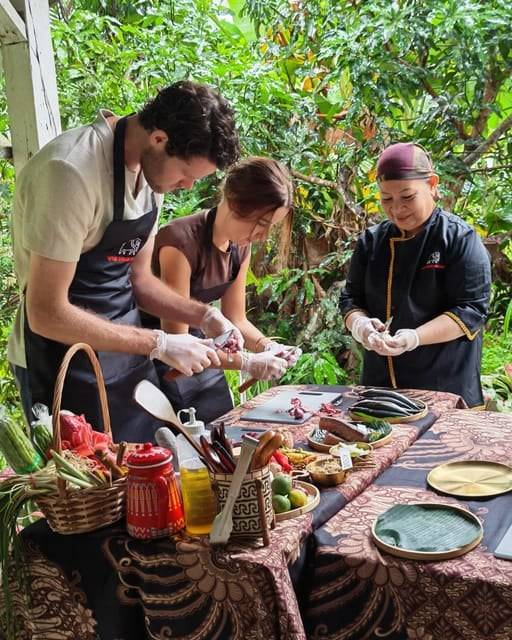
Our verdict: a food tour on your first evening in Penang, and the cooking class in KK if you want to know what Borneo eats
Good to know as well: how to behave at the table and during Ramadan is in Malaysia etiquette, and what a day of eating and sleeping costs per place is in backpacking Malaysia: cost per day.
What do you really have to try in Malaysia?
If you only get to pick five: nasi lemak on your first morning in Kuala Lumpur, satay off the charcoal grill on Jalan Alor, asam laksa on a stool by the Air Itam market in Penang, bean sprout chicken with an iced white coffee in Ipoh, and Sarawak laksa for breakfast in Kuching, before the stalls sell out. The first two are our favourites, with nasi lemak at number one.
And one drink: teh tarik, with the froth on top. You will try to make it at home, and it will not work.


