
In Penang you plan your day around your meals, not the other way round. A temple, a hill or a mural is a nice bonus, but the story you tell afterwards is about that one plate of char kway teow on a plastic stool. Accept that from day one and you get the most out of this city.
There is still plenty to see between meals, though. George Town is an old port city full of clan houses and shophouses, the biggest temple complex in Malaysia sits on the hill at the edge of town, and in the north west the rainforest runs right down to the sea. None of it has to happen on the same day, and none of it has to happen early.
So where do your days in Penang go, and what do you save for round two?
Getting there, where to sleep and how many days to give it are all on our Penang page.
Stall to stall at a hawker centre
This is why you come to Penang. A hawker centre is a square packed with stalls where every cook makes one thing, and that one thing is usually very good. You walk round, point, and eat from five different kitchens in one evening.
Gurney Drive on the seafront is the famous one, and you get there by bus or Grab. The stalls on Chulia Street are in the centre, walking distance from almost every hostel. Most only open once the sun is down, and plates start at about €1.50.
Order asam laksa, char kway teow, nasi kandar and curry mee, and finish with a cendol or a frothy teh tarik. Chinese, Malay, Indian and Peranakan cooking sit side by side here, and that is what makes Penang different from the rest of the country.
The trick you learn on your first night: grab a table, remember its number, and give that number at every stall you order from. They bring it to you.
Our verdict: every night, and always order one plate too many
Kek Lok Si and the Air Itam market
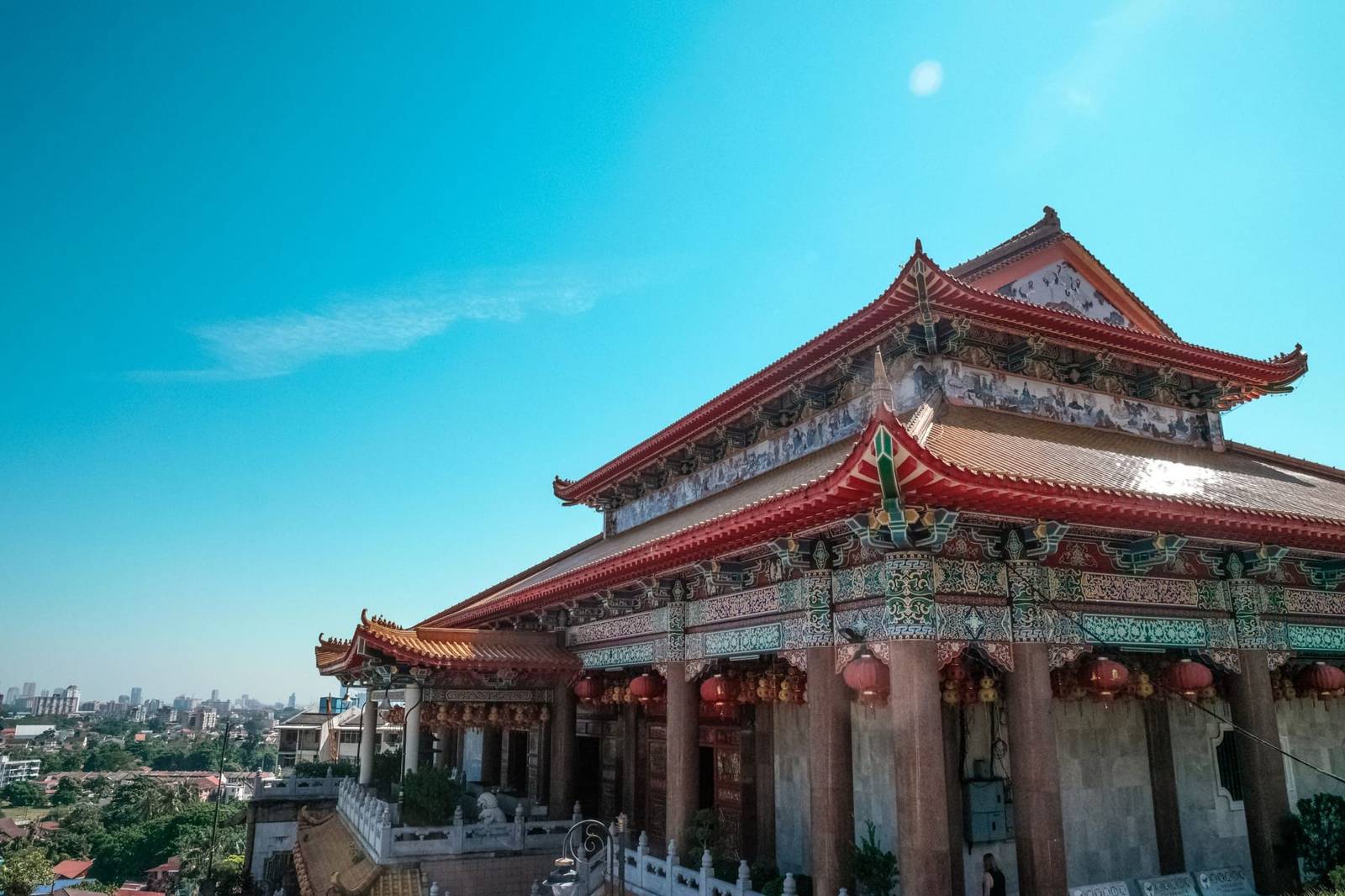
Kek Lok Si climbs the hill at Air Itam in terraces. A seven storey pagoda full of Buddha statues, roofs stacked on roofs, and right at the top a huge bronze statue of Guanyin, the goddess of mercy. It is the biggest Buddhist temple complex in Malaysia, and it feels like it.
Entry is free. The pagoda and the little lift to the top cost a small fee. Cover your shoulders and knees, and take the bus to Air Itam from the centre.
The best part is at the bottom of the hill. The Air Itam market has one of Penang’s most famous asam laksa stalls, in the same spot for decades. Sour fish soup with noodles, a stool by the road, about €1.50.
If you are there around Chinese New Year, come back in the evening. Thousands of lanterns go up and the whole complex is lit.
Our verdict: the biggest temple complex in the country, with the best lunch on the island right below it
The clan jetties at sunset
On the George Town waterfront, wooden houses stand on stilts in the water, built by Chinese families who each had their own jetty. Families still live here, and that is what makes it different from a museum: you walk past front doors, over wooden planks, to little temples at the end of the jetty.
Chew Jetty is the famous one, with little shops and places to eat. It gets busy during the day. Come towards sunset, when the day trippers have gone and the light falls across the water, with the mainland on the other side.
Then carry on to one of the smaller jetties. They are quiet, and often you have one completely to yourself. This is what this side of the city looked like a century ago.
It is free. The only thing to bring is a bit of respect: these are front doors, not a film set.
Our verdict: free, quiet and at its best as the sun goes down
Penang Hill until the lights come on
Penang Hill is 833 metres high, and the funicular climbs steeply up through the forest. At the top it is a few degrees cooler, and after a day in the city you feel that straight away. You look out over George Town, the bridge to the mainland and the sea.
A return costs about €6. Go late in the afternoon and stay until dark: you watch the sun go down and the city lights come on below you one by one. There are rainforest trails at the top too, if you are early.
At weekends there is a long queue for the funicular at the bottom, so pick a weekday if you can.
Penang Hill and Kek Lok Si sit at the foot of the same hill. Put them together, with the Air Itam laksa in between, and you have one of the best afternoons in Malaysia.
Our verdict: go late and stay until the city lights up below you
Street art in the old town
In 2012 the Lithuanian artist Ernest Zacharevic painted a series of murals across George Town, and you have looked at walls differently here ever since. Children on a Bicycle on Armenian Street is the famous one: two painted kids on a real bike bolted to the wall.
On top of that, iron cartoon sculptures hang on the walls and tell each street’s history in a few lines. Most of the work is around Armenian Street, Lebuh Ah Quee and Cannon Street, and it costs nothing.
Go before ten in the morning. After that there is a queue for the famous murals. You do not need a map: wander the lanes and you will run into them.
Our verdict: a morning of wandering, ideally before the queue shows up
Penang National Park and Turtle Beach
In the north west of the island is one of the smallest national parks in Malaysia, and it is exactly the right size for a day. Rainforest running all the way down to the sea, monkeys and monitor lizards along the trail, and at the end a beach with nothing built on it.
Take bus 101 from George Town to Teluk Bahang, about an hour. Entry is about €10 for foreigners. Ask at the gate which trails are open, and hike to Turtle Beach, also called Pantai Kerachut. You can get back on foot or by boat.
Take plenty of water, because there is nothing to buy along the way. And do not feed the monkeys, however cheeky they look.
Our verdict: the day you leave the city behind for a while
Got time to spare in Penang?
Little India and Fort Cornwallis
Between the street art and the water are Little India and the old colonial quarter by Fort Cornwallis, both walking distance from your hostel. Walk through them on your way to the clan jetties, and grab something from an Indian stall as you go.
An afternoon in Batu Ferringhi
Fancy some sand under your feet after all? Take the bus to Batu Ferringhi on the north coast. An afternoon on the beach, and you are back in George Town in time for dinner.
A food tour with a guide
Not sure where to start? Book a food tour. There are tours with more than fifteen tastings, including a morning version for breakfast. After that you order for yourself for the rest of your stay, and you know what you are pointing at.
A rain shower or the midday heat
The heat in the middle of the day is no joke. Duck into a café or a museum and carry on when the sun is lower. If it rains, just keep walking under the five-foot ways, the covered walkways along the shophouses.
Our top five in Penang
Only got a few days? If we had to boil it down to five, these are the ones:
- A hawker centre every night, with Gurney Drive and Chulia Street as your regulars
- Kek Lok Si, with asam laksa at the Air Itam market
- Penang Hill late in the afternoon, until the lights of George Town come on
- The clan jetties at sunset, beyond Chew Jetty
- An early morning of street art around Armenian Street
Still got time after that? Take bus 101 to the national park and hike through the rainforest to Turtle Beach.
So what do you really have to do in Penang?
Honestly: eat. Lots, and often, at stalls whose names you cannot pronounce. The temples, the hill and the walls are beautiful, but the food is what makes Penang different from every other stop in Malaysia.
If we have to add one more thing, it is that one afternoon in Air Itam. Kek Lok Si, a bowl of asam laksa on a stool, and then the funicular up for sunset. Penang at its best three times over, in a few hours and for a few euros.
And loosen your plan a little. People who book three days here often stay longer, and the food is usually to blame. You might as well count on it.


