
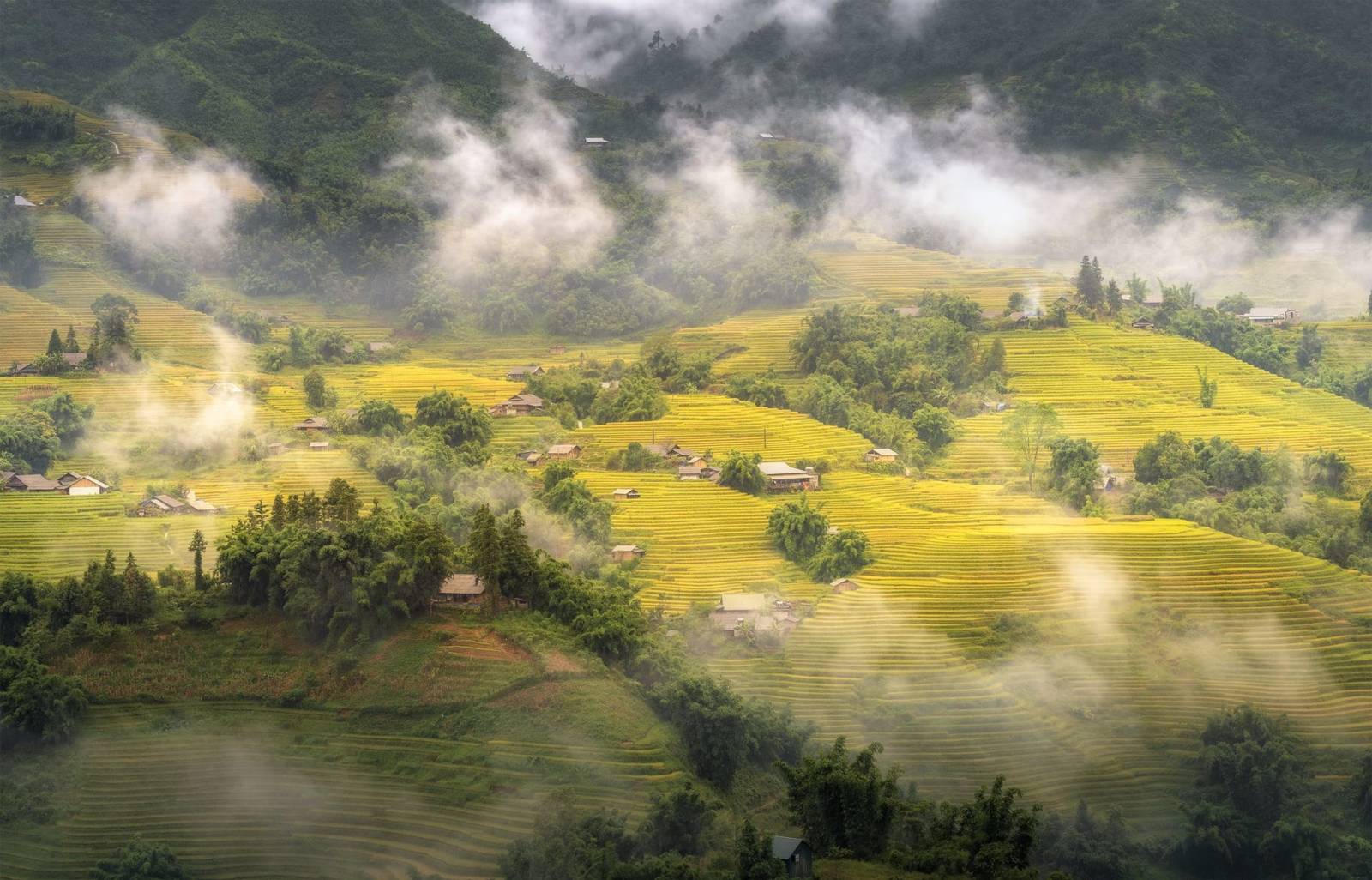
Ask ten travellers what Vietnam is like and you get ten different answers. One talks about misty mountain passes and homestays where everyone eats at one table, the next about lanterns hanging over a river, and the third about fourteen million people and a stream of scooters that never stops.
All three are right. Vietnam is 1,650 kilometres long and in places only a few dozen kilometres wide, and that turns the north, the centre and the south into three regions with very little in common. Different climate, different landscape, different food, different pace. Spend three weeks here and you have not seen one country, you have seen three.
Vietnam at a glance
Vietnam runs along the eastern coast of mainland Southeast Asia, with Laos and Cambodia to the west and China to the north. The coastline is more than three thousand kilometres long, the average daytime temperature sits at around twenty-eight degrees, and the official language is Vietnamese. In the tourist areas, more and more people speak English.
You pay in Vietnamese dong, and you become a millionaire without trying: prices run into the hundreds of thousands in no time. Take a calm look at how many zeros are on each note on your first day, because it saves you some expensive mistakes.
Why the country is so long and so narrow
That shape decides almost everything about a trip here. The country runs from the Chinese border down to the Mekong Delta, and in some places it is only a few dozen kilometres across. So the mountains, the coast and the rice plains are often an hour apart, while the north and the south are two days of travel from each other.
In practice, your route draws itself as a straight line: Hanoi to Ho Chi Minh City, or the other way round. The choice is what you do along the way, not which direction you go.
Three climates in one country
This is the only country on our route where “when is the best time to go” has no single answer. In January you can be sitting in Hanoi under a grey drizzle at seventeen degrees while Ho Chi Minh City is dry and thirty-two. In July it rains in the south while Nha Trang lies in the sun.
That sounds more complicated than it is, and mostly it is good news: there is hardly a month when the weather is bad everywhere in Vietnam. You fit your route to your month, not your month to your route. Which region is at its best when is all worked out in best time to visit Vietnam.
The north: mountains, mist and rice terraces
Above Hanoi starts the part of the country where most travellers have their best days. Sapa sits at fifteen hundred metres, with rice terraces that turn gold in September, and further along the border is the Ha Giang Loop: roughly 350 kilometres of mountain passes right up against China.
Closer to Hanoi are Ninh Binh and Cat Ba, where limestone towers rise straight out of the water and the rice fields. The north has four real seasons, so bring a jumper if you are here in winter. Sapa even gets the occasional bit of snow.
Central Vietnam: history and the shortest good season
The centre is narrow and compact. Phong Nha has a national park with over four hundred caves, Hue has the Imperial Citadel and the royal tombs along the river, and Hoi An has an old town of eight hundred historic buildings that glows under its lanterns after six in the evening.
Keep an eye on the calendar here. This is the wettest region in the country: September to November is the rainy season, with a chance of flooding in Hue and Hoi An and caves in Phong Nha that close. The best stretch is February to April, which falls exactly outside the months when most people come.
The south: heat, the delta and the big city
Ho Chi Minh City has fourteen million people and is louder, hotter and more modern than Hanoi. This is also where the heavier part of the trip is: the War Remnants Museum in the city and the Cu Chi tunnels forty kilometres out tell the story of the war between them.
Below the city lies the Mekong Delta, where life happens mostly on the water. Along the coast you have Nha Trang and Mui Ne, Da Lat up in the hills, and Phu Quoc if you want to finish on an island. The south is the easiest part to plan: dry from roughly November to April, on Phu Quoc from December, and wet after that.
The food is a reason in itself
For a lot of travellers the food is the best thing about Vietnam, and that is not an exaggeration. Pho, the noodle soup people eat here for breakfast. Banh mi, the baguette left over from the French era that has long since overtaken the original. Bun cha in Hanoi, cao lau in Hoi An, fresh spring rolls everywhere.
And the coffee. Vietnam is the second biggest coffee producer in the world and drinks it strong, with condensed milk, over ice. A meal costs you about €1.50 here, so you can happily try everything. More in food in Vietnam.
Politeness works differently here
Vietnamese people are known for being welcoming and curious, and a few habits get you a long way. Shoes off and shoulders covered in temples and pagodas. Take and give things with both hands. A quick “xin chào” when you walk in opens more doors than you would expect.
The most important one: do not lose your temper in public. Face matters a lot here, and whoever raises their voice is guaranteed to get less done than whoever keeps smiling calmly. Haggling at the market is part of the deal, and it is friendly, not fierce. And do not photograph military buildings or uniforms. More in Vietnam etiquette.
A history you run into along the way
Vietnam has thousands of years of history, and influences from China, France and its own heritage are all mixed together. You see it in the architecture: a pagoda next to a French colonial building, with scooters weaving between them.
The twentieth century is never far away. In the south there are the museums and the tunnels, in the centre the places along the old demarcation line, and in the north you mostly notice how fast the country has been rebuilt since. It is not a heavy country to travel through, but it pays to set aside one proper day for it rather than just walking past.
You travel at night
Distances are bigger than the map suggests, and the solution is almost always the same: you travel while you sleep. The sleeper bus is how most backpackers get around, with a bed rather than a seat and a price of around €10. The night train costs more, is more comfortable and links the big cities.
For the long jumps, Hanoi to Ho Chi Minh City for example, flying is cheap enough to consider. And then there is the motorbike: the Hai Van Pass along the coast between Hue and Da Nang, or several days on the Ha Giang Loop. All the options with prices and journey times are in our guide to sleeper buses and night trains.
What a trip here costs
Vietnam is one of the cheapest countries on the route. Count on about €25 a day, with a bed for around €6, a meal for €1.50 and a beer for under a euro. That daily figure also covers getting from place to place and the things you book along the way.
The money does not go on food, it goes on distance and multi-day trips. The Ha Giang Loop with an easy rider costs about €45 a day all-in, and a cave tour in Phong Nha can be the most expensive day of your whole trip. What it all adds up to is in backpacking Vietnam: cost per day.
Visa: it depends on your passport, plus one condition
Whether you can walk in visa free or need an e-visa first, and how many days you get, depends entirely on your passport. Vietnam is the country on our route where passports differ the most, so check yours on our visa page before you book anything.
There is one condition that applies either way: you need to be able to show a return or onward ticket. Do not have one yet? You can sort an onward ticket for exactly that.
Why people stay longer than planned
Almost everyone we talk to let their plans slip somewhere in Vietnam. Usually it happens on the Ha Giang Loop, where three days become four, or in Hoi An, where a third night becomes a fifth.
That is because this country does not let itself be ticked off. The famous names are worth it, but what sticks are often the bits in between: a bus that stops in a village, a bowl of pho on a plastic stool, or the moment on a mountain pass when you switch the engine off because you just want to look for a while.
Is Vietnam good for backpackers?
Yes, and it is one of the easiest countries to start with. It is cheap, the food is excellent, everything a traveller needs is well organised, and the classic route from north to south explains itself: you do not need to research much to get through it well.
What it does ask for is time. Two weeks is enough for one half of the country, three weeks for the whole line if you keep moving, and four if you also want to hang around wherever you like it. Do not try to squeeze it all into ten days, because then you mostly see the inside of a sleeper bus.
And the climate asks for one decision up front. Check which month you are travelling in and which region is best then, and build your route around that. Skip that step and you arrive in Hoi An in October with the water running through the streets. The full route with every stop is in our Vietnam itinerary, and the five experiences that stay with you longest are in best things to do in Vietnam.


