
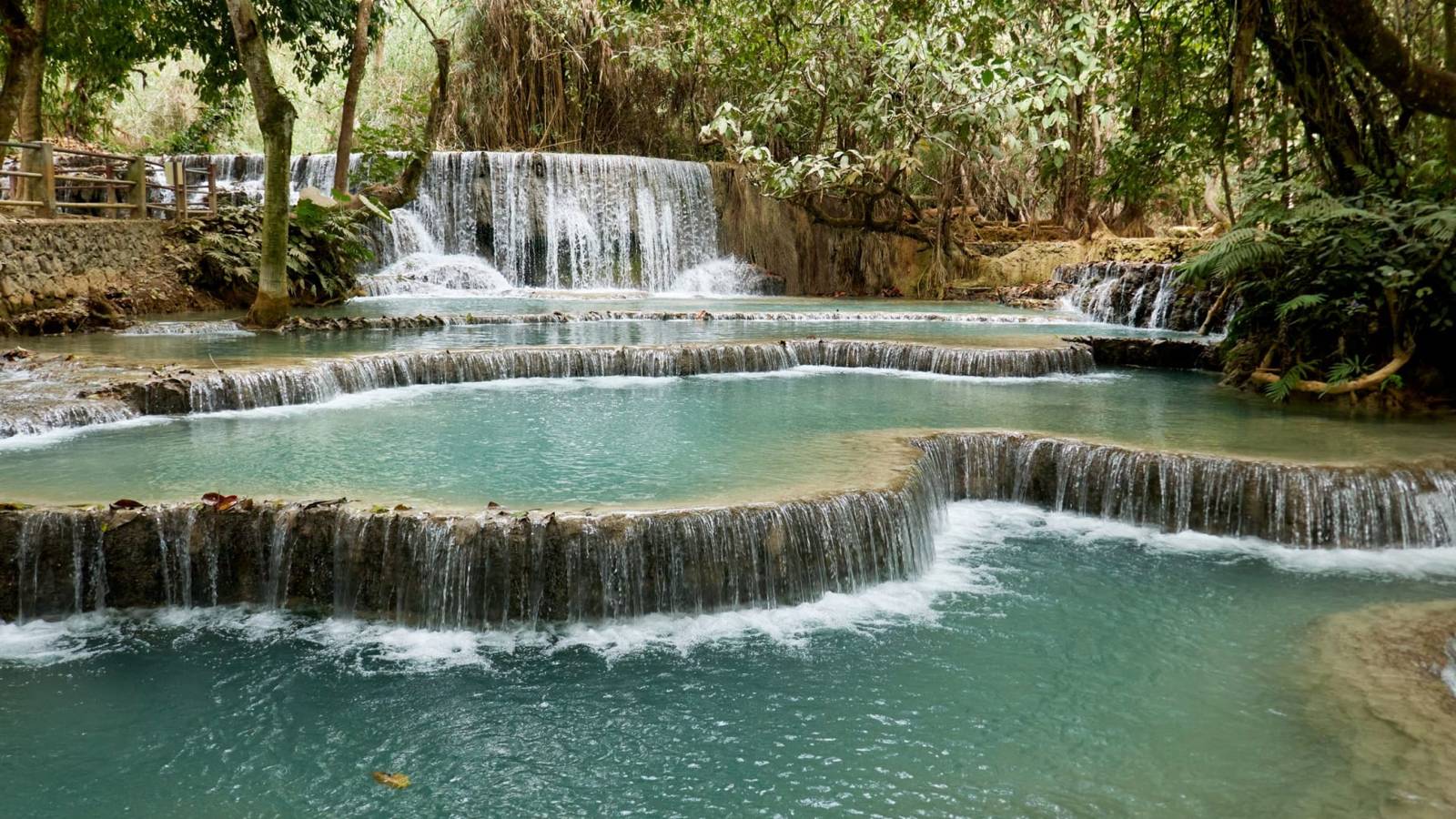
On most Southeast Asia routes, Laos is the stopover: the country between Thailand and Vietnam that you “just pass through”. Anyone who has actually been knows how wrong that is.
Laos has no tropical islands, no megacity like Bangkok and no sea of scooters like Vietnam. What you get instead: endless green mountain ranges, small villages, the Mekong, temples, jungle and a pace that is noticeably slow. In some places time genuinely seems to run a little slower, and that is exactly what makes Laos such a good country to travel through.
Laos at a glance
Laos is wedged between Thailand, Vietnam, Cambodia, China and Myanmar, and it is the only country in Southeast Asia without a coastline. The capital is Vientiane, and with around seven and a half million people the country is surprisingly empty for its size.
Large parts of Laos are mountains, forest, rice fields and small communities. Leave the well-known route and it goes quiet fast: no 7-Eleven on the corner, no taxi app that has a car outside in three minutes, and sometimes nobody who speaks English.
Where the charm of Laos comes from
Laos is not about a list of world-famous sights you work through one by one. The charm is in everything around them: the ride through the mountains, the village where the bus stops for no obvious reason, kids waving from the side of the road, the sun dropping behind the Mekong. And that bus ride that was supposed to take “four hours”, where seven hours later you are still sitting in it and nobody seems to find that remarkable.
Laos is unpredictable. And that is exactly why travelling here feels like travelling in the original sense of the word again.
Sabaidee: the people of Laos
One word you hear all the time: sabaidee, hello. Especially in the smaller villages, kids shout it at you from the roadside.
Lao people come across as calm, friendly and a bit more reserved than in the busier tourist areas of the neighbouring countries. Away from the main routes English is far from universal, but that often makes the contact worth more. A few words of Lao, some hand gestures and a translation app get you surprisingly far.
Laos is also more culturally diverse than it looks at first. Dozens of ethnic groups live across the country, each with its own language, clothing and traditions, and in the mountain villages of the north especially, daily life feels fundamentally different from Vientiane or Luang Prabang.
A country that shifts down a gear
Come in straight from Bangkok or Hanoi and you feel the difference immediately: less traffic, less honking, less hurry. Even the capital, Vientiane, looks almost like a quiet provincial town by Asian standards.
A bus leaves later than planned, an order takes a bit longer, and nobody seems too bothered about it. If you are used to a tight schedule that can take some getting used to. But a few days in, you are the one sitting with a drink watching the Mekong, wondering why everything back home is always in such a rush.
Buddhism underneath everything
Theravada Buddhism is everywhere you look: temples, Buddha statues and monks in their unmistakable orange robes. Luang Prabang is where you see it most. Early in the morning, monks walk through the streets in silent lines while locals hand them food.
It is an impressive ritual to watch, but it is not a tourist attraction. If you want to watch or take photos, keep your distance, dress properly and treat the tradition with respect.
That same modesty runs through Lao culture more broadly: shouting or making someone look foolish in public does not fit here. When something does not go to plan, calm and friendliness always get you further than frustration. And while a bikini at the hostel pool is fine, in a village, a shop or a temple you put something on. Relaxed here does not mean anything goes.
The Mekong: the lifeline of the country
You can barely talk about Laos without the Mekong. The river cuts right through the country and forms the natural border with Thailand in several places. For centuries it has been the backbone of transport, farming, fishing and trade.
In the north, boats spend days on it. In Vientiane you look straight across it at Thailand from the promenade. And right down in the south there is an archipelago of thousands of tiny islands in the middle of the river. The Mekong is not just scenery, it is the thread that runs through the whole country.
Slow travel in the most literal sense
Laos is made for slow travel, and the famous slow boat down the Mekong is the best proof of that. You can always travel faster. The question is why you would want to.
Hours on the river, staring out of a bus window at mountains that just keep coming, staying an extra night because a place simply suits you: that is what backpacking Laos is. This is not a country where you leave early every morning to tick off as many highlights as possible.
How the stops fit together is in our route along the Mekong, and the slow boat itself, the best-known boat trip in the country, is on our Huay Xai page, where it leaves from. Which other connections there are is in getting around Laos.
Traces of a colonial past
Laos was once part of French Indochina, and that history is still easy to see, especially in Luang Prabang and Vientiane, with colonial buildings and French touches in the architecture. It makes for some striking combinations: a Buddhist temple next to a nineteenth-century French building, with scooters riding straight between them.
A history that deserves your attention
Behind the calm streets there is a heavier history too. During the Vietnam War, Laos was bombed intensively for years, and there is still unexploded ordnance (UXO) in the ground in rural areas. For travellers the rule is simple and important: stay on marked paths and never ignore a warning sign. Keep that rule in mind and there is little to worry about, but it is part of the story of this country.
Mountains, jungle and villages as far as you can see
Where Thailand makes you think of beaches, Laos is almost the opposite: green, and then very green. In the north especially you find high mountain landscapes, limestone rock formations, jungle and valleys full of small villages.
On some routes you sit in a bus or minivan for hours while the view just keeps going, and those are often the best moments of the trip: head against the window, watching the landscape roll past.
Beyond the well-known route
In places like Luang Prabang and Vang Vieng, Laos is pretty well set up for travellers. Ride a little further out and the scene changes fast: wooden houses, local shops, kids playing by the road, cows and chickens wandering across the street.
Life in a lot of places is simpler than most visitors are used to, and that contrast is exactly what makes Laos interesting. You often need no special activity at all to feel like you are seeing something genuinely different.
And yet Laos is changing fast
At the same time, this is not a country standing still. The clearest example is the modern railway that runs through it. Where travellers used to spend hours on winding mountain roads between Vientiane, Vang Vieng and Luang Prabang, you now get on a fast train.
That makes for some almost absurd contrasts: you ride past small villages and rice fields, and a few hours later you are standing in a huge, brand-new station. Investment from neighbouring China is more and more visible along the way.
Travelling on a budget
Laos is still very doable on a backpacker budget. Hostels, guesthouses and local transport are generally affordable. The currency is the Lao kip (LAK), so expect to pay in amounts that run into the hundreds of thousands. Cash stays useful, especially outside the bigger tourist spots. What a day here costs, broken down by place, is in backpacking Laos: cost per day.
When to go
Laos roughly has a dry season and a rainy season. November to February is the most pleasant stretch: drier weather and comfortable temperatures. March to May gets properly hot. In the rainy season the country turns intensely green and the rivers and waterfalls are at their most impressive, though some roads get a lot less comfortable. Month by month, including the burning season in the north, it is all in best time to visit Laos.
Pi Mai: Lao New Year
Be in Laos in April and you have a good chance of catching Pi Mai, one of the biggest festivals of the year. Just like Songkran in Thailand, water plays the lead role and the streets turn into spontaneous water fights. A proper waterproof phone pouch is not an optional extra that week.
Why Laos is so often underrated
Laos is not the country you write the longest bucket list for before you go. And that is precisely why it surprises so many travellers. It is not about that one famous temple or that one well-known beach. The whole country is the experience: the long ride between two stops, the view from the bus, an unexpected evening with other travellers, a village where nobody speaks English, the Mekong, the mountains, and above all the realisation that things are allowed to go a bit slower.
What sets Laos apart
Thailand you travel through without effort. Vietnam is busy, chaotic and full of famous stops. Laos feels different: calmer, rawer, greener, less polished.
Sometimes things do not go to plan. Sometimes a bus ride takes three hours longer than promised. And sometimes you arrive somewhere, wonder what on earth there is to do, and three days later you do not want to leave.
The five experiences that capture that feeling best are in best things to do in Laos. And what else is useful to know before you go: Laos etiquette and food in Laos.
Want to plan from here? Our Laos page puts the eight stops in order, with the hostels and the daily budget for each one.
How do you get the most out of a trip through Laos?
Step out of the backpacker bubble on purpose at least once during your trip.
Laos has a lot of different ethnic groups, traditions and villages, and you see far more of them away from the usual backpacker spots.
Stop in a small village on the way, buy something from a local shop or sleep in a local guesthouse. Not to look at people as a tourist attraction, but to get a small sense of what daily life in Laos actually looks like. Ask before you take photos and respect local customs.
Chances are that exactly that kind of unplanned moment ends up leaving a bigger impression than the most famous highlight of your trip.


