
Travelling through Laos often feels like an adventure in itself. The pace is slower than in the neighbouring countries, and that is a big part of the charm. But something has changed in the last few years: the Laos-China Railway now cuts straight through the north, and what used to be a day bouncing along a mountain road now takes an hour.
That makes the choice an interesting one. You can get from Vientiane to Luang Prabang in two hours by train, or spend two days on the Mekong on the slow boat. Both are good, and they give you a completely different trip. And in the south, where there are no tracks, the night bus is still how you get around.
Below, transport by transport: what it does, what it costs and what to watch out for, plus how the border crossings into Thailand, Vietnam and Cambodia work. The full route, with the journey from each stop to the next, is in our Laos itinerary.
The fast train: the north in hours, not days
The Laos-China Railway is the fastest and most comfortable way to travel in the country. From Vientiane you are in Vang Vieng in an hour and in Luang Prabang in about two, for around €13. Vang Vieng to Luang Prabang is an hour as well. That is a huge difference from the bus, which takes five to six hours over the same mountain road.
One thing to plan for: the stations are outside the towns. In Vang Vieng it is six kilometres out, so count on a shared minibus in, and in Vientiane and Luang Prabang the train does not stop in the centre either. Add that to your travel time. And book ahead, because the train is popular and seats are limited.
Our verdict: take the train between Vientiane, Vang Vieng and Luang Prabang, and allow an extra half hour for getting to and from the station
The slow boat: two days on the Mekong
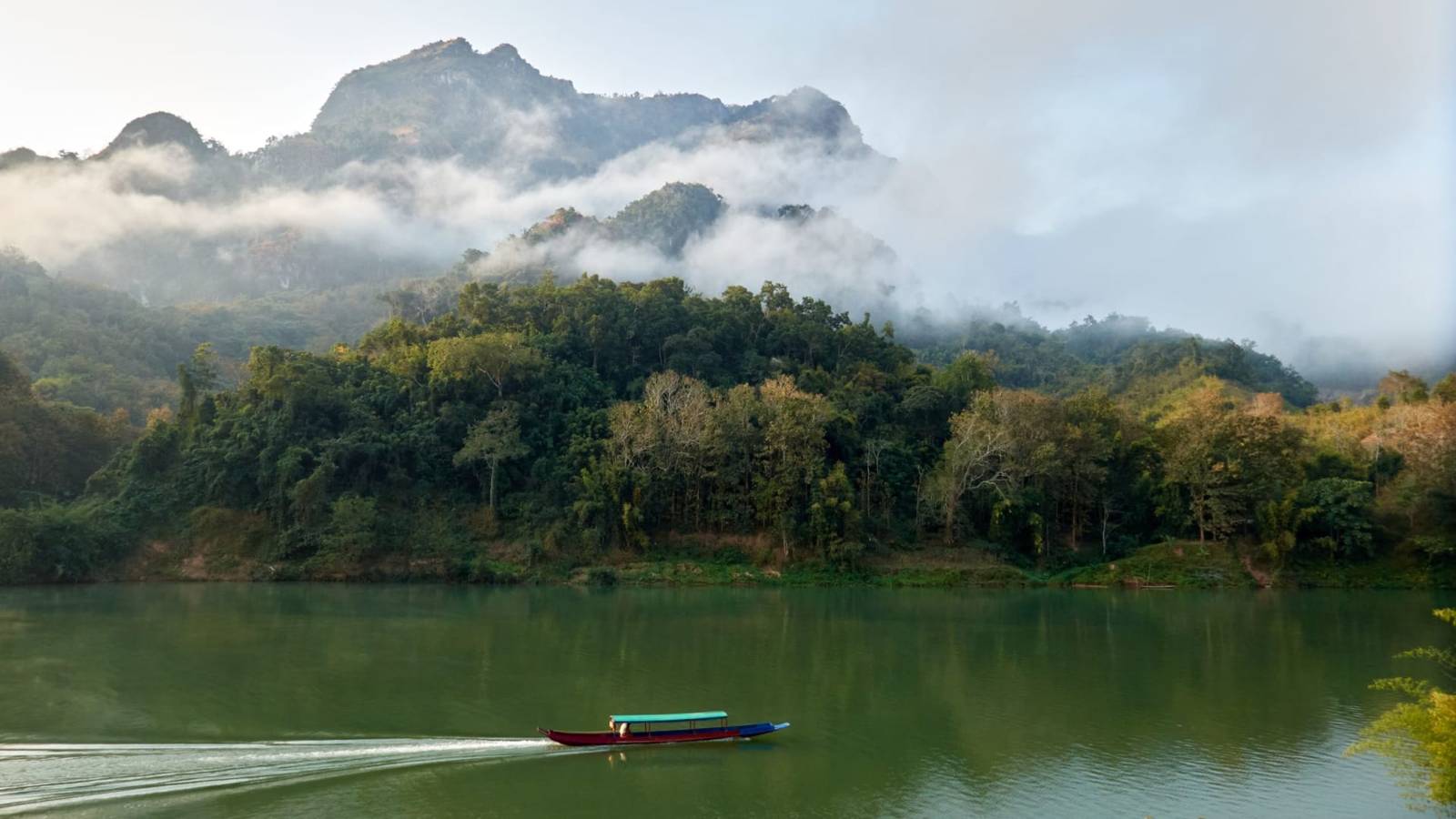
Coming in from Thailand at Huay Xai? Then the slow boat to Luang Prabang is the classic way to arrive in Laos. Two days on the river, with a night in the village of Pakbeng, and hills, villages and water buffalo drifting past the whole way. It is not efficient transport. It is the reason people take this route.
Do come prepared. Buy your ticket at the official office, not from a middleman. Stock up on enough food and water for two days, because what they sell on board is expensive and runs out. And bring a cushion or a jacket, because the benches are hard. Also, do not count on the boat leaving on time: departure times are flexible here.
There is also a speedboat that does it in one day. We would not get in it: it does sixty kilometres an hour down a river full of rocks. If you take it anyway, wear a helmet and a life jacket. The whole crossing from Thailand is in Chiang Rai to Laos.
Our verdict: the slow boat is one of the best journeys in Southeast Asia, so give it the two days and leave the speedboat to someone else
Bus and minibus: everywhere without a railway
Where the train does not go, the bus does, and that means the whole south and the mountains of the north. From Luang Prabang the minibus takes about three hours to Nong Khiaw, winding but paved, and the view on the way is worth the ride on its own. Nong Khiaw to Oudomxay is also about three hours. From Huay Xai, buses run overland to Luang Namtha in four hours and Oudomxay in six.
The south is night bus country. From Vientiane the bus takes about six hours to Thakhek and about ten to Pakse, and Thakhek to Pakse is six hours too. From Pakse the minibus takes about three hours to Nakasang for the 4000 Islands, and from there a longtail gets you to Don Det in ten minutes.
The old bus over the mountain road between Vang Vieng and Luang Prabang still runs and takes five to six hours. Slow, but spectacular, so if you have the time and want the view, it is a choice worth making on purpose.
Our verdict: the bus for the south, and in the north only when that mountain road is exactly what you want to see
Flying: only for the big jumps
Laos is small enough to do overland, but there are flights. Luang Prabang and Vientiane both have direct connections to Bangkok, Hanoi and Chiang Mai. Pakse has a small airport with flights to Vientiane and Siem Reap, which is handy if you want to carry on from the south into Cambodia without the long bus day.
Our verdict: you will rarely fly within Laos, but Pakse to Siem Reap saves you a whole day
The scooter: Thakhek and the Bolaven
Two places in Laos are all about the scooter, and both are multi-day loops. From Thakhek you ride the loop past the Kong Lor cave, where a longtail takes you seven and a half kilometres straight through the mountain. From Pakse you ride the Bolaven Loop past the waterfalls and the coffee farms. Count on about €8 a day, and in Thakhek get a semi-automatic, which handles those roads better.
Sort out the practical side first. Laos recognises the 1949-convention international driving permit alongside your own licence, and without the right category your travel insurance does not cover you. The rental shops in Pakse store your big bag while you ride the loop, so you can set off with a small one. Take photos of the scooter before you ride off, and keep your helmet on.
For short distances you can rent a scooter elsewhere too. In Vang Vieng it costs about €6 a day and gets you out to the lagoons and the caves; a bicycle does the job there as well, and costs a lot less.
Our verdict: rent a scooter for Thakhek and the Bolaven, and in Vang Vieng for when you want to go further than the first lagoon
In the city, the village and on the island
Distances within the places themselves are small. In Luang Prabang the old town is mostly car-free and everything is walkable; for the Kuang Si falls you take a shared tuk-tuk or minibus, about €5 return. Vientiane is compact and flat, which makes it ideal for cycling. Tuk-tuks there often quote tourist prices, so agree the fare first or use the LOCA app. Count on around €2 for a tuk-tuk ride.
In the villages you need nothing at all. Nong Khiaw is one street with a bridge that you walk across in ten minutes, and for the river you take a longtail from the pier; Muang Ngoi is an hour upstream. On Don Det there are no cars: you walk or you cycle, and Don Det and Don Khon are joined by a bridge.
Our verdict: cycle in Vientiane and on Don Det, and agree the price before every tuk-tuk
The borders: getting in and out of Laos
From Thailand there are two standard routes. In the north the Friendship Bridge runs from Chiang Khong to Huay Xai, where you get a visa on arrival: cash, preferably in US dollars, because they do not take cards. Do not change money at the border itself, because the rate there is poor. Near Vientiane the Friendship Bridge to Nong Khai is twenty-five kilometres out of the city, a bus runs across it, and on the Thai side the night train to Bangkok connects, about eleven hours. From Thakhek you cross to Nakhon Phanom over the third bridge, and from Pakse the minibus takes about three hours to Ubon Ratchathani.
Vietnam is over the mountains, and that takes time. From Thakhek the bus runs via the Cha Lo border towards Phong Nha, a long day but the shortest route into central Vietnam. From Nong Khiaw you go via Oudomxay and Dien Bien Phu, two long days, and from Pakse via the Bo Y border.
For Cambodia you leave Don Det on a combined ticket: boat, minibus and the border at Nong Nok Khiene. Expect a long day to Kratie or Siem Reap.
Our verdict: plan every border day as a full day, and make sure you have US dollars in cash on you
How to book it
Carry more cash than you think you will need, everywhere. In the small towns and on the islands almost everything is cash only, and that goes double at the border crossings.
Fast train or slow boat in Laos?
They do not do the same job, so it is not really a choice between two options. The fast train runs between Vientiane, Vang Vieng and Luang Prabang and is pure transport: two hours instead of a day, for around €13. The slow boat runs between Huay Xai and Luang Prabang and is the experience itself: two days on the Mekong with a night in Pakbeng.
Coming in from northern Thailand? Take the slow boat, because that is what the route is for. Heading south after that? Take the train, because otherwise those mountain roads cost you two travel days you would rather spend in Vang Vieng or Luang Prabang. Do both, and you see Laos at its best.


