
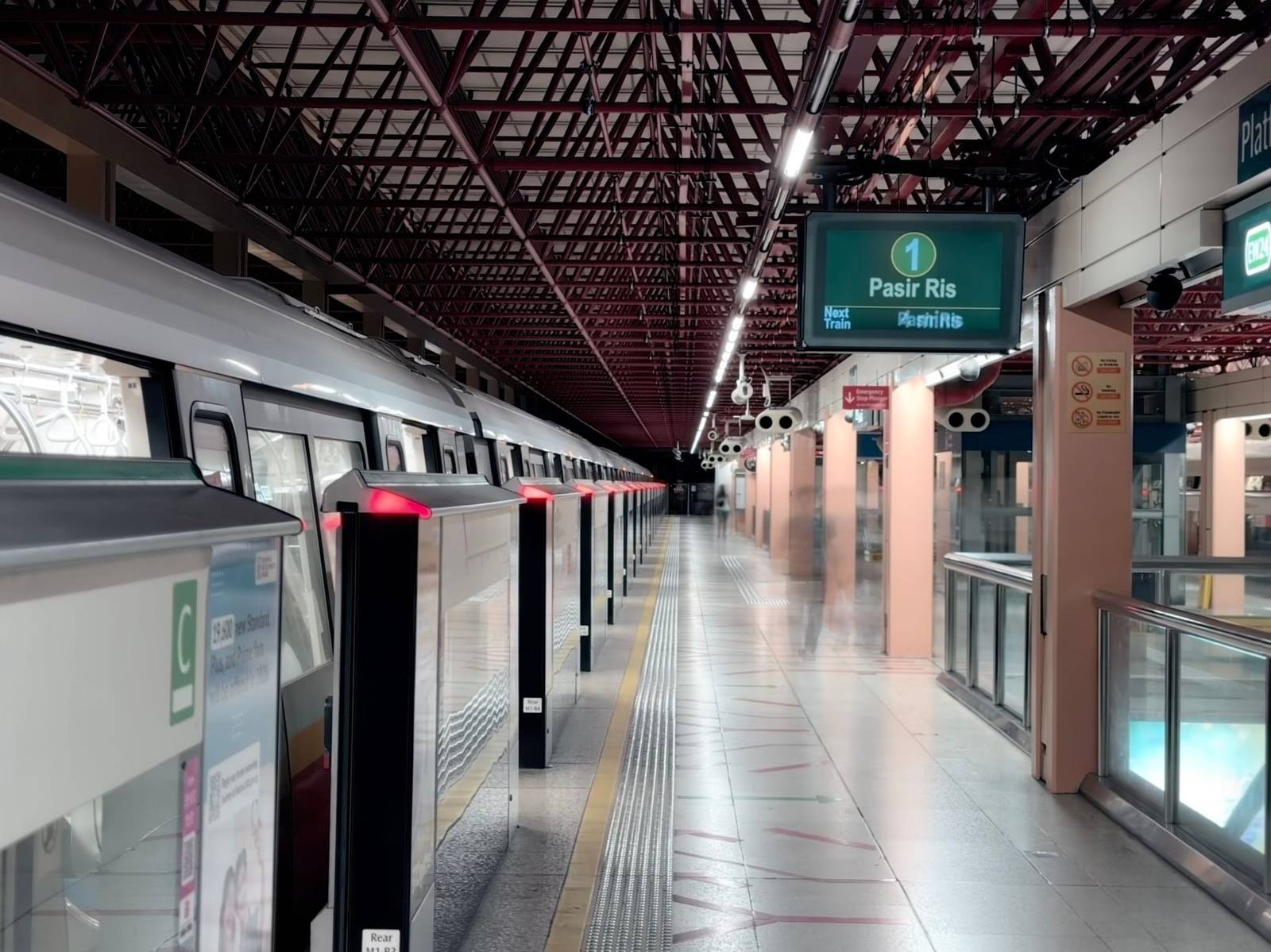
You land at Changi, walk up to the MRT gate and hold your own bank card against it. Beep, open. No ticket desk, no ticket, no fumbling for change. Half an hour to 45 minutes later you step out in Chinatown, off a train so cool you briefly forget how hot it is outside.
That is how getting around Singapore works almost everywhere. The whole country fits inside one city, the metro goes nearly everywhere, and what the metro misses, the bus or a Grab picks up. All you have to learn is a handful of rules, because on the train they really do apply.
The exciting part starts at the edge of the city. Across the Causeway lies Malaysia, five minutes away by train, and from there buses and trains run on to Melaka, Kuala Lumpur and the port for Tioman. Below is what each type of transport does, what it costs and when it wins.
From Changi into the city
The MRT gets you from the airport to the centre in half an hour to 45 minutes, changing at Tanah Merah, for about €1.50. A Grab to Chinatown is €20 or more, worth it mainly if you land in the middle of the night or split a car four ways.
Only got a layover? Then you do not even have to leave the airport. Jewel, the building opposite Terminal 1, with its 40 metre Rain Vortex, is free to visit, and your bag can go in the baggage storage. Five and a half to 24 hours between flights? Then transit passengers can hop on the Free Singapore Tour, a free bus ride past the skyline, as long as the SG Arrival Card is done. How to plan a day like that is in our Changi stopover guide.
Our verdict: take the MRT unless you land after midnight, and save the Grab for the way back with a full backpack
The MRT: tap in with your own bank card
The metro is the only transport you really need in Singapore. It is fast, cool and cheap: a ride costs about €0.90 to €1.80. You do not need to buy a ticket. Hold your own contactless bank card, credit card or phone against the gate when you get on, and the same card again when you get off. So do not switch cards or phones halfway, or the gate has no idea where your ride started.
Covered walkways link many of the stations, so even in a thunderstorm you get from the train to the mall without getting wet. Chinatown and Maxwell stations sit right in the middle of backpacker land, and Bugis and Little India take you to the other side of the centre. For Gardens by the Bay get off at Gardens by the Bay or Bayfront, for Sentosa at HarbourFront.
Now the rules. On the metro and the bus you cannot eat or drink, not even a sip of water, and the fines are steep. Durian, the famously smelly fruit, is not allowed on public transport. It sounds strict, but you see the result straight away: a metro without a single crumb on the floor.
Our verdict: the best metro in the region, and with your bank card in your hand you get everywhere without ever buying a ticket
The bus: for the places between the stations
The bus costs the same as the MRT and you pay the same way, by tapping your card on the reader. You mostly need it for the far corners. To Changi Point Ferry Terminal, where the bumboat to Pulau Ubin leaves, you take the bus from Tanah Merah. For the Night Safari up north you combine the MRT and a bus too: allow an hour.
Staying in Joo Chiat or Katong? The bus or the MRT from Paya Lebar gets you to the centre in twenty minutes. And if you want to reach the border without the train, buses CW2 and 170 run up to the Causeway too.
Our verdict: handy for Pulau Ubin and the Night Safari, and the rest of the time the MRT does the job
Grab: the taxi with a fixed price
In Singapore too, Grab is the app for taxis: you see what you pay up front, there is no haggling, and it runs at night as well. For an ordinary ride across town the MRT is a lot cheaper, so you use Grab for what the metro does not do. A late ride to your hostel, an early flight, or a bus terminal you do not fancy changing to with your backpack on. Install the app before you land and you can book straight away.
Our verdict: your ride after the last metro, and before that you will rarely need it
Walking, cycling and the boardwalk
Singapore is smaller than you think, and many of the best bits you do on foot. From Chinatown it is a twenty minute walk to Marina Bay, and Tiong Bahru is ten minutes away. From Kampong Glam to Little India takes a quarter of an hour. The loop around the bay, past the Merlion and the Helix Bridge, takes about an hour and costs nothing.
Getting to Sentosa costs nothing either: from HarbourFront you walk through the VivoCity mall to the Sentosa Boardwalk and straight onto the island. Not in the mood to walk? Take the Sentosa Express for about €3. On the island itself, free shuttle buses run past the beaches. The cable car is the luxury way in.
On a bike the city gets even bigger. Hire one at Betel Box in Joo Chiat and ride the East Coast Park cycle path along the sea to Marina Bay. Rather have someone explain what you are looking at? A guided bike tour takes you past the bay, the colonial centre, the river and the old neighbourhoods in a few hours.
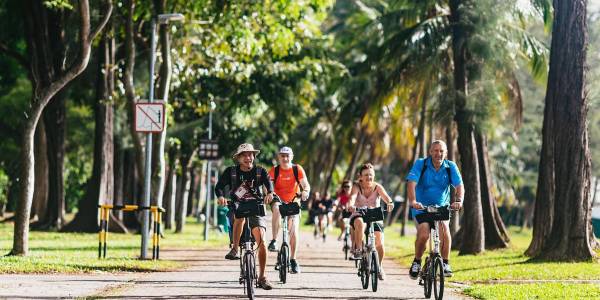
Our verdict: walk the centre, and take the boardwalk to Sentosa instead of the ticket desk
The bumboat to Pulau Ubin
This is the most fun ride in Singapore, and it costs next to nothing. From Changi Point Ferry Terminal a bumboat takes ten minutes to Pulau Ubin, for S$4 per person, about €3. It leaves as soon as it is full, so you do not need a timetable. Do bring cash, because the boats and the bike hire on the other side much prefer it. A bike for the day costs about €6 to €10, and on it you ride the sandy tracks to Chek Jawa.
Our verdict: the cheapest day out from the city, and the only transport in Singapore you need cash for
Across the border to Johor Bahru
Malaysia is just across the Causeway at Woodlands, and you have two ways to cross.
The KTM Shuttle Tebrau
Our favourite. This train runs from Woodlands to JB Sentral in Johor Bahru in five minutes, for S$5, about €3.50, and it glides straight past the traffic jam on the road next to it. At JB Sentral you change to the ETS train heading north.
Its days are numbered, though. The RTS Link, a short metro on the same stretch between Woodlands and Johor Bahru, is set to open in February 2027, and the Shuttle Tebrau stops running around six months after that. Check which of the two you need before you travel.
By bus to the border
Bus CW2 or 170 takes you to the border at the Causeway for a few euros. That works fine as long as the road is quiet. Not on a Friday evening, a weekend or a public holiday, though: then the Causeway jams solid and the crossing can cost you a few hours.
However you go, coming in or leaving overland still means a border post. If you enter Singapore overland you fill in the SG Arrival Card in advance, just like at the airport, and at Woodlands, one of the busiest checkpoints in the world, a card that is already done gets you through the queue a lot faster. Everything else that comes with the border is on our visa page.
Our verdict: take the Shuttle Tebrau while it runs, and plan your Causeway crossing for any time but a Friday evening
On to Melaka, Kuala Lumpur and Tioman
From Singapore the whole Malay Peninsula lies open, and each of the three classic next stops has its own route.
To Kuala Lumpur
Two options. The direct bus takes you to Kuala Lumpur in five to six hours without a change, in a comfy coach for €14 to €30. The fastest way when the traffic is bad is the train: the Shuttle Tebrau to JB Sentral, then the electric ETS train to KL Sentral, running since December 2025, in about four and a half hours from about €16. With just a few trains a day, it pays to book several days ahead. What to do once you are there is on our Kuala Lumpur page.
To Melaka
To Melaka the bus goes direct, in four to five hours from about €18. You arrive at Melaka Sentral, because the town has no train station, and a Grab gets you to the old town in fifteen minutes for about €2. If you want to work your way north slowly, this is the loveliest first stop. Everything about the town itself is on our Melaka page.
To Tioman
Want to hit the beach straight away? Take the early bus to Mersing, about four hours. From there the ferry takes an hour and a half to two hours to Tioman, for about €12 to €17, plus about €6 in cash for the marine park. Departure times depend on the tide, so leave yourself an hour or two of slack. And from November to February, during the monsoon, the ferries run far less often. On the way back: do not carry duty free booze from Tioman into Singapore, because you pay Singapore duty on it anyway.
Our verdict: the bus for Melaka, the train via Johor Bahru for Kuala Lumpur, and an early start for Tioman
Every connection at a glance
| From | To | How | Travel time | Fares from |
|---|---|---|---|---|
| Changi | city centre | MRT, change at Tanah Merah | 30 to 45 minutes | €1.50 |
| Changi Point | Pulau Ubin | bumboat | 10 minutes | €3 |
| Woodlands | JB Sentral | KTM Shuttle Tebrau | 5 minutes | €3.50 |
| JB Sentral | KL Sentral | ETS train | about 4.5 hrs | €16 |
| Singapore | Kuala Lumpur | direct bus | 5 to 6 hrs | €14 |
| Singapore | Melaka | direct bus | 4 to 5 hrs | €18 |
| Singapore | Mersing | bus | about 4 hrs | |
| Mersing | Tioman | ferry | 1.5 to 2 hrs | €12 |
Flying from Changi
You do not need a plane for Singapore itself, but Changi is your gateway to the rest of the region. Long-haul flights come straight into Changi, and from there a budget flight takes you to pretty much any city in the region. That makes Singapore a smart place to start: land here, spend a few days getting used to the heat, then travel north overland. Or do it the other way round, and finish with an afternoon in Jewel before your flight home.
When you book, keep your passport in mind: it should still be valid for six months on the day you leave Singapore, and on arrival you can be asked for a ticket for your onward journey. Most nationalities get up to 90 days visa free, Canadians 30. Check yours on our visa page.
Our verdict: fly into Singapore and carry on overland, and you see two countries for the price of one plane ticket
How to book it
In Singapore you pay for almost everything contactless, from the metro to plenty of hawker stalls. Which card to bring is on our travel cards page. With an eSIM you have internet for Grab and the map the moment you land. When the weather plays along on both sides of the border is in the best time to visit Singapore.
Do you need a transport card in Singapore?
No. You tap in and out on the MRT and the bus with your own contactless bank card, credit card or phone, so there is no ticket or top-up card to buy. Just use the same card going in and coming out. A ride costs about €0.90 to €1.80, and from Changi you are in the centre for about €1.50.
Grab is only for when the metro has stopped or you need to get a heavy backpack to a bus terminal. Cash is mostly for the bumboat to Pulau Ubin and the older hawker stalls. And if you are carrying on into Malaysia, take the Shuttle Tebrau to Johor Bahru while it runs: five minutes and you are across the border, even on a Friday evening, when the buses sit in the jam on the Causeway.


