
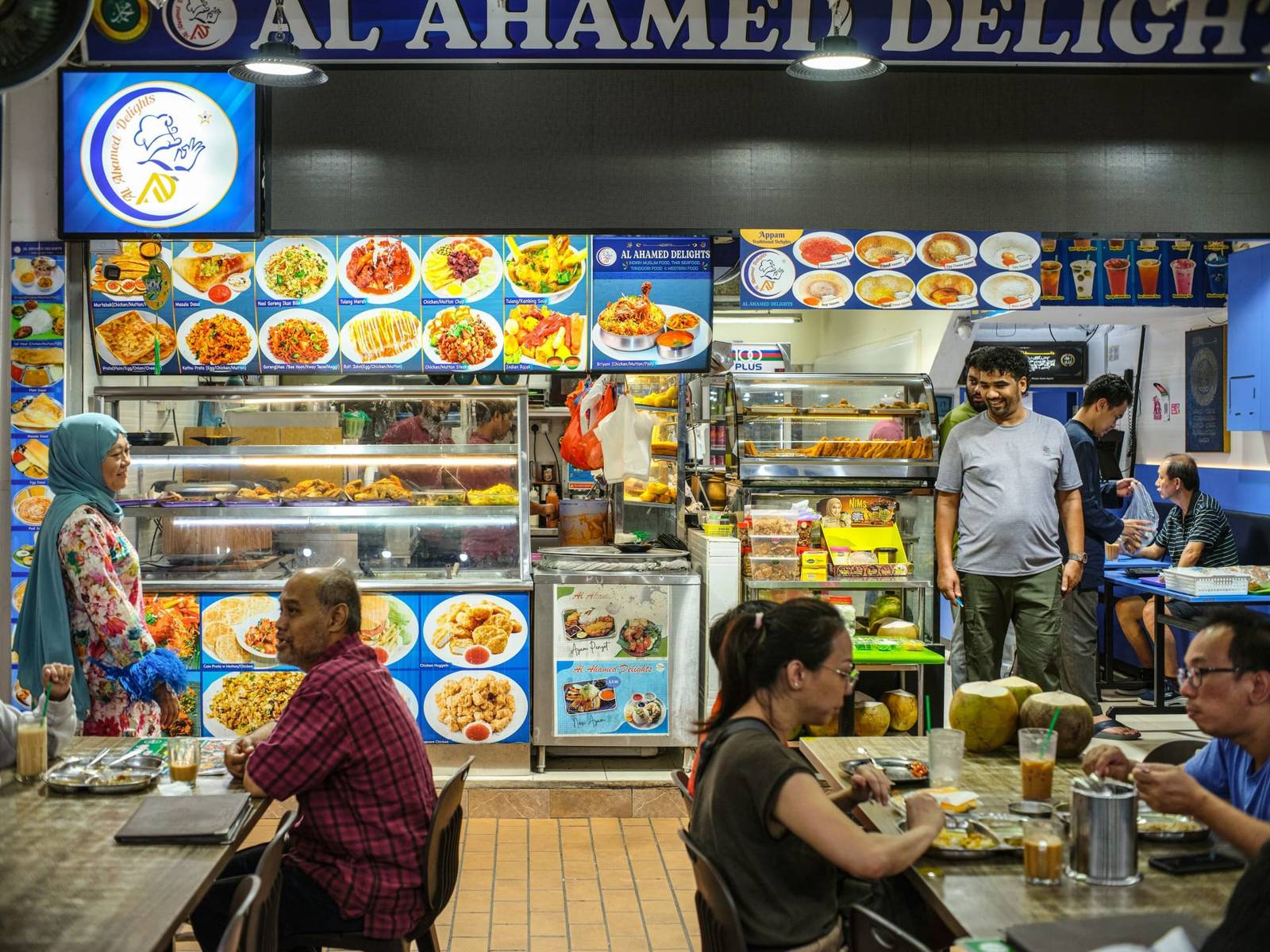
Around lunchtime Maxwell Food Centre is a madhouse. Office workers, grandads and students all squeeze in at the same plastic tables, and every empty seat has a packet of tissues on it. Your plate of chicken rice costs about three euros. It is the best thing you eat all day.
Food in Singapore does not mean restaurants, it means hawker centres. That is not a budget trick, it is how the whole country eats. Chinese, Malay, Indian and Peranakan Singaporeans have been cooking side by side for generations, and in one hall full of stalls you taste all four cuisines in an afternoon. Since 2020 hawker culture has even been on UNESCO’s list of intangible heritage.
It is good news for your budget too. A bed and a beer are expensive in this city, but your food is not. Below is how a hawker centre works, which halls to know, which dishes you have to order, and what to drink in a city where beer is a luxury and the tap water is perfectly fine.
How a hawker centre works
A hawker centre is a covered hall full of stalls, with tables in the middle where everyone sits together. Each stall makes one or two dishes, often for decades, sometimes for generations. There are more than a hundred of them spread across the city, so wherever you sleep, there is one round the corner.
Now the most important ritual. See a packet of tissues on a table or a chair? That seat is taken. It is how Singaporeans claim their table before they join the queue, and from now on you do it too. So always carry a packet. When you are done, take your tray back to the rack yourself.
Torn between two stalls? The rule of thumb is simple: join the longest queue. A line of locals is the best review a stall can get. Two more things. Some stalls close one day a week, so if your favourite has its shutters down, come back tomorrow. And plenty of stalls take contactless, but the older ones prefer cash: keep a few Singapore dollars in your pocket.
Our verdict: tissues in your bag, the back of the longest queue, and your tray back to the rack yourself
The hawker centres you need to know
Maxwell Food Centre
Right in Chinatown, walking distance from most hostels, and the place for your first chicken rice. Coming by MRT? Get off at Maxwell and you are practically at the door. Go just before or after the lunch rush and you have your pick of the tables.
Chinatown Complex
Chinatown’s second hawker centre, and like Maxwell an easy walk from your hostel. Wander through without a plan: point at whatever looks good on the next table and order that.
Lau Pa Sat and Satay Street
Lau Pa Sat stands between the office towers, and by day the people from those towers have lunch here. But you come for the evening. That is when the street next to it closes to traffic, the grills fire up and it becomes Satay Street.
Tekka Centre
Little India’s hawker centre, and the place to eat Indian food off a banana leaf. Start your morning here with roti prata, then walk through Little India to Kampong Glam, and your day is sorted.
Tiong Bahru Market
In the city’s hippest neighbourhood, between the white art deco flats, is the market where the locals queue in the morning for chwee kueh and kopi. Come early and have breakfast the way the neighbourhood does.
Our verdict: Maxwell for your first lunch, Satay Street for your first evening, Tekka Centre for your first breakfast
Singapore food you have to try
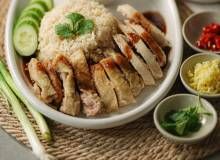
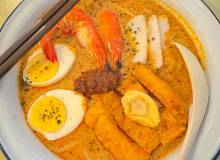
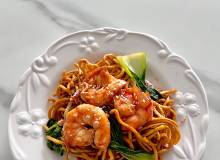
Hainanese chicken rice: our number one
The national dish, and the most deceptive plate in the city. Poached chicken, fragrant rice, chilli sauce. That is it. You think there is nothing to it, until the first mouthful, and then you get why people queue at Maxwell for one particular stall. Order it on your first day, and again after that.
Katong laksa
The laksa of the east: a creamy coconut curry with noodles that in Katong you eat with just a spoon. Eat it where it comes from, in Joo Chiat and Katong, among the mint green and pink Peranakan houses. Pair it with an afternoon wandering those streets and you have one of the best afternoons of your trip.
Hokkien mee and char kway teow
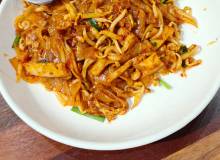
Two noodle dishes from the wok, and both at their best when the cook has been at it for years. Hokkien mee is fried with prawns and squid, char kway teow is flat noodles fried in the wok. Pick your stall by the queue, not by the board with photos.
Satay
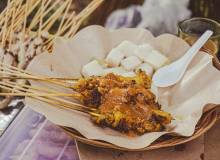
Skewers off the charcoal grill with peanut sauce, and an evening dish. On Satay Street at Lau Pa Sat you eat them at a table full of travel mates with the office towers all around you. After a day in the heat, this is exactly the right dinner.
Bak kut teh
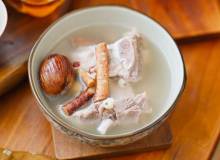
A peppery broth with pork ribs. Sounds like something for a cold winter’s night, and yet Singaporeans happily sit down to it at 31 degrees. Do as they do.
Banana leaf rice and roti prata
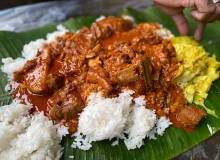
Little India eats differently. With banana leaf rice your rice and curry come on a banana leaf instead of a plate, and the best in the city is in this neighbourhood. Roti prata is breakfast at Tekka Centre: Indian flatbread with curry on the side.
Our verdict: chicken rice at Maxwell and a Katong laksa in Joo Chiat, after that the rest of the list in any order you like
Breakfast like a Singaporean
Breakfast in Singapore is a ritual, and you have it down after one go. Order kaya toast: toast with butter and kaya, a sweet coconut jam. With it come two soft boiled eggs in a little bowl: add a splash of soy sauce, stir and dip your toast in. Then the kopi, strong coffee with condensed milk, so sweet that one sip has you wide awake.
Want to do it properly? Head to Tiong Bahru. At the market the locals queue in the morning for chwee kueh and kopi, and afterwards you walk straight on to the neighbourhood’s coffee bars and bookshops. There is no better start to a day in Chinatown.
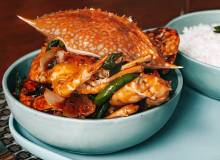
Chilli crab: your one big feast
Chilli crab is the dish Singapore is famous for, and the only one on this list that is not a budget meal. You eat it in a restaurant, the crab is priced by the kilo, and it comes in a spicy tomato sauce. Order fried buns on the side to mop up the sauce, because honestly that is the best bit.
The smart way is with a group. Share one crab with a few people from your hostel, and it stays affordable and you have your evening sorted.
Our verdict: splash out once, with a group and with buns on the side
What to drink in Singapore
Kopi, lime juice and tap water
Every meal in a hawker centre comes with something cold. A glass of fresh lime juice costs about a euro, and after a day in the heat it is the best thing you can order. And you can drink the tap water everywhere: bring your own bottle and refill it, which saves money and plastic.
Beer, and why it is expensive
Singapore taxes alcohol hard, and you notice. The cheapest beer in town is a big bottle of Tiger at the hawker centre, for about €6. In a bar one glass easily sets you back €8 to €12, and more on a rooftop. Hunt down the happy hours, or simply drink your beer at the plastic table with your dinner, like the locals do.
Fancy a night out? On Haji Lane in Kampong Glam you sit among the murals with a drink, and around Club Street and Ann Siang Hill in Chinatown the bars are packed close together. On Sentosa you watch the sunset with a drink on Siloso Beach.
Crossing into Malaysia afterwards? Then your bill halves. In Melaka and Kuala Lumpur a beer is about €3 and a hawker plate about €2. More on that in food in Malaysia.
Our verdict: lime juice with lunch, a Tiger at the hawker centre with dinner, and save the rooftop for one night
What food costs
A dish in a hawker centre costs about €3 to €4. That makes eating at the hawker centre three times a day one of the cheapest things you do in Singapore, and it is still the tastiest food in the city. Our daily budget of €55 covers that easily.
Going to a restaurant for once? Check the price on the menu: a ”++” after it adds a 10% service charge and 9% GST to the bill, and nobody expects a tip on top. What a whole day here costs is in backpacking Singapore: cost per day.
A food tour on your first evening
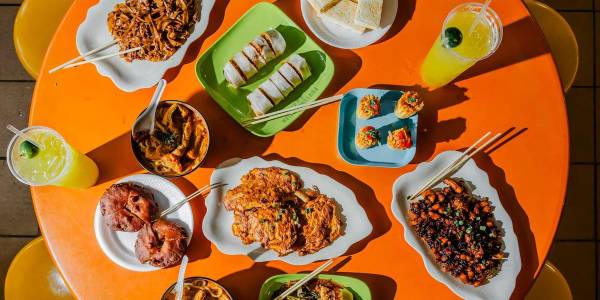
You can wander from stall to stall on your own, but with a guide you eat more in one evening than you would have ordered in three days. On this tour you try more than twelve things, including dishes you would never have pointed at yourself.
Our verdict: the smartest start if you only have a few days, and for the rest of the week you know exactly which stalls to hunt down
How to behave in the hawker centre and in the rest of the city is in Singapore etiquette. Where to spend the rest of your days is in things to do in Singapore.
What food do you really have to try in Singapore?
If you can only pick five: chicken rice at Maxwell Food Centre on your first day, kaya toast with soft boiled eggs and a kopi for breakfast, roti prata at Tekka Centre, a bowl of Katong laksa in Joo Chiat, and satay on Satay Street at Lau Pa Sat when the grills fire up in the evening. That first one is our favourite.
And if you want to splash out once: chilli crab, shared with a group, with buns for the sauce. For everything else the same rule applies everywhere: find the longest queue, put your tissues on the table and join the back.


