
The Philippines is the odd one out in Southeast Asia, and it starts with the map. In Thailand, Vietnam, Laos and Cambodia you get on a bus and a few hours later you get off somewhere else. Here there is water between almost every stop. Seven thousand six hundred and forty one islands, split into three groups that are each a flight apart.
That makes the country pricier and slower than its neighbours, and it is also exactly what makes it so good. The best places can only be reached by boat, and you feel that the moment you arrive: lagoons you paddle into by kayak, beaches with nobody on them, and a reef that starts five metres off the shore.
The Philippines in brief
The country sits east of mainland Southeast Asia, out in the Pacific, and with thirty six thousand kilometres of coastline it has one of the longest in the world. The average daytime temperature is around thirty one degrees and it is warm all year.
The official languages are Filipino, also called Tagalog, and English. That second one is a big difference from the neighbours: almost everybody here speaks good English, which makes the Philippines one of the easiest places in the region to find your feet, especially if it is your first time in Asia. You pay in Philippine pesos.
Why the water decides everything
This is the one thing to get your head around before you start planning. The three island groups are Luzon in the north, with Manila, the Visayas in the middle, with Cebu, Bohol and Siquijor, and Mindanao in the south, with Siargao. Palawan, home to El Nido and Coron, is a long thin strip on the western side.
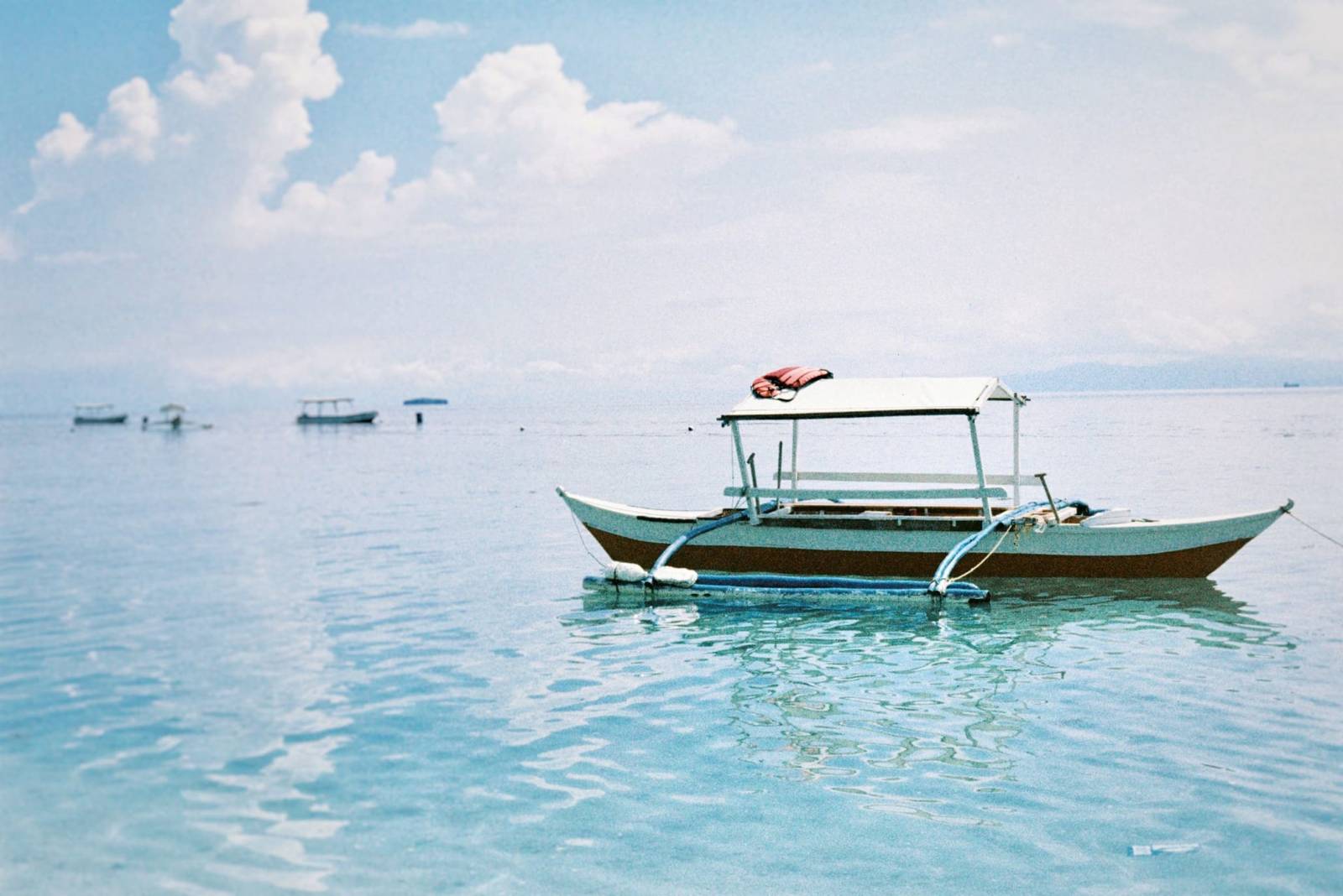
Within a group you get around by ferry and by bangka, the narrow wooden boats with outriggers on both sides. Between the groups you fly. That is why the Philippines, at about €35 a day, is the most expensive country on our route, even though a bed and a plate of food cost barely more than in Thailand.
The practical takeaway is simple: with three weeks, stay within one or two island groups. Whatever you save on flights, you can spend on the water.
When to go
The climate is tropical, with a dry season and a wet one. December to February is dry, sunny and pleasant, and that is the best time for island hopping and diving. March to May is hot and sunny and still great for the beach.
June to November is the rainy season, and it comes with something the neighbours do not have: it is also typhoon season. That does not mean you cannot go, but it does mean you plan differently. The seasons, and why Siargao runs on its own calendar, are on our Philippines page.
Do not fill every day
This is the best advice we have for this country. Delays are part of it: a ferry that stays in because the sea is too rough, a domestic flight that moves, a boat trip that slips a day. And that does not only happen in the rainy season.
So always keep a spare day before your flight home, and do not stack your connections too tightly. A missed connection here costs you an extra night and sometimes a new ticket, so set aside money for that as well as time.
A culture that is nothing like its neighbours
The Philippines was shaped by Asian, Spanish and American influences, and you feel it straight away. More than three centuries of Spanish rule made the country Catholic, with a church in almost every village and fiestas going on somewhere all year round. The American years brought English and basketball, which you see on every village square.
Filipinos are known as some of the friendliest people in the world, and that is not a brochure line. People talk to you, invite you in and take you along, and striking up a conversation is the norm rather than the exception.
Po, opo and Filipino time
A few habits go a long way. Use po and opo as the polite form with anyone older than you: it is two syllables and people notice when you do it. Accept an invitation to eat. And do not expect English everywhere on the smaller islands, where a few words of Tagalog get you further.
Then there is Filipino time, because that is very much a thing. Arrangements are a rough guide rather than a promise, and the boat leaves when it leaves. Getting angry or impatient backfires, and so does criticising someone in front of other people, because losing face is a big deal here too. People would rather not give a blunt no: a friendly maybe later is the answer instead. More in Philippines etiquette.
The food is different, and underrated
Filipino food is less famous than Thai or Vietnamese, which is a shame, because there is a lot to it. The influences are Asian and Spanish mixed together: adobo, meat braised in vinegar and soy sauce, is the national dish. Lechon is roast suckling pig and turns up at every party. Pancit is fried noodles, sinigang a sour soup.
For something sweet there is halo-halo, a mountain of shaved ice with all sorts mixed through it. And on the islands you mostly eat fish: you point at it at the talipapa, the little market, and have it grilled next door. That is almost always the best plate of your day. More in food in the Philippines.
The real highlight is underwater
The Philippines sits right in the Coral Triangle, the area with the richest marine life on earth, and you notice it everywhere. Turtles on the seagrass, coral gardens at snorkelling depth, manta rays and, in some places, sharks.
The best known dive areas are Malapascua, where thresher sharks come up at dawn, Coron with its Japanese shipwrecks, Apo Island and the remote Tubbataha Reef. And Moalboal, where a shoal of millions of sardines hangs just off the beach all year and all you need is a snorkel. The diving section of our Philippines page goes through the sites on our route.
Getting around: flying, boats and the jeepney
Between the island groups you fly, and booking well ahead costs a lot less than sorting it on the road. Within a group you take ferries and bangkas, usually for around €10.
On the islands themselves you rent a scooter, from €6 a day, and it gets you everywhere. In Manila there is the jeepney, the colourful converted army truck that defines the streets, at about twenty cents a ride: the cheapest transport on our entire route. On Boracay ordinary vehicles are banned and you ride an electric trike. It is all laid out in getting around the Philippines.
What a trip here costs
Reckon on about €35 a day across the whole country. On the ground it is not bad at all: Siquijor comes to €18 a day, most islands to €20, and the priciest stops stay at €25 or under. A bed costs €6 to €9 and a meal €2 to €3.
So the difference is not what you spend on the ground but what goes on getting between the islands. That is almost all boats and planes, and it is exactly the part you can control. How it adds up is in backpacking the Philippines: cost per day.
Bring more cash everywhere than you think you will need. The smaller islands have no reliable cash machine, and where there is one it is regularly empty.
Visa: 30 days, and mind your onward ticket
Every passport on our visa page gets up to thirty days in the Philippines without a visa, and you can often extend that in the country.
One thing matters more here than anywhere else: you have to be able to show an onward ticket, and you get asked for it here more often than in the rest of the region. No onward travel booked yet? Then sort out an onward ticket. What applies to your passport is on our visa page.
Why you come back
Nobody finishes the Philippines in one go. The islands are too far apart and there are too many of them, and that is the charm: you pick one corner of the country and do it properly, instead of a lap past all the famous names.
It also makes it a country you cannot tick off. The travellers who got the most out of it are nearly always the ones who stayed on one island longer than planned, because the boat was not going anyway or because they simply liked it there.
Is the Philippines a good first destination in Asia?
Yes, and on one point it is even easier than the neighbours: almost everybody speaks English. You never have to mime your way through sorting out a bus or a room, and that saves a lot of hassle at the start.
Where it is harder than Thailand or Vietnam is the logistics. There is no obvious through route here, because every stop needs a boat or a flight, and you have to arrange those in advance. For a first trip we would stay within one island group: just Palawan or just the Visayas is a complete trip of two to three weeks, and suddenly the planning is easy to keep track of.
Also give yourself more time than you think you need. Thirty days visa free sounds like a lot, and on a map with seven thousand islands it is not. How to string the stops together is in our Philippines itinerary, and the five experiences that stay with you longest are in best things to do in the Philippines.


