
Filipino food is underrated, pretty much across the board. Arrive from Thailand or Vietnam and for the first few days you miss the chilli and the fresh herbs, and you decide there is not much to eat in the Philippines. That is judging too soon. This cooking is different from the rest of Southeast Asia: less spicy, a lot of sour and salty, and with a clear Spanish and Chinese layer on top.
What you get in return is a country where almost every dish comes with a little bowl of vinegar and garlic, where the suckling pig is a point of national pride, and where on every island you point at the morning’s catch before it goes on the grill. And it is cheap: at a karinderia a full plate costs a euro or two.
Below are the dishes you have to try, where to eat them, and how to get your fish on the islands without paying over the odds.
A kitchen that tastes nothing like its neighbours
The sweet and sour play of vinegar and soy sauce is what makes Filipino food so recognisable. Adobo is braised in it, sinigang is soured with tamarind, and that little bowl of vinegar and garlic on the side is not decoration: it belongs with the food, and it makes the difference. Dip into it.
On top of that, this is a kitchen of meat and fish. In the Visayas you eat a lot of pork, on every island the fresh catch, and in Manila you find all of it together, from stalls by the road to restaurants reinventing the classics. Manila is the best place in the country to taste the whole range. See things to do in Manila.
The dishes you have to try
Adobo
The national dish: meat, usually chicken or pork, slowly braised in vinegar and soy sauce with garlic. You get it everywhere, from Manila to Siquijor, and it is the dish that never lets you down at any karinderia. In Puerto Princesa a plate costs about €2.50.
Sinigang
The sour tamarind soup, with meat or fish and vegetables in it. For a lot of travellers the biggest surprise of the whole cuisine, because nothing in Thailand or Vietnam is anything like it. Eat it on Bohol, in Port Barton or in El Nido, where it is on every menu.
Lechon
Slow roasted suckling pig with crackling skin, the party dish of the country. A lot of Filipinos will tell you Cebu makes the best lechon in the country, and if you are in Moalboal and do not try it, you have missed something. Meet someone serving it in Puerto Princesa and you will not need to eat anything else that day. See things to do in Moalboal.
Pancit
Fried noodles, the Chinese layer of the cuisine. Simple, cheap and everywhere: on Bohol, in Coron, on Malapascua, on Siquijor and in Manila. The plate you order when you fancy a break from the vinegar.
Sisig and lumpia
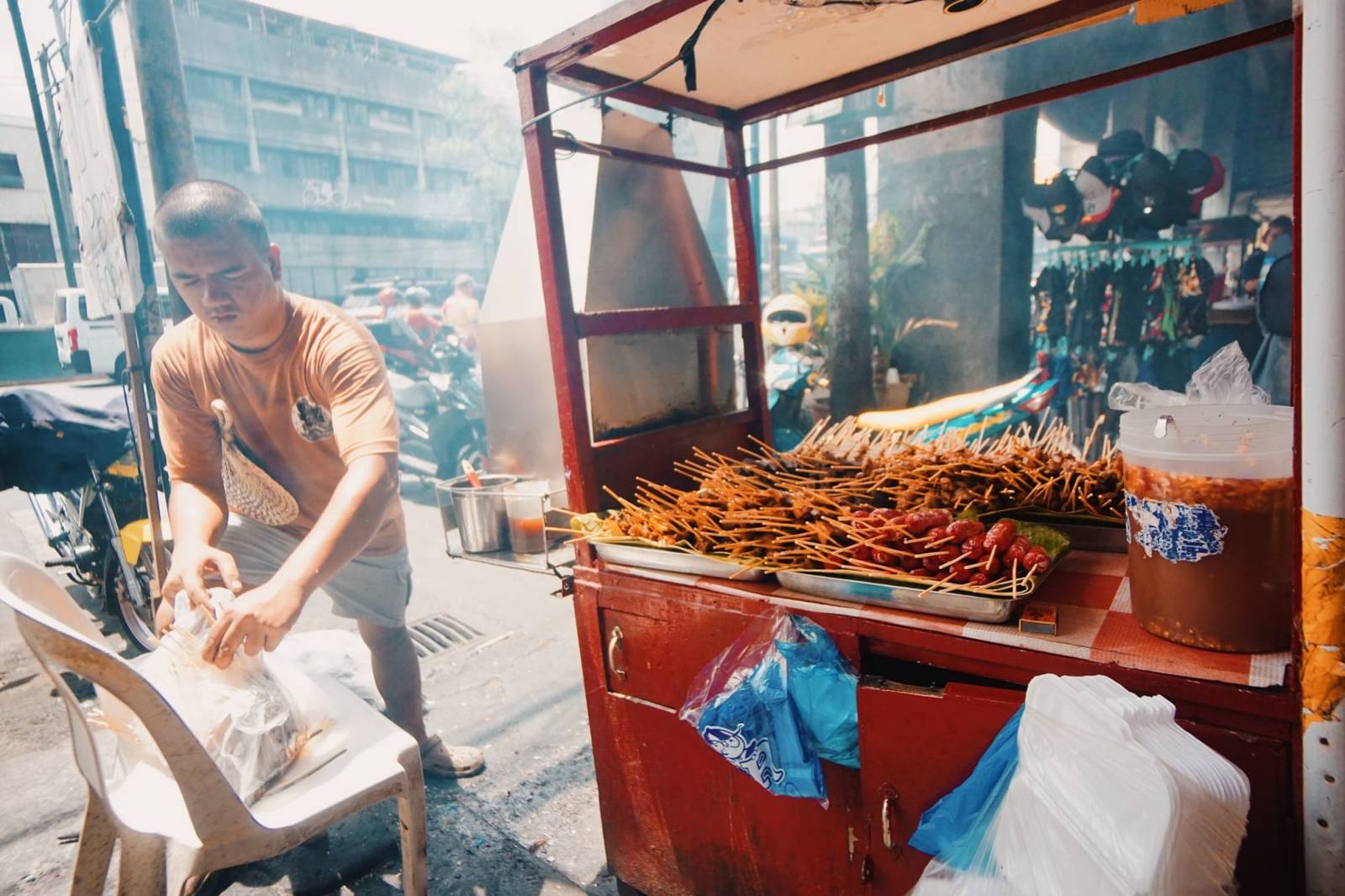
Two things you eat on the street in Manila. Sisig is chopped pork off a sizzling plate, lumpia are Filipino spring rolls. From about five in the afternoon the carts come out and you pay from about 30 cents a skewer. Pick a stall with a lot of turnover, so everything is fresh and it comes fast.
Halo-halo
Shaved ice with all sorts in it: beans, fruit, jelly, milk. It looks like a mess and it is exactly what you need after a day in the sun. You find it on every island, from Boracay to Siargao, and it rounds off almost every meal in the country.
Our verdict: start with adobo and sinigang at a karinderia, save lechon for Cebu and finish every hot day with halo-halo
Fish: the talipapa, the Baywalk and the grill on the beach
On the islands you eat whatever came in that morning, and in most places you pick it out yourself. On Boracay you go to the talipapa, the fish market at D’Talipapa: you buy your fish by the kilo and have it cooked at one of the places next door, where you only pay for the cooking. Ask both prices before you point at anything. In Puerto Princesa the grills are lit on the Baywalk in the evening: you point at your fish, pay by weight and eat at a plastic table looking out over the water.
In El Nido they grill the catch on the beach in the evening and you pay by the piece. In Coron you buy at the market by the harbour in the morning and plenty of places will grill it for you in the evening; the local speciality is fresh tuna. On Malapascua, in Port Barton and on Siquijor it is simpler: the morning’s catch, shellfish off the boat, and that is it.
Our verdict: pick your own fish once on every island, and on Boracay always go through the talipapa
How to eat in the Philippines
Go to a karinderia. These are the simple eateries where the food sits in trays behind the counter and you just point at what you want. A meal there costs about €2.50 in Puerto Princesa and around a euro in Moalboal town and in the villages on Siquijor, so it is easy to try something different every day. On Bohol, ride ten minutes inland from Alona Beach and you eat the same thing for a third of the price. See things to do in Puerto Princesa.
Get away from the beach. On Boracay the beachfront prices remind you this is the most touristy island in the country, and a couple of streets inland, around D’Mall and in the village, you eat for a fraction. In El Nido there is as much pizza and açaí as Filipino food, and the tastiest and cheapest food is at the stalls behind the main street. In Moalboal the good karinderias are in the town itself, a few kilometres inland from Panagsama Beach.
Bring cash. Port Barton and Malapascua have no proper supermarket, Port Barton has no cash machine in the village and the only one on Malapascua is regularly empty, so you eat at your guesthouse and the handful of places there are, and you pay in cash. Work out what you need and bring a bit extra.
Siargao: the exception
For such a remote island, Siargao eats absurdly well: surfers from all over the world have opened cafes, bakeries and restaurants there. In General Luna you can eat anything from poke bowls to fresh pasta. Want Filipino and cheap? Head to the market or a karinderia in the village. See things to do on Siargao.
Our verdict: eat Western on Siargao once because it is good there, and the rest of the time at the karinderia because it is better
What does it cost?
On the islands, reckon on €2 to €3 for a meal and €1.20 for a beer, or €1.50 on Boracay. In El Nido a meal is around €3 and a beer about €1.20. El Nido and Siargao come out a little higher, and the karinderias in Manila, Puerto Princesa and Siquijor a good deal lower.
Which island is best for what, and where to sleep there, is on our Philippines page, destination by destination.
What do you really have to try in the Philippines?
Everything on this list is worth it, but if you only get to pick five: a plate of adobo at a karinderia, because that is the taste of the country. Sinigang, because you will not find that sour soup anywhere else in Southeast Asia. Lechon on Cebu, because Filipinos themselves say it is best there. A fish you picked out yourself at the talipapa on Boracay or on the Baywalk in Puerto Princesa. And halo-halo after a day in the sun, even if it looks like a mess.
And dip into that little bowl of vinegar and garlic. That is the moment Filipino food starts to make sense.


