
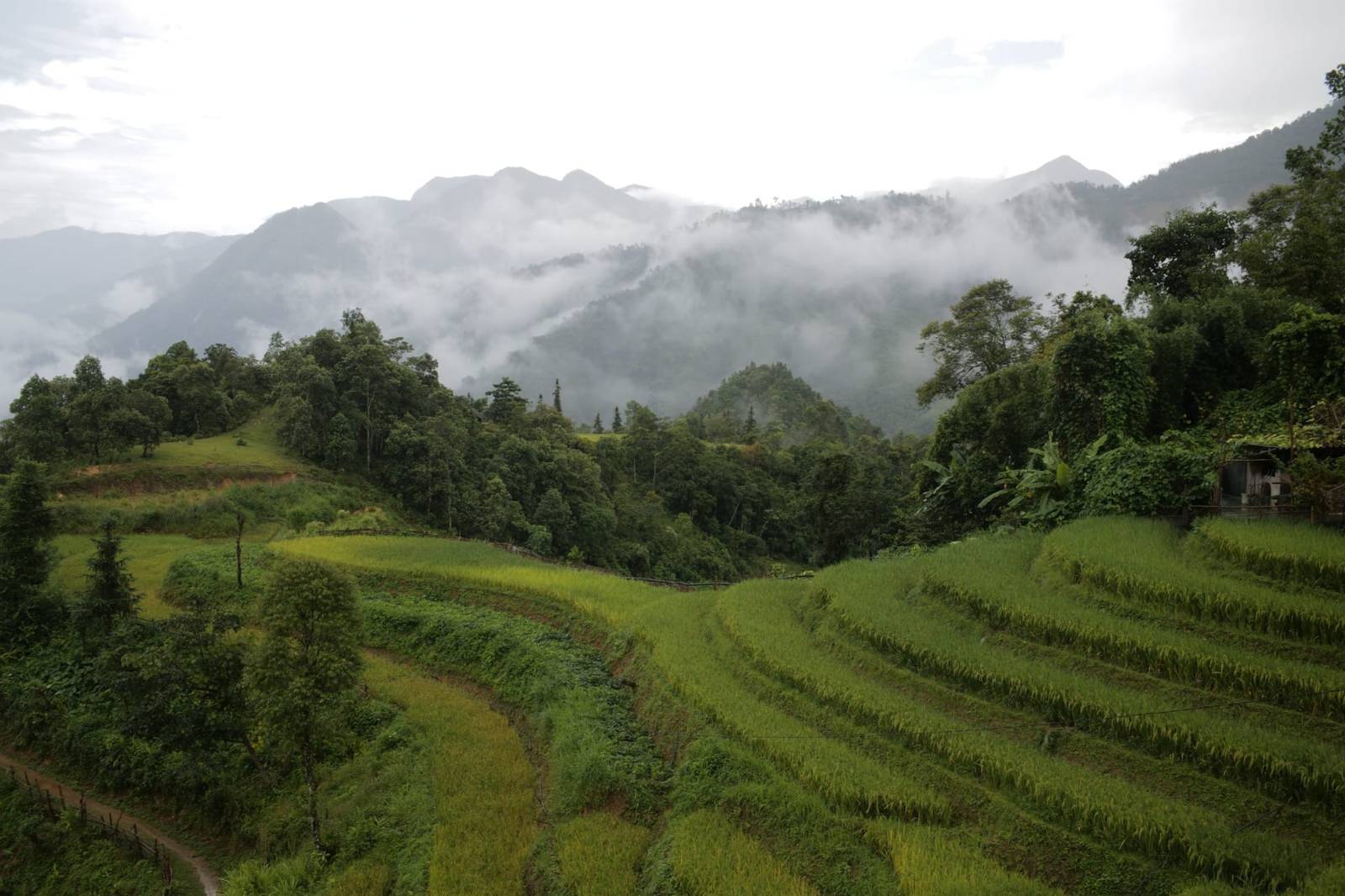
In Sapa everything happens outside. You come for the valleys below town, for the terraces stepping down the hillsides and for the mountains above them. The town itself takes fifteen minutes to walk through, so what you do here decides entirely what your visit is like.
A few things really belong on your trip: the trek, one morning before sunrise, a night with a family down in the valley. Around Sapa there is also plenty that has been built for visitors, from cable cars to a coaster, and that is mostly fun if you have a day spare. The weather has a say too: lose one day to fog and you are left with just one real day.
So where do those two or three days in Sapa go, and what can wait?
Below are the places themselves. Where to sleep, how to get there and how many days to give it are all on our Sapa page.
The trek through the valleys to Lao Chai and Ta Van
This is what you came for. You drop from town down into the valley and walk for five to six hours on narrow paths straight through the rice terraces, past water buffalo, kids on their way to school and fields climbing up on every side. No roadside viewpoint comes close to what you see from the path itself.
You walk with a guide from one of the mountain villages, and that is exactly what makes this more than a hike: someone who lives there explains the daily life of the Hmong. Most backpackers book the two-day version, with a night at a homestay in Ta Van, hotpot on the table and home-distilled rice wine on the side. Agree the total price up front, food and bed included.
Shoes with grip are not a luxury here, they are essential. The paths through the terraces are often muddy, even after days without rain, and in flip-flops you will not enjoy the first descent.
Our verdict: absolutely, and take the version with the overnight stay
Sunrise over the rice terraces
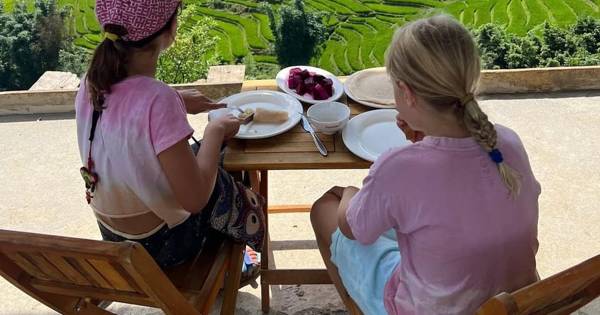
The best morning in Sapa costs nothing. As the sun comes up, the mist is still hanging in the valleys and it lifts within half an hour, while the light slowly creeps across the terraces. You have that moment to yourself, because the tour minibuses do not leave until hours later.
Set off around five, because the light comes at about a quarter to six. The viewpoint above Ta Van works well, and so does the Tram Ton pass. You can walk, or a lift on a motorbike gets you there for about €4.
Put on an extra layer. At 1,500 metres it is properly cold before sunrise, and most of the people standing there with chattering teeth left their jacket at the hostel.
Our verdict: up at five with an extra layer on, because at 1,500 metres it is cold until the sun arrives
Walking around Ta Van on your own
Most backpackers head straight back to town or onto the night bus after their trek, and that is a shame. Stay an extra day in Ta Van and walk the little paths along the rice fields with no guide and no plan. This is our own favourite in Sapa.
It costs nothing and there is nothing to arrange. Leave the route your guide took you on the day before and follow the side paths between the fields. You will hardly meet another traveller, and you see a far more everyday side of mountain life than on any tour.
Bring cash, because you cannot withdraw money in most of the valleys. A bed at a homestay costs around €5 here, so that extra day will not wreck your budget.
Our verdict: our favourite day in Sapa, and the cheapest one too
Fansipan, the roof of Indochina
At 3,143 metres, Fansipan is the highest mountain in Vietnam, and on a clear day you look out over the whole range from the top. There are temples up there and you really are standing on the summit, which makes it more than just a view.
You have two options. On foot with a local guide it is a tough trek, and for adventurous travellers often the achievement of their whole trip. The cable car gets you up in twenty minutes, for about €30 return, daily between 7.30 and 17.30.
Dress warmly, because at the top it is 8 to 10 degrees colder than in town, and in a T-shirt you feel that within a minute. Check the weather before you buy a ticket too: a cable car ride through a cloud shows you nothing.
Our verdict: go, but only when it is clear
Cat Cat Village in the valley
Cat Cat is the closest village below Sapa and the easiest way to fill your first morning. You walk through a valley with waterfalls, wooden houses and traditional crafts, and it is every bit as photogenic as everyone says.
Entry is about €3 and it keeps you busy for two to three hours. The village is three kilometres below Sapa: walking down is easy, the way back up is a stiff climb, or you take a motorbike for about a euro.
Go early. Cat Cat is the tourist village of the region, and by midday groups are walking through it. If you are heading into the valleys later that same trip, Cat Cat will feel a bit tame in hindsight.
Our verdict: fun for your first morning, and half a day is just right
An evening around the hotpot
Food in the mountains is nothing like on the coast: no delicate herbs and plates of fresh greens, but hearty food cooked over a wood fire. Grilled skewers from a street barbecue, sticky rice from a banana leaf, and in the evening a hotpot that takes over the whole table. At ten degrees, nothing on the menu hits the spot quite like it.
A meal costs about €2 and a beer around 60 cents, so you can easily eat out every night without noticing. Almost every hostel and homestay puts a hotpot on the table at some point in the evening, usually with other travellers around it.
Trekking during the day? Grab a banh mi in the morning. Down in the valleys you will not pass a single stall for hours, and a hot Vietnamese coffee before you set off is no hardship either.
Our verdict: a must, and especially on your first cold evening
The market, early or on a Sunday
Sapa’s market is where the different ethnic groups of the region meet. Clothes, herbs, tools, animals: it is not a sight but simply a market where people do their shopping, and that is exactly why it is fun.
Entry is free, but timing is everything. Early in the morning you walk among people from the villages. Two hours later it is mostly souvenir stalls and you have ended up in a tourist market.
If you are here on a Sunday, go to the Sunday market at Bac Ha, about two hours’ drive away. It feels clearly more authentic, and for many travellers it is a reason to plan their last day differently.
Our verdict: early in the morning, or Sunday in Bac Ha
Got time to spare in Sapa?
The alpine coaster and the tubing park
Around Cat Cat a whole attraction zone has been built, with a coaster, inflatable tubing and a viewpoint with props around it. It is well made, and on a grey rainy day a good way to fill your afternoon. Got two clear days? Then that time goes to the valleys, of course, because that is what you rode 320 kilometres north for.
Ham Rong Mountain
Ham Rong is right next to town, costs about €3 to get in and takes an hour and a half up and back from the church square, past gardens with views over Sapa. It is the easiest viewpoint to reach, so keep it for the moment a foggy morning finally clears. If you are walking through the terraces to Ta Van on the same trip, you will already have had the best view there.
The cable car on a clear day
The cable car up Fansipan is an impressive ride, and thirty euros is a lot of money by Sapa standards, so you want to do it on the right day. Wait for a clear morning, and from the roof of Indochina you see the mountains all the way into China. If the clouds are hanging low, save it for the next day.
Planning with slack in the mountains
The trek, Fansipan, Cat Cat and the market in two days fits on paper, but here the weather can easily eat a day of your plans. Make the trek your base and add one thing to it, and you do everything properly instead of halfway. With three or four days, the rest falls into place on its own.
Our top five in Sapa
Only got a few days? These are the five we would do no matter what:
- The trek through the valleys to Lao Chai and Ta Van, with a guide from the villages
- A night at a homestay in Ta Van, with hotpot and rice wine
- Sunrise over the rice terraces, setting off around five
- Fansipan on a clear day, on foot or by cable car
- An extra day walking around Ta Van on your own
Still got time after that? Cat Cat makes an easy morning, and the market early in the morning is well worth a look. If you are here on a Sunday, swap it for the market at Bac Ha.
So what do you really have to do in Sapa?
Honestly? On this whole list, exactly one thing really matters, and that is walking down into the valley. Everything above is a variation on that one thing: how far you go, who with, and whether you sleep along the way. The rest is for when the weather is not on your side.
Sapa does not do checklists either. It is often foggy, cold and muddy here, and it is precisely the days that do not go to plan that give you the stories you tell back home. So do not pack your days full, because the best hours here are the ones when you did not have to be anywhere.
If we had to pick just one thing: spend a night with a family in Ta Van. You sit at the table with people whose fields you walked through that same afternoon, it is cold, the rice wine is too strong and you wake up with the terraces outside your door. That costs you five euros, and it is the bit of Sapa you will still be telling people about a year from now.


