
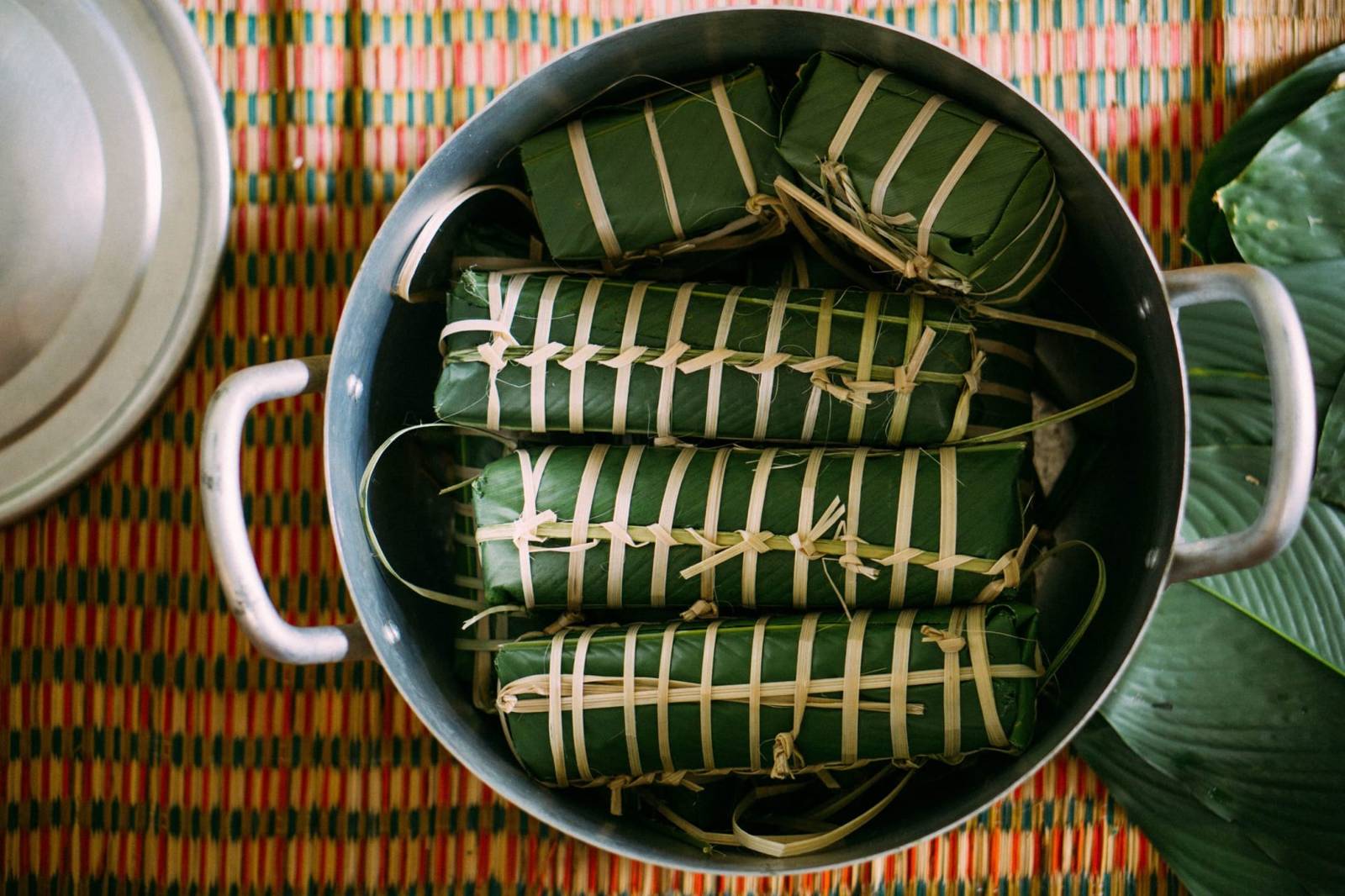
Ask someone about Asian food and you will probably hear pad thai, pho or a steaming bowl of ramen. Cambodian food? Hardly anyone brings it up.
Which is a shame, because Cambodian cooking deserves far more attention than it gets.
At first glance it looks like what you already know from Thailand and Vietnam: rice, noodles, fresh herbs, lots of fish. But travel around the country for a while and you notice something different going on. Less fiery than Thailand, served with less of a rush than in Vietnam, and with its own flavour profile built on sweet, sour, salty and a hint of bitter, all at once in a single bite.
This is your guide to what to taste, what to save for later if your stomach is on the sensitive side, and why a simple bowl of soup by the road sometimes turns out to be the best meal of your trip.
Amok: the dish that puts Cambodia on the map
If there is one dish you cannot miss, it is amok.
Amok is a creamy curry, usually made with fish, steamed in a banana leaf until it almost has the texture of a custard. The base is kroeung, a Cambodian paste of lemongrass, galangal, turmeric and kaffir lime leaf, with coconut milk and egg added.
The result is soft, slightly sweet, fragrant without being fiercely spicy, and seriously addictive. Amok is often seen as the national dish of Cambodia, and after your first bite you get why.
Our verdict: the best dish in the country, and the first thing you order
Lok lak: beef with a story
Lok lak is another dish you will find on almost every menu: marinated pieces of beef, seared quickly and hot, served on a bed of lettuce, tomato and onion, with a fried egg on top and a little dipping sauce of lime juice, pepper and salt on the side.
Simple on paper, but the mix of juicy meat, sharp fresh sauce and those crunchy vegetables underneath works surprisingly well. It is the kind of dish you order when you are not sure what you want, and it rarely lets you down.
Our verdict: the safest choice on any menu, and better than that description makes it sound
Bai sach chrouk: breakfast from the street
Walk through almost any Cambodian town early in the morning and you smell it before you see it: pork grilling over charcoal.
Bai sach chrouk is thin slices of pork, marinated in coconut milk and garlic and grilled slowly, served on rice with a bit of pickle and a cup of clear broth on the side. The vendors are often set up before sunrise, and it is exactly the kind of breakfast you ride past on a bike or scooter, drop onto a plastic stool for, and are back on the road ten minutes later.
It does not look like much. It is one of the best things you can eat in Cambodia.
Our verdict: the best breakfast in Southeast Asia, as long as you get out of bed for it
Kuy teav: the noodle soup that saves your day
Cambodia has its own version of the Southeast Asian noodle soup, and it is called kuy teav.
A clear broth, simmered slowly from pork or beef bones, with thin rice noodles, pieces of meat, bean sprouts and fresh herbs. You add lime juice, chilli sauce, fish sauce or sugar yourself until it is exactly right.
It is the kind of dish that tastes a little different at every street stall, and that gives you exactly what you need after a long bus ride or a hangover.
Our verdict: your saviour on travel days, and different everywhere, so always worth another go
Nom banh chok: noodles for breakfast
Where bai sach chrouk is the grilled breakfast, nom banh chok is the fresh alternative: thin rice noodles under a green, curry-like fish sauce, usually made with lemongrass and turmeric, and topped with a pile of raw vegetables like bean sprouts, cucumber and fresh herbs.
You mostly find it in the morning at local markets, often sold by women whose families have made it the same way for generations. Cold, fresh and the exact opposite of a heavy meal.
Our verdict: the freshest breakfast in the country, and worth an early trip to the market
Prahok: for the adventurous
And then there is prahok.
This fermented fish paste is the flavour behind a lot of Cambodian dishes, and there is no mistaking the smell. For Cambodians it is an essential part of the kitchen, a bit like how fish sauce is used in Thailand or Vietnam, only a good deal more intense.
There is a big chance you have already tasted it without knowing, worked into a sauce or a curry. Want to try it on purpose? Start with a small portion: subtle it is not.
Our verdict: taste it on purpose once, and start with a small portion
Fresh spring rolls and other small bites
Next to the bigger dishes, Cambodia has a whole world of small snacks and bites. Fresh (not fried) spring rolls with prawn, lettuce and mint, steamed dumplings, fried bananas, and at a lot of markets grilled insects too, like crickets and grasshoppers.
That last one sounds more daring than it is. Crunchy, lightly seasoned, and mostly a matter of getting over the first bite. Nobody makes you do it, but it is a bit of the Cambodian adventure.
Fruit: the other highlight
Cambodia’s tropical climate produces a huge variety of fruit, and every market is overflowing with it. Mango, pineapple, dragon fruit, rambutan, mangosteen and, for the brave, durian.
A lot of that fruit goes into shakes: fruit, ice, sometimes a bit of sugar or condensed milk, all blended into something that is perfect against the heat. A freshly made mango shake by the road is reason enough for plenty of travellers to keep stopping at the same stall.
Cambodian coffee: strong, sweet and surprisingly good
Cambodia grows its own coffee, mostly in the northeast of the country, and the way it is served here is a story of its own.
Classic Cambodian coffee is brewed strong, mixed with a generous amount of condensed milk and often poured over ice. Sweet, creamy and exactly what you need after a hot morning walking around temples. In a lot of places you can also just get black coffee, but the local version with milk is worth trying, even if it is only once.
What to drink besides coffee
Angkor Beer is the best-known local beer and you will see it everywhere, from street stalls to rooftop bars in Phnom Penh. Light, fresh and perfect on a hot day.
In a lot of villages you will also find homemade rice wine, often stronger than you expect and with a taste you will not forget in a hurry, for better or for worse. Sugar cane juice, pressed fresh from the canes with a scoop of ice, is another classic you find on almost every street, and it is surprisingly refreshing.
Where to eat
The best Cambodian meals are rarely in a restaurant with a long menu and air conditioning. They are on plastic stools by the road, at local markets and at nameless stalls where the owner has been perfecting the same dish for twenty years.
Point at whatever a local is eating. Try a stall without an English menu. The best meals of your trip often come out of exactly that uncertainty.
A few practical tips
Street food in Cambodia is generally safe as long as you watch a few things: pick stalls that are busy, where the food is cooked fresh in front of you, and where the turnover is high enough that nothing sits around for long.
Only drink water from sealed bottles or through a filter, however tempting it is to ignore the ice in your drink. Most tourist places use ice made from clean water these days, but when in doubt there is no harm in asking.
And do not feel pushed into prahok or durian if you are not in the mood. There is plenty of other delicious Cambodian food to eat your way through before you start on the more adventurous stuff.
What do you really have to try in Cambodia?
Amok, ideally on your first evening. It is the dish this cuisine revolves around, you can get it everywhere, and it is the best way to understand straight away why Cambodian food tastes different from Thai or Vietnamese: sweet, sour, salty and a hint of bitter at once, without setting your mouth on fire.
On top of that, we would get up early one morning for bai sach chrouk off the grill, and always order kuy teav on a travel day. Expect to pay around €2.50 a meal, so you can easily get it wrong and try again at the stall next door.
But the best advice is this: plan at least one evening at a local market with no plan at all. Walk around, watch what is going on, point at whatever looks good and just sit down. The best Cambodian meals rarely come from a search on Google Maps, but from chance and a bit of nerve to order something whose name you cannot pronounce.


