
Cambodia is a compact country with one climate, and that makes planning easy. From November to February it is dry and pleasant, with blue skies and around thirty-one degrees in Siem Reap and Phnom Penh. From March to May it is scorching, with thirty-seven degrees and afternoons when you genuinely do not want to do anything. And from June to October the rain comes in short, heavy downpours.
Still, the choice is less obvious than in the neighbouring countries, and that is down to Angkor. The famous reflection of the temple in the pond in front of it needs water, and the water is highest right at the end of the rainy season. Come in January and you get blue skies and a half-empty pond. Come in October and you get green temples and a chance of rain.
Below is what each part of the year gives you, what it means for the temples, the coast and the countryside, and when each place is at its best.
November to February: the best months
This is the dry season and it is good everywhere. In Siem Reap it is dry and a little cooler, with blue skies over the temples. In Phnom Penh the evenings are pleasant and the city is nice to walk around. In Battambang it is perfect cycling weather for the countryside, and on the coast Kampot and Koh Rong are sunny, with a calm sea and clear water.
It is also the busiest and most expensive time, so book your bed in Siem Reap and on Koh Rong ahead. And in Battambang and the countryside, bring something warm for the early mornings, because they are fresh.
Our verdict: come between November and February if you only get one shot, because then the whole country works
March to May: the hottest months of the year
Now it gets seriously hot: thirty-seven degrees in Phnom Penh, Siem Reap and Battambang, and heavy with it. The temples of Angkor are mostly in full sun with very little shade, so you get up early, do the temples in the morning and rest in the afternoon. Take two litres of water each into the temples.
For the coast, these months are actually fine. In Kampot the dry season runs until the end of April, with clear views from Bokor Mountain, and Koh Rong is good until the end of April, with May still good weather before the first rain arrives. Battambang is dusty and dry in this stretch.
Our verdict: come in these months for the coast, and do the temples only in the early morning
June to October: rainy season, and the greenest time
The rain comes in short, heavy bursts, usually in the afternoon, and in between it is simply dry. Prices are at their lowest and the well-known places are a lot quieter.
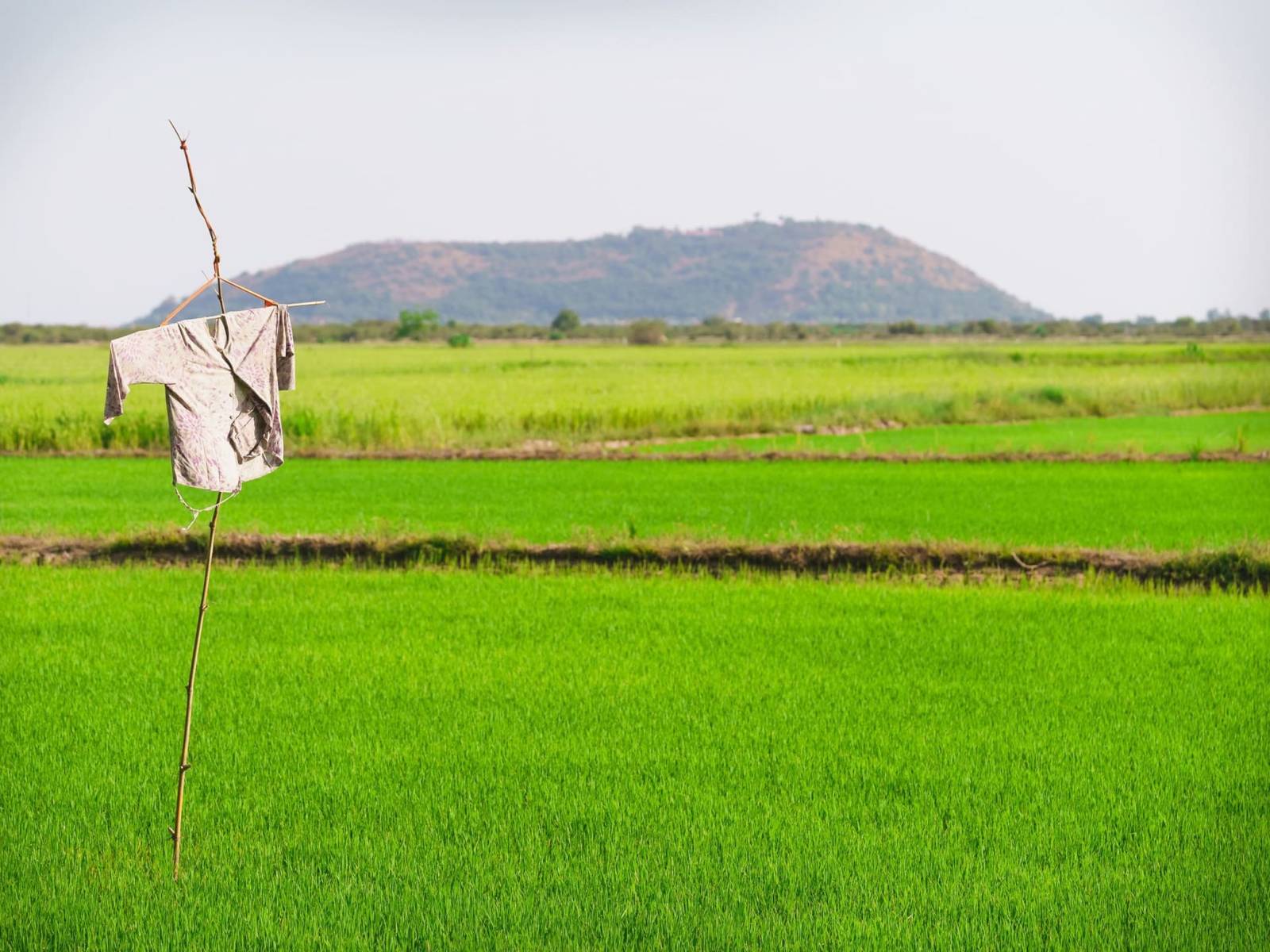
This is also the most beautiful time to see Cambodia. The temples of Angkor are at their greenest, and the pond in front of Angkor Wat is at its highest at the end of the rainy season, roughly September to November, which is exactly when that reflection works best. Around Battambang the rice fields are green and under water, and at the stilt village of Kampong Phluk near Siem Reap the water rises to the floorboards of the houses, which stand on stilts ten metres tall.
What you trade for it: in Phnom Penh the streets can flood, in Kampot September and October are the wettest months and Bokor is often in the clouds, and on Koh Rong the wind picks up and the sea gets rough, so the boats run less often.
Our verdict: September and October are the most beautiful months for Angkor, and the least suited to Koh Rong
How hot is it really?
Cambodia is warm all year round, and that is the biggest factor in your planning. In the dry season the average daytime temperature is around thirty-one degrees in Phnom Penh, Siem Reap, Battambang, Kampot and on Koh Rong. It never gets cool here.
From March to May that climbs to thirty-seven degrees inland, with heavy air on top, and you feel it most in places without shade: the temples of Angkor, the climb up Phnom Sampeau, the countryside around Battambang. In the rainy season it drops to around thirty-two, and the downpours cool things off for a while.
In practice that means: do your outdoor things between sunrise and about ten, carry more water than you think you need, and plan your afternoon in the shade or indoors. That goes for November just as much as April, it is just that in April you can no longer ignore it.
Our verdict: plan your days around the afternoon rather than around the rain, because the heat costs you more days here than the weather does
Place by place: when is each one at its best?
- Phnom Penh, Siem Reap and Battambang: November to February
- Kampot: November to April
- Koh Rong: November to April
So the coast stretches the dry season a couple of months further than the interior does. Coming in March or April? Flip your route: the coast first, and the temples in the early mornings.
How to plan your days around the heat and the rain
Whatever you choose, start early. You do Angkor at sunrise, not at eleven, the bats at Phnom Sampeau come out of the cave at around quarter to six in the evening, and the bike rides around Battambang are nicest in the morning.
Coming in the rainy season? Plan the outdoor days in the morning and the indoor things in the afternoon: the Killing Fields and Tuol Sleng in Phnom Penh, a museum, the markets. That way you lose almost nothing to the rain.
How to split up your days at Angkor is on our Siem Reap page, and the whole route with its connections is in our Cambodia itinerary and our guide to getting around Cambodia.
Which places to visit in those months, with the hostels and the daily budget for each stop, is on our Cambodia page.
Can you visit Angkor in the rainy season?
Yes, and for photos it may well be the best time. The temples are surrounded by green, it is a lot quieter than in high season, and the pond in front of Angkor Wat is at its highest at the end of the rainy season, roughly September to November. That reflection you know from every photo needs water, and in the dry season the pond is often low.
What you have to accept is a downpour in the afternoon. So do the temples in the morning and keep your afternoon flexible. Expect mud on the paths at the temples that sit further from the road, too.
Coming in March, April or May? Then the opposite problem is bigger: no rain, but thirty-seven degrees and barely any shade. Of those two, the rain is the friendlier one.


