
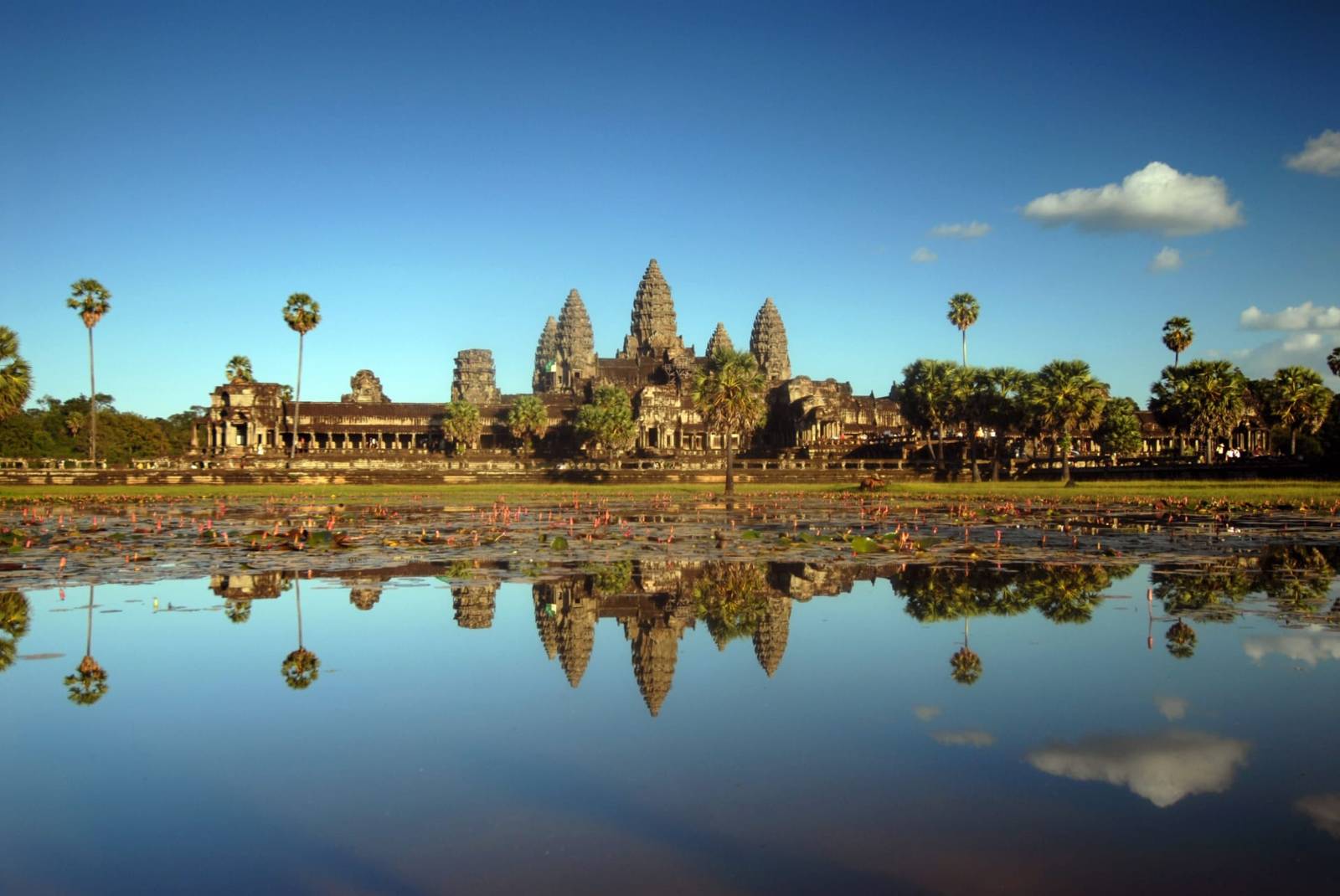
You know how it goes. Someone asks what you know about your trip through Asia, and within three seconds the words Angkor Wat come up.
Fair enough, because it is absurdly impressive. The complex near Siem Reap covers around 400 km² and holds the remains of several capitals of the old Khmer empire. It is one of the most remarkable places in all of Southeast Asia, and for a lot of backpackers it is reason enough to put Cambodia on the map.
But catch the bus to the next border straight after that one sunrise photo, and you leave most of the country unseen.
Cambodia has a history that takes your breath away, in two completely opposite directions. Cities that run on their own chaotic logic. A countryside where the clock seems to tick at a different speed. The Mekong cutting straight through all of it. And islands that make you almost forget they belong to the same country as those ancient temples.
You come for Angkor Wat. Chances are you leave with a very different story.
The facts, quick and painless
Cambodia is wedged between Thailand, Laos and Vietnam, with a coastline on the Gulf of Thailand. Around 181,000 km², almost 18 million people, and Phnom Penh as the capital.
So unlike neighbouring Laos, Cambodia has sea and islands, while a large part of the interior is flat plains and farmland. Two things shape pretty much the whole landscape: the Mekong and the Tonle Sap lake. The language is Khmer, and the Khmer are also the largest group in the population.
For backpackers the country is easy to get your head around, and it is almost always combined with Thailand, Laos and Vietnam. Just do not sell it short: treat Cambodia as a destination in its own right, not a stopover.
A country full of contradictions
Angkor Wat is even on the flag, that is how big a symbol it is. But Cambodia is just as much Khmer culture, the Buddhism that seeps into everything, the vast Tonle Sap lake, the Mekong, tropical islands off the south coast, and, unavoidably, one of the darkest chapters in recent world history.
That exact mix is what makes the country so intense. One moment you are standing in front of a temple almost a thousand years old. A few days later you are in Phnom Penh learning about one of the darkest periods of the twentieth century. And after that you are lying on a beach as if nothing happened.
Cambodia does not pretend that kind of whiplash is normal. It just never gets used to it.
The people make the difference
Ask travellers what they remember best about Cambodia, and the answer is rarely about stones. It is about the people.
Outside the tourist hotspots you soon notice how curious and hospitable people can be. Kids waving from the side of the road. Someone trying to help you out while you have no language in common. A tuk-tuk driver who, halfway through the ride, tells you his whole life story without being asked.
Do not expect every Cambodian you meet to become your new best friend, because that is not how it works anywhere. But make the effort to really connect. A few words of Khmer go a long way.
- Hello → Suostei
- Thank you → Arkun
Your pronunciation will probably be terrible. The attempt is almost always appreciated.
Politeness is not optional here
Just like in Thailand and Laos, Cambodian culture is built largely on respect. The traditional greeting, the sampeah, is palms pressed together and a slight bow: the higher your hands, the more respect you show.
You do not have to do a full sampeah every time you meet someone, but it tells you how much politeness matters here. Shouting or losing your temper in public almost never works in your favour, and it is more likely to cost both sides face than to fix anything.
Something not going to plan? Stay calm. That bus will turn up eventually.
Probably.
Buddha is watching everywhere
Theravada Buddhism is woven deep into daily life. You see pagodas, temples and monks in their familiar orange robes all over the country, and outside the cities the local temple is often the beating heart of the community.
Visiting a temple? Then behave like it: shoulders and knees covered, shoes off where you are asked, and leave the Buddha statue alone rather than using it as a climbing frame for the perfect photo. Sounds obvious. Apparently it still needs saying.
The empire that turned Southeast Asia upside down
To understand Cambodia even a little, you need to know something about the Khmer empire.
From around the 9th century it grew into one of the most powerful civilisations in the region, with an influence that at its peak reached far beyond the borders of modern Cambodia. Angkor was its beating heart: dozens of temple complexes, ancient roads, reservoirs and structures that are now on the UNESCO World Heritage List.
Walk around there and it slowly sinks in how advanced and powerful this civilisation once was. Angkor Wat is not a backdrop for a carefully posed photo. It is a fundamental part of Cambodian identity.
The other side of the coin
And then there is the chapter nobody skips, however heavy it is.
The Khmer Rouge years, from 1975 to 1979, left deep scars. Under Pol Pot’s regime huge numbers of Cambodians died through executions, forced labour, disease and famine, in one of the worst genocides of the twentieth century.
Confronting, yes. But essential for understanding the country you are travelling through. In and around Phnom Penh you can learn a lot more about this period. It makes that part of your trip less light-hearted, but it gives you a far deeper understanding of the people you meet along the way. Since 2025 the memorial sites from this period have been on the UNESCO World Heritage List as well.
A country that rebuilt itself
What is maybe even more impressive is how Cambodia carried on afterwards.
The horror is not far in the past, and a lot of families still live with the consequences every day. And yet on the road you mostly meet a young generation that is looking forward. Phnom Penh is growing, tourism has developed, and in a lot of places the country is changing fast.
Know a bit of the history and you will probably look at the people you meet differently. Not in a heavy way: it makes those encounters richer.
A different country starts at the city limits
Leave Phnom Penh or Siem Reap, and within a few kilometres Cambodia changes completely.
Rice fields as far as you can see, small villages, cows blocking the road, wooden houses on stilts, dusty dirt tracks. Most of daily life happens out here, far from any tourist route.
Scooters that seem to fit a whole family plus the shopping, stalls by the side of the road, kids swimming in the river. At some point you seriously start wondering how that much stuff physically fits on one scooter.
Welcome to Southeast Asia. And honestly: the rides between destinations are often what show you the most of the real Cambodia.
The water that keeps the country running
Just like in Laos, the Mekong is a lifeline here. The river cuts straight through the country and has been crucial for centuries for transport, farming, fishing and everyday life. Phnom Penh sits on this river system too.
It gets more interesting at Tonle Sap, the enormous lake in the middle of the country. Thousands of people live from and on the water, in communities that revolve entirely around fishing.
The remarkable part: in the rainy season the Mekong rises so much that the Tonle Sap river literally reverses its flow. A huge volume of water pours towards the lake, and Tonle Sap swells to a gigantic size during the wet season. That natural system is essential for fish stocks, for farming and for the livelihoods of millions of Cambodians.
As a backpacker you might just see “a big lake”. For Cambodia it is the backbone of the country.
Phnom Penh: loud, raw and full of character
Phnom Penh is the opposite of the quiet countryside. Scooters shooting off in every direction, tuk-tuks, busy markets, modern coffee shops between the street vendors, and traffic that seems to make up its own rules on the spot.
It may not be the prettiest capital in Asia, but it is one of the most interesting to experience. Modern Cambodia and the country’s history sit literally side by side here: one moment you are in a trendy cafe, the next you are standing somewhere that confronts you head-on with the past.
That contrast hits hard. It is simply part of the city.
And then, suddenly: beach
This is the one backpackers regularly forget: Cambodia has a coast on the Gulf of Thailand, with beaches, mangroves and dozens of islands off the south coast.
Ready for some rest after weeks of temples, cities and bus rides? You do not have to go back to Thailand for it. Around the islands off the south coast you find tropical beaches, jungle and a noticeably more relaxed pace, which is more proof of how much range this country has.
Switching to Cambodian time
Just like in Laos, you sometimes have to let go of a tight schedule here. Not everything happens when you expect it to. A bus leaves later than planned, a ride suddenly takes twice as long, and “five minutes” is an extremely stretchy idea.
You can get annoyed about it. Or you can get used to it and go with the pace. The second option makes backpacking Cambodia a lot more enjoyable. Which bus, boat or minivan to take where is in getting around Cambodia, and which stops to do in which order is in our route from Angkor to Koh Rong.
Dollars, riel and a bit of confusion
It takes some getting used to at first: the official currency is the Cambodian riel (KHR), but the US dollar has played a big part in everyday payments for decades. Prices are often in dollars, while your change comes back in riel.
For the first few days it feels like juggling two currencies at once. After a few purchases you have it sorted. What a day here costs, broken down by place, is in backpacking Cambodia: cost per day.
Is Cambodia good for backpackers?
Without a doubt. The country sits on the classic Southeast Asia route and travelling between the well-known destinations is fairly easy. Hostels, guesthouses, buses and minivans are everywhere, and you meet plenty of other travellers on the way.
The best part: it is also easy to get out of the backpacker bubble here. Ride a little way out of Siem Reap or Phnom Penh and the picture changes completely. That is exactly where it gets interesting.
When should you go?
Cambodia has a tropical climate with a clear dry season and a clear wet one. The drier months are popular because getting around is easier and there is less chance of a tropical downpour messing up your plans.
Travel in the rainy season and you get a spectacularly green Cambodia in return: bright green rice fields, fuller rivers and a hugely swollen Tonle Sap. So rain is no reason to leave Cambodia off your list, at most a reason to be soaked through within seven seconds.
How Cambodia compares to its neighbours
Cambodia gets compared to Thailand, Laos and Vietnam almost automatically, but it really has its own character. Thailand is the easiest to find your feet in. Vietnam is the busiest and most intense. Laos is the calmest and greenest.
Cambodia may well have the biggest contrasts of the four: from Angkor Wat to the Khmer Rouge, from chaotic Phnom Penh to silent rice fields, from temples almost a thousand years old to modern rooftop bars, from dusty back roads to tropical islands. Try putting this country in one box.
Why this country stays with you
Cambodia is not the country where everything runs perfectly. And some parts of your trip here are more confronting than anywhere else on the route.
But that is exactly why it stays with you. You learn about a civilisation that once dominated a large part of Southeast Asia. You see with your own eyes how heavy the recent history has been. And at the same time you meet people who laugh, start businesses, study, build and look ahead, without ignoring the past but also without getting stuck in it.
Cambodia is beautiful and confronting at the same time. That is exactly why it is so much more than a day at Angkor Wat.
The five experiences at the top of our list are in best things to do in Cambodia. For the temples themselves, how many days you need and which circuit to do is on our Siem Reap page. And for everything else that helps before you go: Cambodia etiquette, the best time to visit Cambodia and food in Cambodia.
Is a trip through Cambodia only about the history?
Take Cambodia’s history with you on your trip, but do not let it become the country’s only story. Visit Angkor. Learn about the Khmer Rouge, and give that the time it deserves. But then look further. Talk to people. Look out of the window on a long bus ride. Walk through a local market. Ride out into the countryside and see what Cambodia actually looks like today.
Because Cambodia is not just the story of a mighty empire or a terrible past. Above all it is a country that is alive, changing, and likely to surprise you more than you expected.
Want to start planning from here? Our Cambodia page puts the five stops in order, with the hostels and the daily budget for each one.


