
There is no border where a customs officer hands you a little book called “how we do things here”. And yet that book does exist. It is just invisible, made up of habits every Cambodian has known since birth and that you, as a traveller, work out bit by bit.
The vibe in Cambodia is easy-going, people are gentle, and hardly anyone will say anything if you get something wrong. But that friendliness is exactly why it pays to keep your own eyes open. Nobody corrects you, so it is on you.
None of what follows is law you have to learn by heart. It is the kind of stuff that makes your trip a lot smoother once you know it.
Body language means something different here
Back home it might not matter much if you ruffle someone’s hair or put your feet up on the table. In Cambodia those things are more sensitive.
The head is seen as the most valuable part of the body, so do not touch anyone there, not even children, however cute they are. The feet are the exact opposite: they are seen as unclean. So do not point them at anyone and do not put them up on furniture when other people are sitting nearby.
The greeting you see everywhere is the sampeah: palms together at chest height, with a slight bow. Greeting people with it yourself goes down well, and when someone gives you a sampeah, always return it. It costs nothing and it is appreciated.
In a temple you are a guest, not a tourist
Angkor may be world famous for its photos, but for Cambodians it is above all a place of faith and culture.
That means: shoulders and knees covered where it is expected, shoes and hats off in certain sacred spaces, and at Angkor itself an official set of rules that bans climbing on the ruins and touching fragile parts. Monks and worshippers still come to pray while you walk around with your camera, and you keep that in mind.
A temple a thousand years old is not a film set. That one photo is not worth treating it carelessly.
Monks: ask, do not touch, and take extra care as a woman
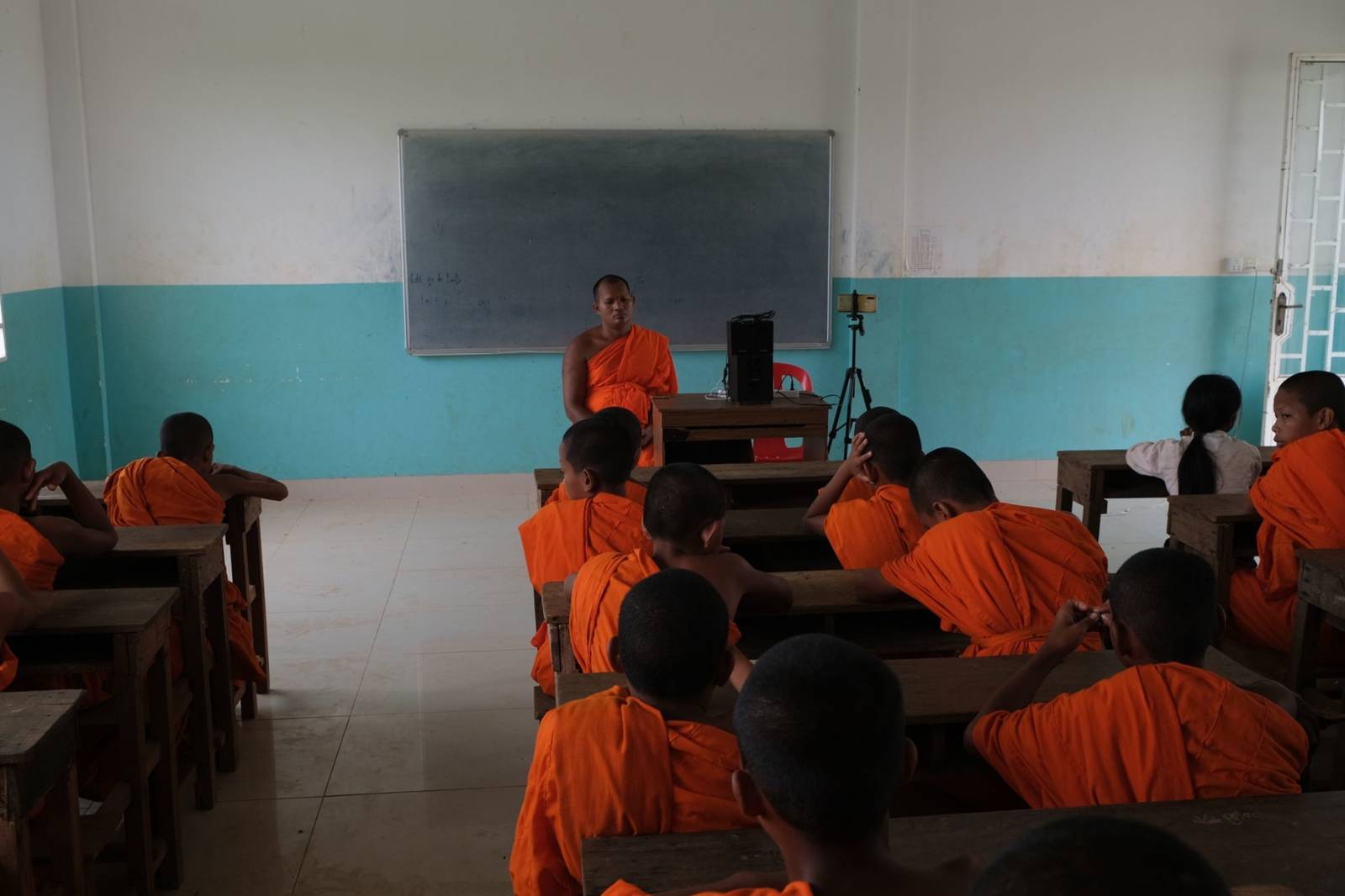
You see orange robes all over Cambodia, and the monks who wear them deserve a little extra care.
Asking permission before a photo is the basic rule. For women there is one more: you may not touch a male monk, and you do not hand him things directly. Put it down somewhere, or let a man pass it to him.
Beyond monks, the same goes for everyone: ask before you take a close-up photo of someone. Not every Cambodian wants to become the unwitting star of your travel story.
Swimwear is for the beach, not the temple
The heat in Cambodia makes you want to wear as little as possible, we get it. But there is a difference between the beach on Koh Rong and a village street or a temple further along.
After a swim, put something on before you walk into a restaurant, a village or a religious site, especially outside the well-known tourist areas, where the country is a lot more conservative. Pulling a shirt over your head takes ten seconds and saves you a lot of funny looks.
Holding hands is fine, full-on snogging in public less so
Cambodia is more traditional about relationships than a lot of travellers are used to. Walking hand in hand down the street is fine, but heavy kissing or hanging all over each other in public does not go down well.
The Cambodian Ministry of Tourism literally gives visitors this advice: keep public affection limited and respectful. Save the rest for behind the hostel or hotel door.
Drugs: we can keep this short
Simple: leave them alone.
Being offered something on a night out tells you nothing about whether it is legal or safe. Cambodia’s tourism law explicitly names drug use and drug dealing as things tourists must stay well away from.
You are travelling through a country with its own laws, and they apply to you just as much as to everyone who lives there. A backpacking trip gets a lot less fun when it is extended against your will because of the police.
The Khmer Rouge is history, not an anecdote for the bar
Few countries carry a trauma as recent and as heavy as Cambodia does with the Khmer Rouge years. Almost every Cambodian family was touched by it in one way or another.
Visiting places like S-21 and the Killing Fields is an important part of their time in the country for a lot of travellers, and it absolutely should be. Just go with the right attitude: no jokes, and do not expect everyone to be keen to talk about their own family history. The same goes for politics and other sensitive subjects: listening gets you a lot further here than sharing your own opinion.
Giving money to children feels good, but does not help
At tourist hotspots you are almost guaranteed to meet children selling trinkets or asking for money. It is a hard moment, because you want to help, but handing out money often does more harm than good in the long run.
That is why the official visitor code at Angkor explicitly asks tourists not to give money to children. If you really want to contribute, find a reliable local organisation where you know the money ends up in the right place.
A row of shoes by the door? That is not decoration
All over Southeast Asia, and Cambodia is no exception: if you are standing in front of a house, temple or pagoda and there is a pile of shoes outside, yours come off too. In you go in socks or bare feet.
It is a small gesture, and in Cambodia it is seen as a sign of respect for the place and the people who live or worship there.
Patience works better than volume
Something always goes wrong on the road. The bus is late, your room does not quite match the photos on Booking, or your tuk-tuk driver clearly runs on a different clock from you when he says “five minutes”.
Getting angry and telling someone off in public rarely gets you anywhere in Cambodia, and usually makes things worse. Staying calm, making your point politely and showing a bit of patience gets you further. Sometimes “five minutes” simply means nobody knows the exact time. That is just part of it.
Leave the country the way you found it
Litter, plastic on the beach, damage to nature or historic sites: all things you simply do not leave behind.
Cambodia’s tourism law even obliges visitors to respect the environment and cultural heritage. On the islands and in remote places, waste disposal is a serious practical problem, so whatever you do not leave behind does not have to be cleared up there.
Where you will run into these rules first, and where to sleep in each town, is on our Cambodia page.
Do you have to learn all of this by heart before you go?
No, and that is exactly the point of an invisible rule book. Just look around once you arrive, use your common sense and follow what the people around you are doing. Everyone taking their shoes off? Do the same. Not sure whether something is okay? Then leave it.
If you only take two things away: keep your hands off other people’s heads and your feet off the furniture, and stay calm when something goes wrong. Together those two cover most of what can cause offence in Cambodia, and neither costs you a thing.
Cambodia is special precisely because it works so differently from home. Adapt yourself a little to the country instead of the other way round, and your trip only gets better for it. What else to see here is in best things to do in Cambodia.


