
Cambodia is one of the easiest countries in the region to travel on your own. The distances are manageable, comfortable buses and minivans run between all the main towns, and you are never on the road for more than a day. Travel is a little slower than in Thailand, and that is part of the country.
What makes Cambodia different is everything it has besides the bus. There is a boat across Tonle Sap that takes eight hours and shows you a completely different country. There is a train that only runs a few times a week but is a lot more comfortable than the bus. And in the cities you order your tuk-tuk with an app, so you never have to haggle again.
Below, transport by transport: what it does, what it costs and what to look out for, plus how to get around the temples of Angkor and how the border crossings work. The full route, with the journey from each stop to the next, is in our Cambodia itinerary.
The bus: the backbone of the country
You do almost everything by bus, and the travel times are very doable. From Phnom Penh it takes about six hours to Siem Reap, four to Kampot and five to Sihanoukville. Between Siem Reap and Battambang it is about three hours, between Phnom Penh and Battambang five to six, and from Kampot to Sihanoukville two. That means you can see the whole country in a week or ten days without ever losing an entire day.
Book a day ahead, especially in high season, and pick a morning bus if you want to do something on the day you arrive. The bus companies often pick you up at your hostel, which saves you a ride to the terminal.
Our verdict: the bus in Cambodia is simply good, and the morning bus beats the afternoon one
The boat across Tonle Sap
Between Siem Reap and Battambang a boat crosses Tonle Sap, and it takes eight hours against three by bus. So that is your whole day gone. What you get in return is a trip past floating villages and through the lake’s wetlands, and that is a very different way to arrive than by road.
The water level decides how the trip goes and exactly how long it takes, and in the dry season the route can change. Ask about it when you book.
Our verdict: take the boat if you can spare the day, and otherwise the three-hour bus
The train: slow, but comfortable
Cambodia has a working railway again, and that is a nice surprise. Between Phnom Penh and Kampot there is a train that is slower than the bus but more comfortable, and it only runs a few times a week. The same line carries on to Sihanoukville. Check the timetable before you lock in your nights, because with a few departures a week it will not fit into every plan.
There is also a short line you will use more than you expect: from Phnom Penh airport a train runs to the central station for about €1.50, and in rush hour it is much faster than the road.
Our verdict: take the train to Kampot if it runs on your day, and from Phnom Penh airport always
Boats to Koh Rong
You can only reach Koh Rong by water. The fast boat from Sihanoukville takes about forty-five minutes and runs several times a day. Buy a return straight away, because it is cheaper. Want to carry on to the quieter island next door? Koh Rong Sanloem is half an hour by boat.
On the island itself there are hardly any roads. There is one sandy street, and between the beaches you take a boat taxi for about €5 a ride. From Koh Touch to Long Beach you can also walk: the jungle path straight across the island takes about an hour. Bring a torch, because there is no street lighting and that path is truly dark at night.
Our verdict: buy a return ticket, and walk the jungle path in daylight only
Tuk-tuks: the app that ends the haggling
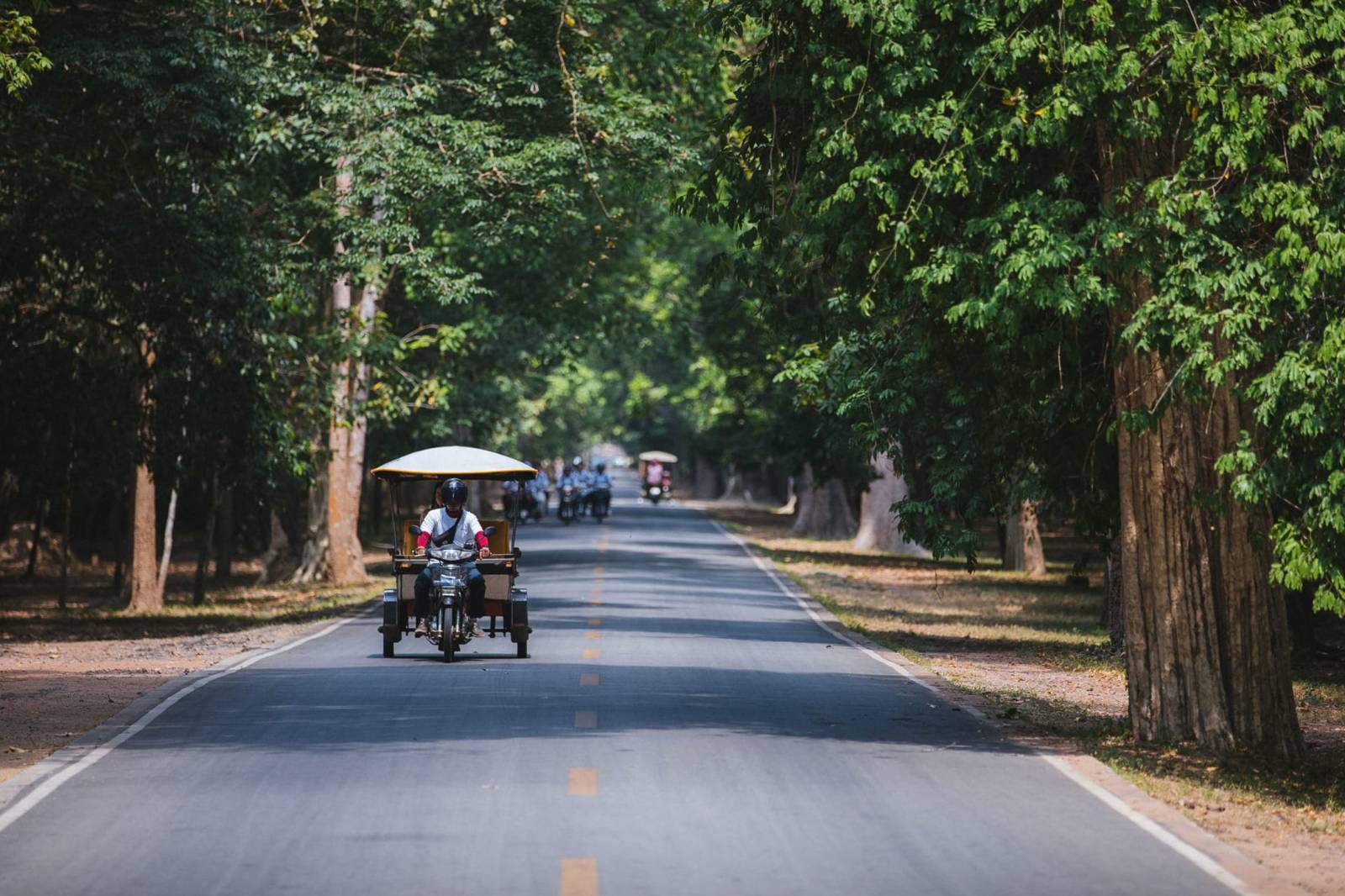
In Phnom Penh and the other cities you order your tuk-tuk with PassApp or Grab. You see the price up front, usually a euro or two, and there is nothing to discuss. That is the biggest change from a few years ago, and it makes getting around town a lot easier.
In Siem Reap you hire the tuk-tuk by the day instead. For the temples of Angkor a full day costs about €12 for the small circuit and a little more for the grand one, and your driver waits for you at every temple. Want it cheaper and have the legs for it? The small circuit is cyclable too, with a bicycle from about €2. In Battambang you take a tuk-tuk for half a day out to Phnom Sampeau, about €10.
In an open tuk-tuk, keep your phone in your pocket and not in your hand.
Our verdict: PassApp or Grab in the city, and in Siem Reap a tuk-tuk for the whole temple day
The scooter: Kampot and Battambang
There are two places where a scooter really pays off. In Kampot you rent one for about €7 a day and ride it up Bokor Mountain, past the pepper plantations and on to Kep with its crab market by the sea. In Battambang it costs about the same, and it opens up the countryside, with the villages and the temple hills around town.
In both towns the centre is small and walkable, so you are really renting it for the area around. Sort out the paperwork first: Cambodia is the one country on our route where your own licence plus an international permit is not enough, and you need a Cambodian licence, which you get on the spot with the 1949 international permit. Without it your travel insurance is not riding with you. Around Battambang, stay on surfaced roads, because the countryside in the west is still being cleared of landmines. Take photos of the scooter before you ride off, and keep your helmet on.
Our verdict: rent the scooter in Kampot for Bokor and Kep, and in Battambang for the countryside
Airports and borders
The new Siem Reap airport is fifty kilometres east of town, about an hour’s drive. A shared bus costs around €8 and a taxi roughly double, and you simply add that hour to your travel time. Phnom Penh has the most conveniently placed airport in the country, ten kilometres west, with that train into the centre.
Overland there are three ways out of the country. For Thailand you cross at Poipet: from Battambang that is two hours west and buses run on to Bangkok from there, and from Siem Reap it is a long day. For Vietnam the bus from Phnom Penh takes six to seven hours to Ho Chi Minh City through the border at Bavet, and from Kampot you cross at Ha Tien towards Phu Quoc. For Laos you travel from the northeast, with a long day towards the 4000 Islands. Whether you need a visa for the next country depends on your passport, so check our visa page before border day.
Our verdict: plan every border crossing as a full day, and at Siem Reap always count that hour to the airport
How to book it
One more thing about paying on the road. In Cambodia you pay mostly in US dollars, and you only get riel back as change under a dollar. Cash machines dispense dollars, so check what your card charges per withdrawal before you go: our travel cards page helps with that. Take enough cash to Koh Rong from the mainland, because the machine on the island is unreliable.
Bus or boat between Siem Reap and Battambang?
The bus if you want to get there, the boat if you want to see something on the way. By road you arrive in about three hours and still have half a day left in Battambang. Across Tonle Sap you are on the water for eight hours, past floating villages and through the wetlands, and then the journey itself is your activity for the day.
Got ten days or more for Cambodia? Then the boat is one of the things that stays with you. Only got a week? Take the bus and use the free afternoon for the bamboo train or the bat cave at Phnom Sampeau.


