
You step off the boat in Luang Prabang, or park your scooter outside a guesthouse in Vang Vieng, and Laos quickly feels like one of the most relaxed countries in Southeast Asia. Beerlao in hand, the Mekong sliding slowly past, villages where nobody seems to be in a hurry.
And that is true, mostly. But the laid-back vibe tells you very little about the law. On several fronts Laos is pretty strict, and more conservative than you might be used to at home. The hostel bubble in Vang Vieng is not the same as the real Laos outside it, and the rules that apply there do not change because you are on holiday.
No need to panic: you do not have to carry a law book around in your backpack. Know the points below and you are already fine.
The hard lines
Drugs. Cannabis, ecstasy, ketamine, cocaine, amphetamine, heroin: all illegal, and all a reason for serious trouble. The Lao Trade Portal explicitly lists marijuana, ecstasy, ketamine and amphetamine, among others, as banned imports. Official travel advice warns of very heavy sentences, up to life imprisonment and in serious cases even the death penalty. Another backpacker telling you everyone does it here is not going to talk you out of a cell.
See a happy shake or a happy menu on a board somewhere? Something being sold openly does not make it legal. Do not assume it is.
Vapes. E-cigarettes and shisha are explicitly on the list of banned goods in Laos. It is not just bringing them in that is a problem: owning and using them can also lead to fines or prison. Seeing someone else vaping still does not make it legal.
Relationships with a Lao citizen. Most backpackers have no idea about this one. Sexual relationships between foreigners and Lao citizens outside an officially recognised marriage can have legal consequences, and living together can fall under this too. Travel advisories warn of fines and possibly even prison. Meet someone on a night out and it gets serious? Know that the rules here are different from home.
What to wear, and when
Laos has no sea, but it has plenty of waterfalls, lagoons, rivers and pools to jump into in your swimwear. Fine. The moment you walk back into the village, a restaurant or a shop, put something on. A bare chest or swimwear away from the water is not culturally appreciated, and official travel advisories say so too. A sarong or a shirt in your daypack solves it on the spot.
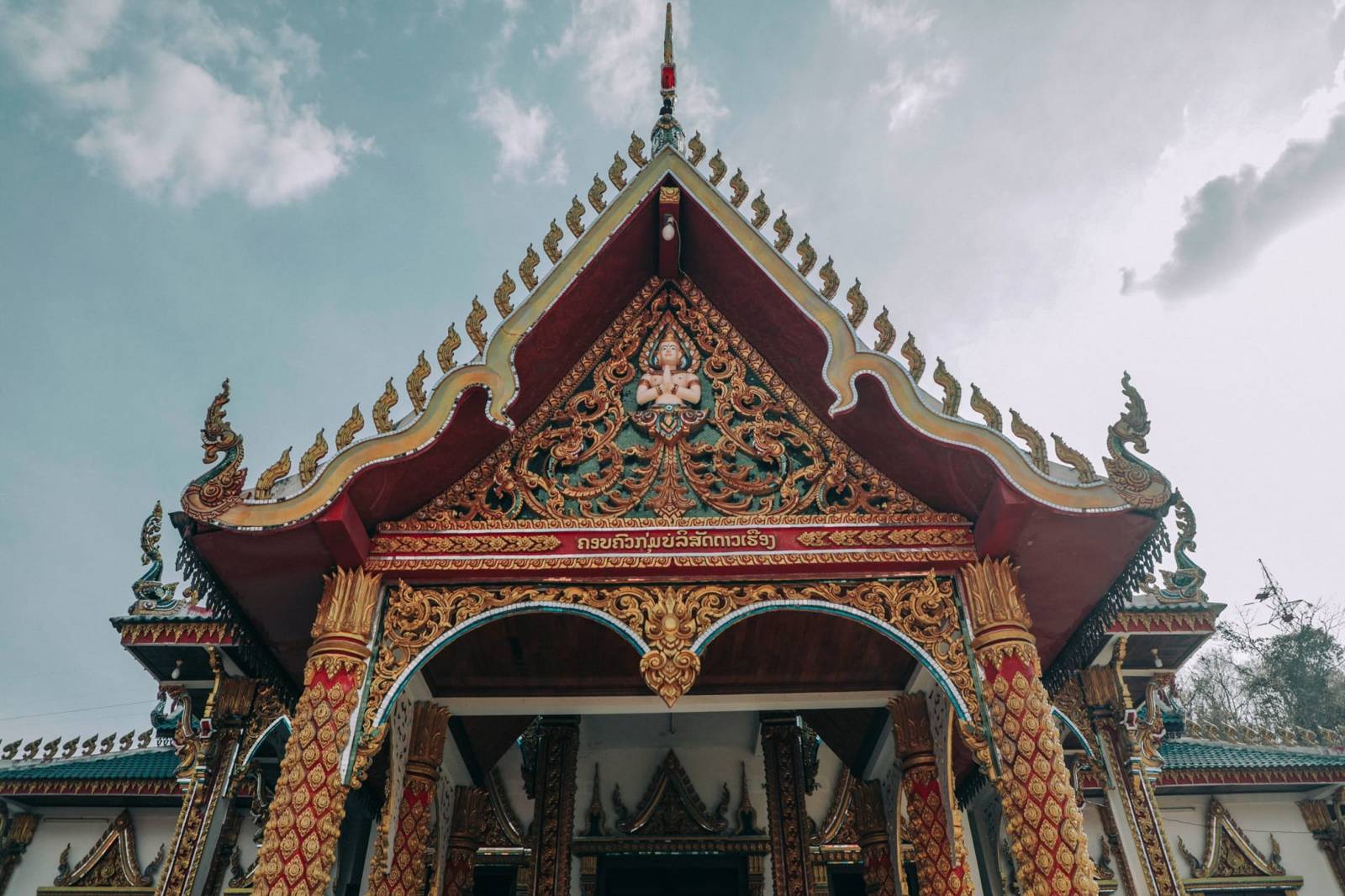
Visiting a temple? Shoulders and knees are covered, for everyone. That is written into official tourism policy as well. Shoes come off when you are asked, or simply: see a pile of flip-flops by the door and you know enough. And do not climb on Buddha statues for a photo.
The alms round in Luang Prabang
This is where things go wrong most often, so it gets its own section. Every morning before sunrise the monks walk the streets of Luang Prabang in silence to receive alms. It is one of the most beautiful things you can see in Laos, and it is not a show.
So watch from a distance, and in silence. No flash photography, do not stand in front of the line to get a better shot, and do not take part in the giving if you do not know how it is done. There are plenty of spots where tourists are handed a basket of rice for a fee so they can join in, and that is exactly what you should not do.
Getting up early to see it is well worth it. Just do it as a spectator, three metres back.
Body language you might not know
The feet are seen as the lowest and least respectful part of the body. So do not point them at people or statues, do not put them up on tables or chairs, and do not aim the soles of your feet straight at someone while you are sitting.
The head is the opposite: the most important part. So do not casually touch anyone’s head, not even as a joke with a kid you meet along the way. Nothing will probably happen if you do it by accident, but it is more polite to leave it.
Come across a monk, which happens a lot, and treat them with respect. For women: avoid physical contact with a monk. Want to take a photo? Ask first. A monk is not an attraction.
Politics: keep it to yourself
Laos is a socialist one-party state. You will often see the Lao flag hanging next to the red communist flag, and you do not need to do anything with that. What you do need to know: voicing extensive criticism of the Lao government, especially online or in public, is not a good idea. Travel advisories point out that publishing criticism of Laos can even be a criminal offence. Save that discussion for when you are back home.
The same caution goes for your camera. Do not photograph military installations, checkpoints or other sensitive government sites. And if you want a local recognisably in your photo, especially in a small village, just ask.
Stay on the path
Laos was heavily bombed during the war, and parts of the country still have unexploded ordnance in the ground, known as UXO. In risk areas, do not leave the marked paths for a shortcut or a better photo.
You take a warning sign seriously here, with no discussion and no exceptions. This is not the country for cutting corners.
Practical things that save you regret later
Renting a scooter. A rental shop handing you the keys without any questions does not mean you are riding legally or insured. Laos recognises the 1949-convention international driving permit alongside your own licence, and without the right category your travel insurance does not cover you. Wear a helmet, and film the scooter before you ride off so any existing damage is on record. And do not learn to ride for the first time on a mountain road in Laos.
Keep your passport on you. The authorities can ask for ID. When you enter, check straight away that you got the right entry stamp, because that is not something you want to discover when you leave. What applies on your own passport is on our visa page.
Crossing the border with alcohol or tobacco. There is a duty-free limit: currently a maximum of two litres of spirits, five litres of beer, three litres of wine and two hundred cigarettes.
Drinking is fine. But walking drunk through a temple, picking a fight with locals or getting on a scooter afterwards is not a good plan. Especially outside the well-known backpacker spots, Laos is more conservative than the vibe in your hostel suggests.
The attitude that gets you everywhere
Laos is generally calm and modest. Shouting, tearing into someone in public or losing it because your minivan is an hour late rarely helps. Making your point calmly and kindly almost always works better, without you having to accept everything.
Outside the tourist spots you regularly pass through small villages and communities. They are not open-air museums. Do not just walk into places, do not photograph people without asking, and do not treat traditions or ceremonies as a backdrop for your Instagram.
Where to go in Laos and what to do there is on our Laos page, place by place.
How do you know what is okay in Laos?
Do not look at what other backpackers are doing, look at what the locals are doing. Ten shirtless tourists walking through a village does not make it normal, and something sold openly is not automatically legal. Those are the two mistakes most people here fall into.
Unsure about a custom? Look around and do what the people around you do. Unsure about a law? Look it up. Two minutes that can save you a lot of trouble, and with drugs and vapes in Laos we are really not talking about a €50 fine.
Laos is not going to change for backpackers. Adapt a little, and in return you get one of the most beautiful and most relaxed countries in Southeast Asia.


