
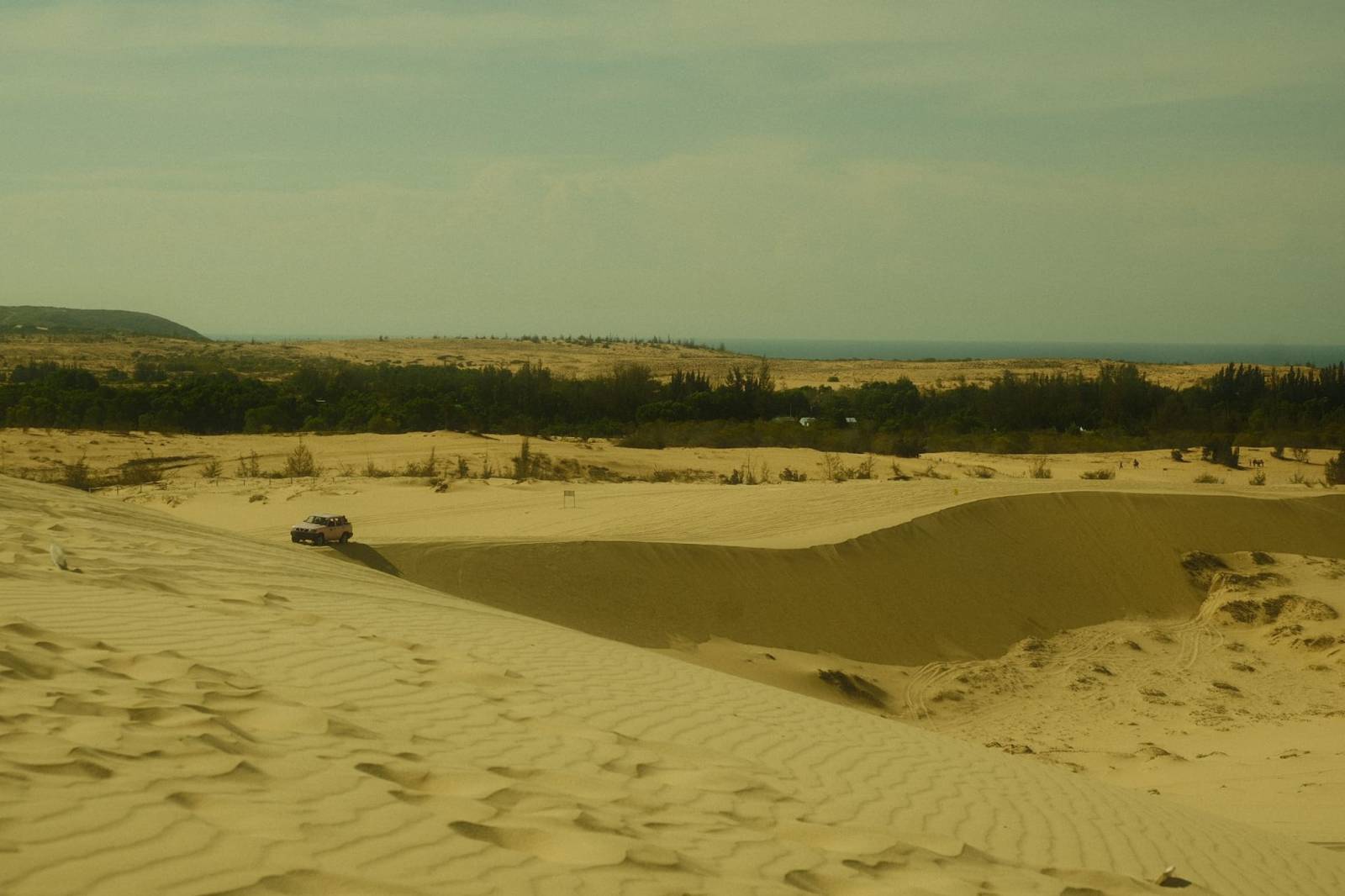
Mui Ne is not a place with an endless list. You have dunes, a stream, a fishing bay and ten kilometres of beach, and in two days you get through most of it. Even so, most backpackers leave feeling they just missed something, and it is almost never down to their list.
It is down to the clock. The same dunes are a desert you have to yourself at six in the morning, and a sand hill with a row of jeeps next to it at four in the afternoon. What you do here matters less than when you do it, and that is exactly the part most lists say nothing about.
So what do you set your alarm for in Mui Ne, and what do you save for next time?
Below are the places themselves. Where to sleep, how to get around and how many days to give it are all on our Mui Ne page.
The White Sand Dunes at sunrise
This is the reason Mui Ne is on your route. Behind the coast lies a stretch of dunes you will not find anywhere else in Vietnam: rolling white sand all the way to the horizon, without a tree or a building in sight. You step out of the jeep and for a moment you stop believing you are in Vietnam.
Leave at around half four in the morning on a jeep tour. It usually also takes you past the Red Dunes, the Fairy Stream and the fishing village, so you have done the four classics in one morning. Take water up with you, because there is no shade and no stall up there.
Book the sunrise version, not the sunset one. Same loop, same money, but with cool air, low light and a fraction of the people.
Our verdict: into the jeep at half four and you have done the four classics before breakfast

Sunrise at the fishing village
At the north end of the strip, five kilometres along, lies the bay where Mui Ne began. At around half five hundreds of colourful boats come back from sea, the catch is carried up the beach and the fish market gets going. Hardly a single visitor is there to see it.
It costs nothing. All you need is a scooter and the willpower to set your alarm another half hour earlier. Stand and watch the boats come in for a while, then walk along the beach past the round basket boats.
Combine it with the morning you already have to be up early for the dunes. Plenty of jeep tours put the fishing village on the programme, but then you get there later in the morning and the catch has long been shared out.
Our verdict: our favourite morning in Mui Ne
The Red Sand Dunes on your own
The Red Dunes are on the coast road towards the fishing village and a lot smaller than the white ones. That is exactly why they work so well at the end of the day: the sand turns deep red in the last light, it is quieter, and you do not have to get up early for them.
Walking in is free and you can rent a sandboard for about €1. Go from an hour before sunset, so you have time to climb up a few times. On a scooter you are there in no time from the beach strip.
Wear something that is allowed to get dirty. Climbing in loose sand is harder than it looks, and at some point you will simply end up lying in it.
Our verdict: a must, especially for a euro
Your first kitesurfing lesson
Mui Ne counts as one of the best places in Asia to learn to kitesurf, and that is down to the wind. From November to April it blows steadily from the northeast almost every afternoon, and the schools along the beach road are within walking distance of each other.
An intro lesson costs from about €45. The wind usually only picks up around midday, so your morning stays free for the dunes or the beach. Choose a school that is affiliated to a recognised body and where the instructors are genuinely certified.
Do not start on a day when it is really blowing. With zero experience on a kite on a hard day, you mostly get dragged across the water, and that is not what you are paying for.
Our verdict: absolutely, but only in season
The Fairy Stream
A shallow stream you walk up barefoot, between cliffs of red and white sand that look as though someone carved them out with a knife. The water never comes above your ankles and the bottom is soft sand, so you do not need any skills for it.
The entrance is at the east end of the beach road, by the bridge. Entry is about €0.60 and it takes you an hour, there and back. Leave your flip-flops at the start, because you walk up the stream itself.
Do it separately from your jeep tour if you have the time. On a tour you only get a short stop there, while the whole stretch takes an hour.
Our verdict: fun, cheap and quickly done
Riding the coast road by scooter
Outside the beach strip it goes quiet straight away. The coast road runs past small villages, endless dragon fruit fields and stretches of beach with nobody on them. It is the easiest way to see what this region looks like without hostels next to it.
A scooter here costs about €5 a day. For the ride out towards the Ke Ga lighthouse, allow half a day. Wear a helmet and check beforehand whether your travel insurance covers riding a scooter, because that is exactly where it goes wrong if something happens.
Ride in daylight. In the evening lots of lorries use the main road, and that is not the moment to find out your headlight is not up to much.
Our verdict: do it on your second day, and take your time
A day doing nothing on the beach
Mui Ne is one of the few places in Vietnam where it is completely normal to plan nothing for a day. Ten kilometres of coast, a pace that slows down all by itself, and nobody asking what you are doing today.
The beach is free and a lounger costs about €1.50. The quietest stretches are at the western end, away from the kite spots. Know what you are getting: the beach is narrow and the surf is stronger than it looks, so check the flags before you go in.
Do not leave your things loose on the sand at the kite spots. That is where the most people pass by, and where things go missing most often.
Our verdict: half a day is enough, unless you end up staying
Got time to spare in Mui Ne?
The dunes at sunrise
There is a sunrise tour and a sunset tour, same route and same price. Pick the early one: the sand is cool, the sun is low and you have the dunes almost to yourself. You have to be out of bed at half four for it, and it is the best bit of sleep you will ever give up.
Sandboarding on the Red Dunes
For about €1 you rent a plastic board and slide down the dunes, and it is exactly as simple and fun as it sounds. Would you rather take a quad or a buggy? Only do that with a helmet and with an operator that gives you one, because without a helmet it goes wrong here regularly.
Kitesurfing in the right season
The kite season runs from November to April, and December to March are the safest months. In May and June the sea is flat and there is little wind: perfect months for swimming, but do not book a kite course then hoping the wind will pick up.
Evenings on the beach
Mui Ne has laid-back beach bars and hostels where you drink a beer for around €0.60 with your feet in the sand. Evenings here wind down early on their own, which suits you perfectly if you want to be up on the dunes before dawn the next morning. In the mood for a long night? Then Ho Chi Minh City is your next stop.
Our top five in Mui Ne
Only got a few days? These are the five we would do no matter what:
- The White Sand Dunes at sunrise, with the jeep that leaves at half four
- Sunrise at the fishing village, around half five when the boats come in
- The Red Sand Dunes at sunset, with a €1 sandboard
- Your first kitesurfing lesson, somewhere between November and April
- The Fairy Stream, barefoot and in no hurry
Still got time after that? Rent a scooter and ride the coast road towards the Ke Ga lighthouse. Or just lie on the beach, because Mui Ne is just as good at that.
So what do you really have to do in Mui Ne?
Everything on this list is worth it, but Mui Ne is above all a great stopover, and the travellers who stay longest had nothing else planned after the dunes. Use this list to choose, and keep the rest of your day open.
If we had to pick just one thing: set your alarm. Everything that makes Mui Ne beautiful happens between half four and eight in the morning, and between twelve and four you belong in a hammock or in the water. That sounds strict for a beach stop, but it is the one real piece of advice we have here.
And on your last morning, ride out to the bay at the fishing village one more time. You buy nothing there and you do nothing there, you just stand and watch hundreds of boats come back after a night at sea. That is the picture of Mui Ne that sticks, not the photo on the dune.


